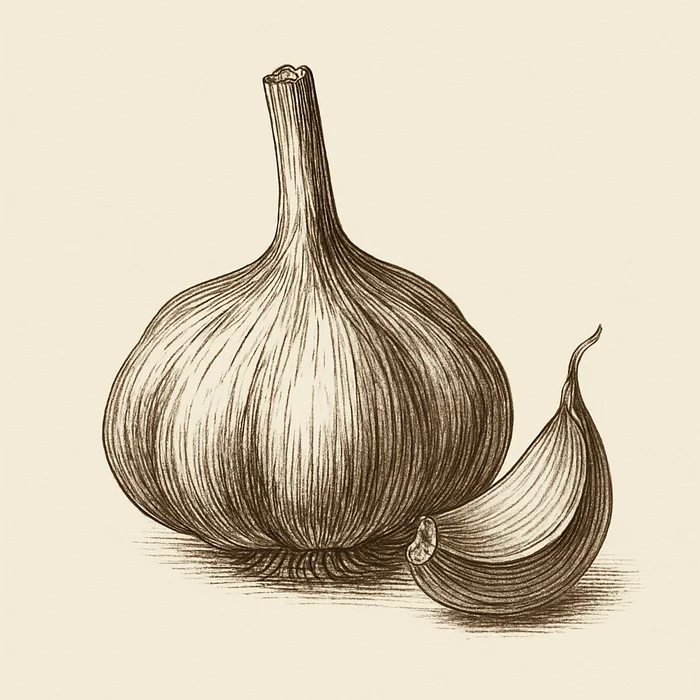
Garlic
Crush a clove of garlic and you trigger a chemical reaction that produces allicin -- a compound potent enough to lower blood pressure by the same magnitude as some first-line medications. But timing matters: wait ten minutes before it hits the pan, or you lose most of it.
Why It Matters for Longevity
Garlic's longevity story centers on its organosulfur compounds, particularly allicin and diallyl disulfide. When you crush or chop a raw clove, the enzyme alliinase converts alliin into allicin, which then breaks down into a family of sulfur-containing molecules that interfere with inflammation, cholesterol synthesis, and tumor growth. A meta-analysis (Ried 2013, Nutr Rev) found that aged garlic extract reduced serum lipids, and an earlier meta-analysis of 11 RCTs (Ried et al., 2008, BMC Cardiovasc Disord) demonstrated consistent BP-lowering effects from garlic preparations -- numbers that rival some first-line anti-hypertensive drugs in magnitude.
The cardiovascular benefits go beyond blood pressure. A randomized double-blind RCT (Wlosinska et al., 2020, BMC Complement Med Ther) showed that aged garlic extract slowed atherosclerotic progression and improved markers of endothelial function, suggesting genuine anti-aging effects on blood vessels. Meanwhile, a meta-analysis of case-control studies (Kodali & Eslick, 2015, Nutr Cancer) found that high garlic intake reduced gastric cancer risk. The mechanism: diallyl sulphide acts as a histone deacetylase inhibitor, a pathway that pharmaceutical companies spend billions trying to target with synthetic drugs.
Garlic also contains selenium (26% RDA per 100g) and manganese (73% RDA), both critical cofactors for antioxidant defense enzymes. It is one of the richest vegetable sources of selenium, which your body uses to build glutathione peroxidase -- a cornerstone of cellular protection.
The Hydrogen Sulfide Pathway
The most precisely understood mechanism behind garlic's blood pressure effects involves hydrogen sulfide (H2S), a gasotransmitter that acts as an endogenous vasodilator. Landmark research published in the Proceedings of the National Academy of Sciences (Benavides et al., 2007, PNAS) demonstrated that human red blood cells convert garlic-derived organic polysulfides into H2S through a nonenzymatic pathway that depends on glutathione (GSH). The process requires allyl substituents and increasing numbers of sulfur atoms -- exactly the structural profile of allicin's breakdown products, diallyl disulfide and diallyl trisulfide. H2S then relaxes vascular smooth muscle by opening ATP-sensitive potassium (KATP) channels, reducing peripheral vascular resistance and lowering blood pressure.
This pathway explains why the 10-minute rest period after crushing garlic matters so much: it allows alliinase to fully convert alliin into allicin and its polysulfide derivatives before heat inactivates the enzyme. The vascular relaxation potency of garlic compounds scales directly with their H2S yield -- meaning the chemistry of preparation dictates the clinical effect.
Quantified Blood Pressure Benefit
The BP evidence has only become more robust with time. A 2020 meta-analysis by Ried (Ried, 2020, Exp Ther Med) pooled 12 RCTs involving 553 hypertensive participants and found garlic supplementation reduced systolic blood pressure by 8.3±1.9 mmHg and diastolic blood pressure by 5.5±1.9 mmHg. The authors estimated these reductions correspond to a 16-40% reduction in the risk of a major cardiovascular event. Beyond blood pressure, aged garlic extract (Kyolic) also improved central arterial stiffness and pulse wave velocity -- two structural markers of vascular aging -- and increased diversity of gut microbiota including beneficial Lactobacillus species.
A broader review by Varshney & Budoff (2016, J Nutr) synthesized four BP meta-analyses and eight cholesterol meta-analyses. Across this body of evidence, garlic preparations reduced systolic pressure by 7-16 mmHg, diastolic by 5-9 mmHg, and total cholesterol by 7.4-29.8 mg/dL. Aged garlic extract consistently showed the most favorable benefit-to-tolerability ratio, with effects on coronary artery calcium and C-reactive protein further supporting its role in slowing atherosclerosis.
Aged Garlic Extract vs. Fresh Garlic
Raw garlic provides allicin and its immediate derivatives at peak concentrations, but with important caveats: allicin is destroyed by heat within minutes, is sensitive to pH changes, and has poor water solubility. Aged garlic extract (AGE) is produced by prolonged cold aging of raw garlic in aqueous ethanol, converting alliin and allicin into stable, water-soluble compounds including S-allylcysteine (SAC) and S-allylmercaptocysteine (SAMC). SAC is over 90% bioavailable and survives first-pass metabolism with a plasma half-life of 10-12 hours. The tradeoff: SAC itself does not produce H2S at appreciable rates, but it does activate antioxidant response element (Nrf2) pathways that upregulate intracellular glutathione synthesis, offering a complementary mechanism. For cardiovascular outcomes, both forms show efficacy in trials; aged extract leads for tolerability (no breath odor, minimal GI effects) and for the SAC-specific Nrf2 pathway.
How to Use It
The single most important preparation tip: crush or finely chop garlic and let it rest for 10 minutes before cooking. This gives alliinase time to convert alliin into allicin and its stable derivatives. Throwing whole or sliced cloves straight into a hot pan largely wastes the enzymatic reaction. Aim for 1-2 cloves per day. Aged garlic extract (600-1200 mg/day) is the best-studied supplement form, with the advantage that its key compound, S-allylcysteine, is heat-stable and over 90% bioavailable. For roasting, cook whole heads at moderate heat -- you lose allicin but retain diallyl disulfide and gain that sweet, nutty depth.
What to Pair It With
| Ingredient | Why | Tradition |
|---|---|---|
| Tomatoes | S-allylcysteine + lycopene inhibit stomach cancer synergistically | Italian / Mediterranean |
| Extra-virgin olive oil | Fat-soluble sulfur compounds need a lipid carrier | Mediterranean |
| Ginger | Complementary anti-inflammatory pathways | East Asian |
| Lemon | Acid brightens pungency; vitamin C boosts iron absorption | Mediterranean / Middle Eastern |
| Chili peppers | Heat and pungency amplify each other | Global |
| Cumin | Foundational spice pairing for legume dishes | Middle Eastern / Indian |
Flavor Profile
Raw garlic is sharp, pungent, and almost acrid -- it bites back. Roasted, it transforms entirely: sweet, nutty, and creamy enough to spread on bread. The aroma shifts from sulfurous and aggressive to rich and mellow. Minced garlic gets sticky and caramelizes quickly, so watch the heat.
The Science
- Ried, 2013, Nutr Rev: Meta-analysis — garlic reduces serum total cholesterol and LDL.
- Ried et al., 2008, BMC Cardiovasc Disord: Meta-analysis of 11 RCTs — garlic preparations reduce systolic and diastolic blood pressure.
- Kodali & Eslick, 2015, Nutr Cancer: Meta-analysis — garlic intake associated with reduced gastric cancer risk.
- Wlosinska et al., 2020, BMC Complement Med Ther: Randomized double-blind trial — aged garlic extract slowed atherosclerotic progression.
- Benavides et al., 2007, PNAS: Mechanistic study — garlic-derived polysulfides generate H2S in red blood cells, causing KATP-mediated vasorelaxation.
- Ried, 2020, Exp Ther Med: Meta-analysis of 12 RCTs (553 hypertensive participants) — garlic lowers SBP by 8.3±1.9 mmHg and DBP by 5.5±1.9 mmHg; estimated 16-40% cardiovascular event risk reduction.
- Varshney & Budoff, 2016, J Nutr: Review of 4 BP meta-analyses and 8 cholesterol meta-analyses — reductions of 7-16 mmHg systolic and 7.4-29.8 mg/dL total cholesterol.
References
- Ried K. Garlic lowers blood pressure in hypertensive individuals, regulates serum cholesterol, and stimulates immunity: an updated meta-analysis and review. Nutr Rev. 2013;71(5):282-299. PMID: 23590705. doi:10.1111/nure.12012
- Ried K, Frank OR, Stocks NP, Fakler P, Sullivan T. Effect of garlic on blood pressure: a systematic review and meta-analysis. BMC Cardiovasc Disord. 2008;8:13. PMID: 18554422. doi:10.1186/1471-2261-8-13
- Kodali RT, Eslick GD. Meta-analysis: Does garlic intake reduce risk of gastric cancer? Nutr Cancer. 2015;67(1):1-11. PMID: 25411831. doi:10.1080/01635581.2015.967873
- Wlosinska M, Nilsson AC, Hlebowicz J, Hauggaard A, Kjellin M, Fakhro M, Lindstedt S. The effect of aged garlic extract on the atherosclerotic process -- a randomized double-blind placebo-controlled trial. BMC Complement Med Ther. 2020;20(1):132. PMID: 32349742. doi:10.1186/s12906-020-02932-5
- Benavides GA, Squadrito GL, Mills RW, et al. Hydrogen sulfide mediates the vasoactivity of garlic. Proc Natl Acad Sci USA. 2007;104(46):17977-17982. PMID: 17951430. doi:10.1073/pnas.0705710104
- Ried K. Garlic lowers blood pressure in hypertensive subjects, improves arterial stiffness and gut microbiota: A review and meta-analysis. Exp Ther Med. 2020;19(2):1472-1478. PMID: 32010325. doi:10.3892/etm.2019.8374
- Varshney R, Budoff MJ. Garlic and Heart Disease. J Nutr. 2016;146(2):416S-421S. PMID: 26764327. doi:10.3945/jn.114.202333
Key Nutrients
| Nutrient | Per 100g | Notes |
|---|---|---|
| Allicin | ~4.5 mg per crushed clove | Formed only on crushing; destroyed by heat within minutes |
| S-allylcysteine | 0.5-1.5 mg (raw); 5-10 mg/g (aged extract) | Over 90% bioavailable; stable and water-soluble |
| Diallyl disulfide | 4-14 mg | Heat-stable; active in cancer prevention via HDAC inhibition |
| Selenium | 14.2 mcg (26% RDA) | One of the richest vegetable sources |
| Manganese | 1.67 mg (73% RDA) | Cofactor for superoxide dismutase (MnSOD) |