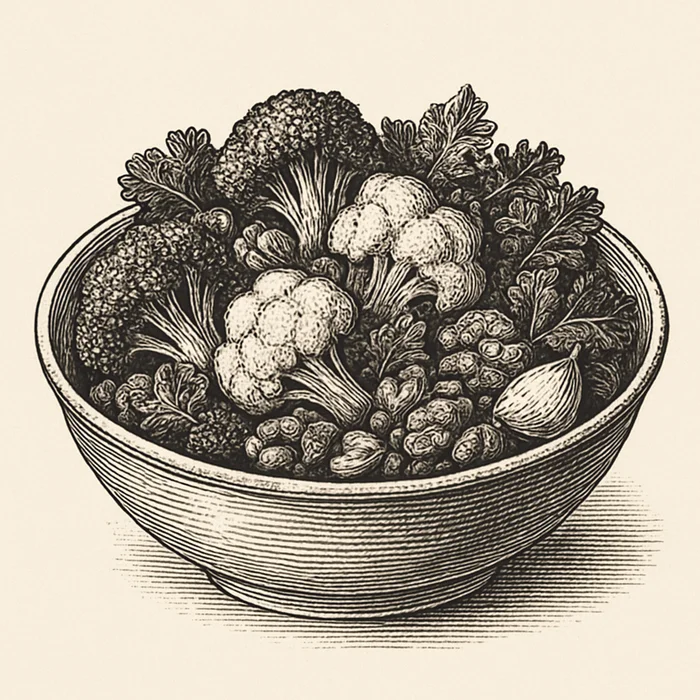
Mediterranean Roasted Cruciferous Bowl
A warm grain bowl built around high-heat roasted broccoli and cauliflower, raw massaged kale, toasted walnuts, and a lemon-caper-mustard dressing -- designed to maximize sulforaphane production through a trick most recipes miss entirely.
Why These Ingredients Together
Cruciferous vegetables are the richest dietary source of glucoraphanin, the precursor to the cancer-preventive compound sulforaphane. But here is the problem: the enzyme that converts glucoraphanin into sulforaphane (myrosinase) is destroyed by cooking. Roasting broccoli at 220C kills myrosinase completely, leaving you with a delicious but pharmacologically inert floret. The fix is the mustard powder in the dressing -- mustard seeds contain their own myrosinase, and sprinkling it over cooked cruciferous vegetables after cooking restores the conversion pathway. The extra-virgin olive oil serves double duty: its fat enables absorption of the fat-soluble vitamins K1 (141mcg per 100g in kale) and vitamin E from the walnuts, while its own oleocanthal adds an independent anti-inflammatory effect via COX-1 and COX-2 inhibition. Capers are the single richest food source of quercetin (up to 180mg per 100g), a flavonoid that in pilot studies synergized with curcumin to reduce colon polyps. And the walnuts contribute alpha-linolenic acid (omega-3) along with ellagitannins that gut bacteria convert into urolithins -- metabolites with documented anti-aging and anti-inflammatory properties.
Ingredients
The Bowl Base
- 1 cup (180g) farro, freekeh, or bulgur wheat
- 2 cups (480ml) water or vegetable stock
- Pinch of salt
Roasted Cruciferous Vegetables
- 1 large head broccoli (~400g), cut into bite-sized florets, stems peeled and sliced
- 1/2 head cauliflower (~300g), cut into bite-sized florets
- 3 tablespoons extra-virgin olive oil
- 6 cloves garlic, smashed and left to rest 10 minutes
- 1/2 teaspoon flaky sea salt
- 1/4 teaspoon red pepper flakes
Raw Kale
- 1 bunch lacinato (Tuscan) kale (~200g), stems removed, leaves torn into pieces
- 1 tablespoon extra-virgin olive oil
- 1 tablespoon lemon juice
- Pinch of salt
Mustard-Lemon-Caper Dressing
- 3 tablespoons extra-virgin olive oil
- 2 tablespoons lemon juice (about 1 lemon)
- 1 tablespoon capers, roughly chopped
- 1 teaspoon caper brine
- 1 teaspoon mustard powder (not prepared mustard)
- 1/2 teaspoon Dijon mustard
- 1 small clove garlic, microplaned
- Freshly ground black pepper
Toppings
- 1/2 cup (60g) walnuts, roughly chopped
- 2 tablespoons flat-leaf parsley, chopped
- Lemon wedges for serving
Instructions
-
Start the grain. Bring 2 cups of water or stock to a boil with a pinch of salt. Add the farro, reduce heat to low, cover, and simmer for 20-25 minutes (15-18 for bulgur, 15-20 for freekeh) until tender with a slight chew. Drain any excess liquid and set aside.
-
Preheat the oven to 220C/425F with a sheet pan inside. (Preheating the pan means the florets start sizzling on contact, which gets you browning and caramelization faster, minimizing the total time the vegetables spend in the heat. Less total cook time means more glucoraphanin survives intact for the mustard's myrosinase to convert later.)
-
Crush and rest the garlic. Smash the garlic cloves with the flat of a knife and let them sit for 10 minutes. (Same principle as always: alliinase needs time to convert alliin to allicin and its stable derivatives before heat denatures the enzyme.)
-
Toss and roast the broccoli and cauliflower. In a large bowl, toss the florets with 3 tablespoons olive oil, the rested smashed garlic, salt, and red pepper flakes. Carefully remove the hot sheet pan from the oven, spread the vegetables in a single layer (use two pans if crowded -- steamed broccoli is not roasted broccoli), and roast for 18-22 minutes until the edges are deeply charred and the stems are tender-crisp. (You want high heat and a single layer so the vegetables roast rather than steam. Roasting at 220C will destroy the myrosinase, but the Maillard browning creates flavor compounds that make this dish something you actually crave. We will fix the myrosinase problem in step 7.)
-
Massage the kale. While the vegetables roast, put the torn kale in a bowl with 1 tablespoon olive oil, 1 tablespoon lemon juice, and a pinch of salt. Squeeze and massage the leaves with your hands for 2-3 minutes until they darken, soften, and reduce in volume by about half. (Raw kale retains all of its myrosinase and vitamin C, which are both heat-sensitive. The mechanical breakdown from massaging ruptures cell walls and starts the glucosinolate-to-isothiocyanate conversion, the same process that happens when you chew.)
-
Toast the walnuts. In a dry skillet over medium-low heat, toast the walnut pieces for 3-4 minutes, tossing frequently, until fragrant and slightly darkened. Remove from heat immediately. (Light toasting enhances flavor without significantly degrading the omega-3 ALA content, which is more heat-stable than the polyunsaturated fats in more delicate nuts. Do not walk away -- walnuts go from toasted to burnt in about 30 seconds.)
-
Make the dressing and add the mustard powder. Whisk together the olive oil, lemon juice, chopped capers, caper brine, Dijon mustard, microplaned garlic, and black pepper. Add the mustard powder last and whisk to combine. (The mustard powder is the key move. It contains active myrosinase enzyme that will convert the glucoraphanin surviving in the roasted broccoli and cauliflower back into sulforaphane. This conversion happens at room temperature over about 30 minutes of contact, so dress the vegetables as soon as they come out of the oven.)
-
Assemble the bowls. Divide the cooked grain among four bowls. Top with a mound of massaged kale, the roasted broccoli and cauliflower, and spoon the mustard-caper dressing generously over the hot vegetables. Scatter toasted walnuts and parsley on top. Serve with lemon wedges.
What Can Go Wrong
-
Forgetting the mustard powder (or substituting prepared mustard only). Prepared mustard has been heat-processed, which destroys most of its myrosinase. You need the raw mustard powder to restore sulforaphane conversion in the cooked vegetables. This is the whole point of the dressing. A teaspoon of mustard powder does not change the flavor much, but it changes the pharmacology entirely.
-
Overcrowding the sheet pan. If the florets are piled on top of each other, they steam instead of roast. Steam means soggy, pale vegetables that nobody wants seconds of. Use two sheet pans if needed. The char is where the flavor lives.
-
Skipping the kale massage. Unmasssaged raw kale is tough, waxy, and unpleasant. The massage breaks down the cellulose structure and activates the glucosinolate conversion. Three minutes of squeezing transforms it from salad punishment into something silky and almost sweet.
Science Notes
Most "eat your broccoli" advice ignores the central paradox of cruciferous vegetable cooking: the compounds that make these vegetables worth eating (sulforaphane, indole-3-carbinol) require an enzyme (myrosinase) that cooking destroys. You can eat raw broccoli, but raw cruciferous vegetables at volume are genuinely hard on digestion. This recipe resolves the paradox by roasting for flavor and texture, then restoring the enzymatic conversion with an external myrosinase source (mustard powder) applied after cooking. Research shows that adding mustard to cooked broccoli increases sulforaphane formation approximately four-fold compared to cooked broccoli alone. The kale stays raw and massaged, contributing its own intact myrosinase and full vitamin C content (which would drop by 30-50% with cooking). The quercetin from capers adds a flavonoid that has shown synergistic anti-cancer effects in combination with other plant compounds. And the walnut ellagitannins are converted by gut bacteria into urolithins A and B, which have shown mitophagy-promoting effects -- essentially helping cells clean up damaged mitochondria, one of the hallmarks of aging.
Nutrition Highlights
- Sulforaphane: Optimized through the mustard powder trick, delivering meaningful glucoraphanin-to-sulforaphane conversion from ~700g of cruciferous vegetables across the recipe
- Omega-3 (ALA): ~1.4g per serving from walnuts, the richest common nut source of alpha-linolenic acid
- Vitamin K1: ~180mcg per serving from kale and broccoli (150% of daily value), absorbed efficiently thanks to the olive oil fat matrix
- Quercetin: Capers deliver up to 180mg per 100g, the highest concentration of any common food, contributing to the anti-inflammatory and potential anti-cancer synergy of the bowl