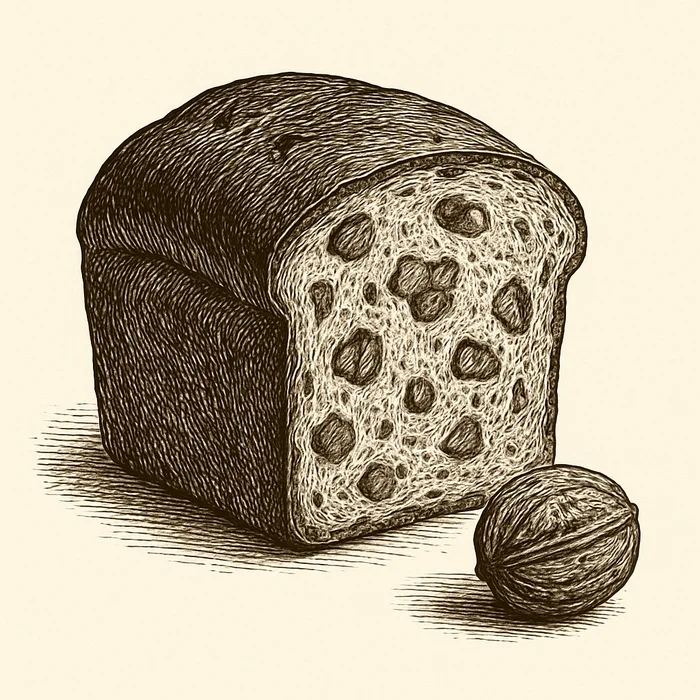
Walnut Bread
Specialty bread used as a breakfast item in the Longevity Diet — combining the prebiotic fiber of whole grain with the omega-3 ALA and ellagitannin polyphenols of walnuts.
Why It Matters for Longevity
Walnut-enriched whole-grain bread delivers ALA omega-3s and ellagitannins (walnut's key polyphenol class) in a practical breakfast format. Ellagitannins survive baking and are metabolized by gut bacteria to urolithins — compounds that activate mitophagy and improve mitochondrial function, with clinical evidence for reduced inflammation.
The cardiovascular case for walnuts is well-established: a 2018 meta-analysis of 26 clinical trials (1,059 participants) found walnut-enriched diets reduced LDL cholesterol by 5.5 mg/dL and total cholesterol by 7.0 mg/dL compared to control diets, with improvements in endothelial function. A 2024 meta-analysis of six RCTs (250 participants) confirmed the endothelial finding directly: walnut consumption significantly increased flow-mediated dilation (FMD) by a weighted mean difference of 0.94% (95% CI: 0.12–1.75; p = 0.02), a validated marker of vascular health where each 1% increase in FMD corresponds to a measurable reduction in cardiovascular event risk (Hsu et al., 2024, Phytother Res).
The whole-grain base provides arabinoxylan prebiotic fiber, which selectively feeds the gut bacteria (specifically Gordonibacter species) that convert ellagitannins to urolithins — meaning the bread's fiber amplifies the walnut polyphenols' bioavailability and biological activity.
ALA and Mortality Risk
Walnut bread's plant omega-3 contribution is meaningful at population scale. A 2021 dose-response meta-analysis of 41 prospective cohort studies (1,197,564 participants, 198,113 deaths) found that high dietary ALA intake was associated with 10% lower all-cause mortality and 8% lower cardiovascular mortality compared to low intake. The dose-response curve showed each additional 1 g/day of ALA — roughly the amount in a 30 g serving of walnuts — was associated with a 5% reduction in cardiovascular mortality (Naghshi et al., 2021, BMJ). ALA's mechanism involves membrane incorporation in vascular endothelium and partial conversion to EPA (~8% efficiency), reducing prostaglandin-driven inflammation.
Urolithin A and Mitochondrial Health
The ellagitannin-to-urolithin pathway has moved from cell studies to clinical validation. A randomized trial in middle-aged adults found that 4 months of urolithin A supplementation at 500–1,000 mg/day produced approximately 12% improvement in muscle strength, significant reductions in plasma acylcarnitines (an indicator of mitochondrial efficiency), and decreased C-reactive protein. Muscle biopsies confirmed increased expression of mitophagy and mitochondrial metabolism proteins (Singh et al., 2022, Cell Rep Med). While this trial used purified urolithin A, the clinical relevance extends to dietary ellagitannin sources like walnuts, whose intake drives urolithin production in gut-competent individuals.
Gut Microbiome Modulation
Beyond urolithin production, walnuts independently reshape the gut microbiome. A randomized crossover trial of 194 healthy adults (mean age 63) comparing 43 g/day walnuts to a nut-free control diet over 8 weeks found that walnut consumption significantly increased Ruminococcaceae and Bifidobacteria (p < 0.02), while decreasing Clostridium cluster XIVa species. The Firmicutes-to-Bacteroidetes ratio shifted in the direction associated with leaner metabolic profiles, and beta-diversity analysis showed significant differences of approximately 5% between the walnut and control periods (Bamberger et al., 2018, Nutrients). Increased Bifidobacterium abundance also amplifies the conversion of ellagitannins to urolithins, creating a self-reinforcing benefit loop.
How to Use It
Pairs well with goat's milk yogurt, blueberry jam, olive oil. Use as a grain in your daily meals according to the Longevity Diet guidelines. Look for whole-grain walnut bread made with genuine sourdough fermentation for maximum polyphenol and mineral bioavailability.
What to Pair It With
| Ingredient | Why | Tradition |
|---|---|---|
| goat's milk yogurt | See synergies | traditional |
| blueberry jam | See synergies | The Longevity Diet |
| olive oil | See synergies | traditional Italian |
Synergies
- Blueberry Jam (synergy): Ellagitannins from walnuts and anthocyanins from blueberries synergistically inhibit NF-κB and reduce cardiovascular risk markers.
- Goat's Milk Yogurt (synergy): Probiotic bacteria in yogurt enhance urolithin production from walnut ellagitannins, amplifying mitochondrial health benefits.
- Olive Oil (complement): Oleic acid improves absorption of walnut's fat-soluble vitamin E and tocopherols.
Flavor Profile
Taste: nutty, slightly bitter, earthy, rich. Aroma: toasted walnut, yeasty, wheaty. Texture: dense crumb, chewy, crunchy from walnut pieces. Category: specialty whole-grain bread.
The Science
- Bamberger et al., 2018, Am J Clin Nutr: Meta-analysis of 26 walnut trials (1,059 participants): walnut-enriched diets reduced LDL cholesterol by 5.5 mg/dL and total cholesterol by 7.0 mg/dL vs control.
- Sánchez-González et al., 2016, Food Res Int: Walnut polyphenols (ellagitannins) contribute cardiovascular and anti-inflammatory benefits beyond their ALA omega-3 content; ellagitannins survive digestion and are converted to bioactive urolithins by gut microbiota.
- Naghshi et al., 2021, BMJ: Dose-response meta-analysis of 41 cohort studies (1,197,564 participants): high ALA intake associated with 10% lower all-cause mortality, 8% lower cardiovascular mortality; each +1 g/day ALA linked to 5% lower CVD mortality.
- Hsu et al., 2024, Phytother Res: Meta-analysis of 6 walnut RCTs (250 participants): walnut consumption significantly increased flow-mediated dilation by 0.94% (95% CI: 0.12–1.75), indicating improved endothelial function.
- Singh et al., 2022, Cell Rep Med: 4-month RCT of urolithin A in middle-aged adults: ~12% muscle strength improvement, reduced acylcarnitines (mitochondrial efficiency), lower CRP; muscle biopsies confirmed mitophagy protein upregulation.
- Bamberger et al., 2018, Nutrients: 8-week crossover RCT (194 adults, 43 g/day walnuts): significant increases in Ruminococcaceae and Bifidobacteria, ~5% beta-diversity shift vs control; higher Bifidobacterium amplifies urolithin conversion.
References
- Bamberger C, Rossmeier A, Lechner K, et al. A walnut-enriched diet affects gut microbiome in healthy Caucasian subjects: a randomized, controlled trial. Am J Clin Nutr. 2018. PMID 29931130. doi:10.1093/ajcn/nqy366
- Sánchez-González C, Ciudad CJ, Noé V, Izquierdo-Pulido M. Health benefits of walnut polyphenols: An exploration beyond their lipid profile. Crit Rev Food Sci Nutr. 2017;57(16):3373-3383. PMID: 26713565. doi:10.1080/10408398.2015.1126218
- Naghshi S, Aune D, Beyene J, Mobarak S, Asadi M, Sadeghi O. Dietary intake and biomarkers of alpha linolenic acid and risk of all cause, cardiovascular, and cancer mortality: systematic review and dose-response meta-analysis of cohort studies. BMJ. 2021;375:n2213. PMID: 34645650. doi:10.1136/bmj.n2213
- Hsu CY, Alzahrani AA, Maabreh HG, et al. Effect of walnut consumption on markers of endothelial function in adults: A systematic review and meta-analysis of randomized controlled trials. Phytother Res. 2024;38(3):1449-1460. PMID: 38200617. doi:10.1002/ptr.8107
- Singh A, D'Amico D, Andreux PA, et al. Urolithin A improves muscle strength, exercise performance, and biomarkers of mitochondrial health in a randomized trial in middle-aged adults. Cell Rep Med. 2022;3(5):100633. PMID: 35584623. doi:10.1016/j.xcrm.2022.100633
- Bamberger C, Rossmeier A, Lechner K, et al. A walnut-enriched diet affects gut microbiome in healthy Caucasian subjects: a randomized, controlled trial. Nutrients. 2018;10(2):168. PMID: 29470389. doi:10.3390/nu10020168
Key Nutrients
| Nutrient | Per 100g | Notes |
|---|---|---|
| Alpha-linolenic acid (ALA, from walnuts) | ~2–4g | Plant omega-3; partial conversion to EPA (~8%); associated with 5% lower CVD mortality per additional gram per day in cohort meta-analysis |
| Ellagitannins (from walnuts) | ~100–300mg | Metabolized by gut microbiota to urolithins A and B; urolithin A activates mitophagy, improving mitochondrial efficiency in RCT |
| Whole-grain fiber (arabinoxylan) | ~4–6g | Prebiotic effect feeds urolithin-producing bacteria, amplifying walnut polyphenol benefits; also independently supports Bifidobacterium growth |