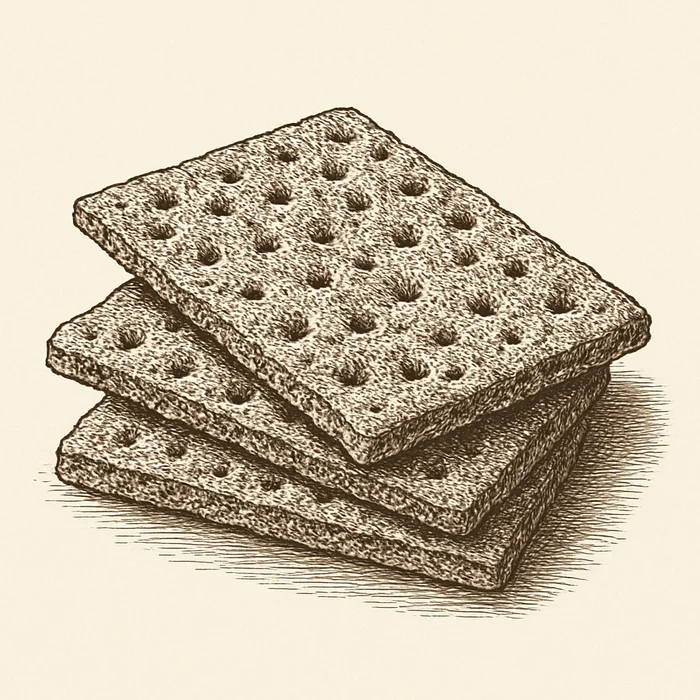
Rye Crackers
Whole-grain rye crackers are used as a side in the Longevity Diet, pairing with smoked fish, sardines, or other protein-rich foods. They deliver whole grain benefits — particularly rye's distinctive alkylresorcinols and arabinoxylan fiber — in a convenient portable form.
Why It Matters for Longevity
Rye crackers made from whole grain rye deliver the same bioactive compounds as rye bread: alkylresorcinols (unique rye phenolics measurable in plasma as whole grain biomarkers), arabinoxylan fiber (a prebiotic that selectively feeds beneficial gut bacteria), and beta-glucans (cholesterol-lowering soluble fiber). Whole grain rye consumption is associated with reduced all-cause and cardiovascular mortality.
A dose-response meta-analysis of prospective studies confirmed that whole grain consumption — including rye — was associated with significantly lower cardiovascular disease, cancer, and all-cause mortality, with each 7 g/day increment linked to a 19% lower CVD risk (Aune et al., 2016, BMJ).
Rye and whole wheat are the primary dietary sources of alkylresorcinols — phenolic lipids with anti-cancer properties specific to whole grain intake that are transported in plasma and can serve as objective biomarkers of whole grain rye consumption (Linko-Parvinen et al., 2007, J Nutr).
Alkylresorcinols and Colorectal Cancer Risk
The biomarker status of alkylresorcinols makes them unusually useful in prospective research: rather than relying on self-reported diet, investigators can measure actual tissue exposure to rye whole grain via plasma alkylresorcinol concentrations. A large nested case-control study within the European Prospective Investigation into Cancer and Nutrition (EPIC) — 1,372 colorectal cancer cases and 1,372 matched controls — found that individuals in the highest quartile of plasma alkylresorcinols had a 52% lower incidence of distal colon cancer compared to the lowest quartile (adjusted IRR 0.48, 95% CI: 0.28–0.83). The protective association was anatomically site-specific, concentrated in the distal colon and most pronounced in Scandinavian and Central European populations where whole-grain rye intake is highest (Kyrø et al., 2014, J Natl Cancer Inst). The mechanism is thought to involve alkylresorcinols' capacity to intercalate into cell membranes and modulate lipid peroxidation, as well as their role in slowing colonic transit, reducing exposure time between bile acids and the colonic epithelium.
The Rye Insulin Factor
Rye's effect on postprandial insulin is distinct from its glycemic effect — a phenomenon studied specifically enough to earn its own label in the literature. A crossover trial in 12 healthy subjects found that whole grain rye breads and endosperm rye products induced significantly lower insulinemic indices than white wheat bread (p < 0.05), and lower insulin peaks correlated with reduced late postprandial hypoglycemia (r = 0.38, p < 0.001) and improved appetite regulation markers (Rosén et al., 2009, Nutr J). A subsequent systematic review of the "rye factor" confirmed that rye foods consistently produce lower insulin responses in the postprandial phase, attributed primarily to a slower rate of glucose appearance into the bloodstream after rye versus wheat consumption (Iversen et al., 2022, Front Nutr). Lower insulin demand per gram of carbohydrate matters over a lifetime: chronically elevated postprandial insulin is an independent predictor of insulin resistance, ectopic fat accumulation, and cardiovascular risk.
Beta-Glucan and Cholesterol Lowering
Rye contains 1–2 g of beta-glucan per 100 g, a soluble fiber that forms a viscous gel in the small intestine, trapping bile acids and reducing their reabsorption. A meta-analysis of 126 clinical studies confirmed that consuming 3 g/day of beta-glucan from oat or barley — the same soluble fiber class found in rye — was sufficient to decrease total cholesterol by 0.60 mmol/L and LDL cholesterol by 0.66 mmol/L (Tiwari and Cummins, 2011, Nutrition). The regulatory mechanism is well-characterized: beta-glucan viscosity reduces cholesterol micellarization in the intestinal lumen, interrupts enterohepatic bile acid recycling, and upregulates hepatic LDL receptor expression as the liver compensates for reduced bile acid return by pulling more cholesterol from circulation.
Whole Grains and Type 2 Diabetes Risk
The broad whole-grain literature extends to diabetes prevention, an outcome relevant to longevity trajectories. The dose-response meta-analysis by Ghanbari-Gohari et al. (2022) — 11 cohort studies, 463,282 participants, 37,249 T2D cases — found a 21% lower type 2 diabetes risk in the highest versus lowest whole grain intake groups, with each additional 50 g/day associated with a 23% further reduction (Ghanbari-Gohari et al., 2022, Food Sci Nutr). Rye crackers at the typical serving size of 20–30 g contribute toward the 60 g/day threshold where the dose-response curve begins to plateau.
How to Use It
Pair with smoked salmon, sardines, or mackerel for a complete Longevity Diet meal — omega-3 fatty acids from fish combined with rye fiber create complementary cardiovascular-protective benefits. Also works with avocado, cheese (in moderation), or as a base for roe. Choose 100% whole grain rye crackers without added sugar or refined flour.
What to Pair It With
| Ingredient | Why | Tradition |
|---|---|---|
| Smoked salmon | Omega-3s in salmon + arabinoxylan from rye: complementary anti-inflammatory combination | Scandinavian |
| Sardines | EPA/DHA from sardines and rye fiber together reduce triglycerides and support gut microbiome | Scandinavian |
| Avocado | Healthy fat enhances absorption of rye's fat-soluble phytonutrients | Modern |
| Olive oil | Oleocanthal anti-inflammatory effects complement rye alkylresorcinols | Mediterranean |
Flavor Profile
Taste: earthy, slightly sour, nutty, robust. Aroma: malty, toasted grain. Texture: dense, crisp, crunchy. Category: whole-grain cracker.
The Science
- Aune et al., 2016, BMJ: Whole grain consumption dose-response meta-analysis: each 7 g/day increment linked to 19% lower CVD risk, 15% lower cancer risk, 17% lower all-cause mortality.
- Linko-Parvinen et al., 2007, J Nutr: Rye is the primary dietary source of alkylresorcinols — phenolic lipids transported in plasma that serve as whole grain rye intake biomarkers.
- Kyrø et al., 2014, J Natl Cancer Inst: EPIC nested case-control (1,372 cases): highest plasma alkylresorcinol quartile associated with 52% lower distal colon cancer incidence (IRR 0.48, 95% CI: 0.28–0.83).
- Rosén et al., 2009, Nutr J: Crossover trial in 12 subjects: whole grain and endosperm rye induced significantly lower insulinemic indices than white wheat bread (p < 0.05); lower insulin peaks reduced late postprandial hypoglycemia.
- Iversen et al., 2022, Front Nutr: Systematic review of rye factor: rye foods consistently produce lower postprandial insulin response than wheat via slower glucose appearance rate; beneficial across insulin and glucose response indices.
- Tiwari and Cummins, 2011, Nutrition: Meta-analysis of 126 clinical studies: 3 g/day beta-glucan sufficient to lower total cholesterol by 0.60 mmol/L and LDL by 0.66 mmol/L via bile acid sequestration and hepatic LDL receptor upregulation.
- Ghanbari-Gohari et al., 2022, Food Sci Nutr: 11-cohort meta-analysis (463,282 participants): 21% lower T2D risk in highest whole grain intake; each 50 g/day increment associated with 23% further risk reduction.
References
- Aune D, Keum N, Giovannucci E, et al. Whole grain consumption and risk of cardiovascular disease, cancer, and all cause and cause specific mortality: systematic review and dose-response meta-analysis of prospective studies. BMJ. 2016;353:i2716. PMID: 27301975. doi:10.1136/bmj.i2716
- Linko-Parvinen AM, Landberg R, Tikkanen MJ, Adlercreutz H, Peñalvo JL. Alkylresorcinols from whole-grain wheat and rye are transported in human plasma lipoproteins. J Nutr. 2007;137(5):1137-1142. PMID: 17449571. doi:10.1093/jn/137.5.1137
- Kyrø C, Tjønneland A, Overvad K, et al. Plasma alkylresorcinols, biomarkers of whole-grain wheat and rye intake, and incidence of colorectal cancer. J Natl Cancer Inst. 2014;106(1):djt352. PMID: 24317181. doi:10.1093/jnci/djt352
- Rosén LAH, Blanco Silva LO, Andersson UK, Holm C, Ostman EM, Björck IME. Endosperm and whole grain rye breads are characterized by low post-prandial insulin response and a beneficial blood glucose profile. Nutr J. 2009;8:42. PMID: 19781071. doi:10.1186/1475-2891-8-42
- Iversen KN, Jonsson K, Landberg R. The effect of rye-based foods on postprandial plasma insulin concentration: the rye factor. Front Nutr. 2022;9:869543. PMID: 35757252. doi:10.3389/fnut.2022.869543
- Tiwari U, Cummins E. Meta-analysis of the effect of β-glucan intake on blood cholesterol and glucose levels. Nutrition. 2011;27(10):1008-1016. PMID: 21470820. doi:10.1016/j.nut.2010.11.006
- Ghanbari-Gohari F, Mousavi SM, Esmaillzadeh A. Consumption of whole grains and risk of type 2 diabetes: A comprehensive systematic review and dose-response meta-analysis of prospective cohort studies. Food Sci Nutr. 2022;10(8):2574-2586. PMID: 35702290. doi:10.1002/fsn3.2860
Key Nutrients
| Nutrient | Per 100g | Notes |
|---|---|---|
| Arabinoxylan fiber | ~8–10 g | Among the highest prebiotic fiber of any grain; selectively feeds Bifidobacterium and Lactobacillus |
| Beta-glucan | ~1–2 g | Soluble fiber forming viscous gel; 3 g/day dose lowers LDL by 0.66 mmol/L via bile acid sequestration |
| Alkylresorcinols | ~400–1,000 mcg | Unique rye phenolics; measurable in plasma as whole grain biomarkers; highest quartile intake associated with 52% lower distal colon cancer risk in EPIC cohort |