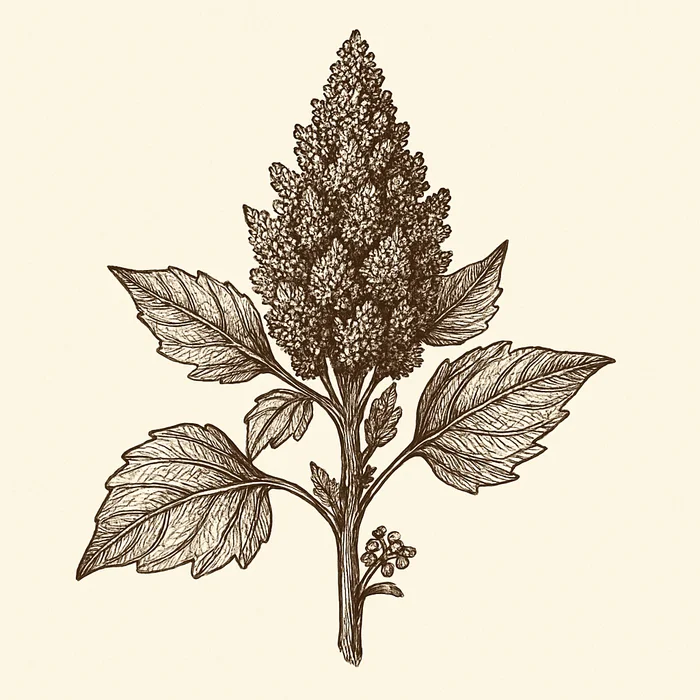
Quinoa
The book recommends quinoa only for those with it in their ancestral diet — the saponins and certain proteins may trigger immune reactions in non-adapted individuals. For those who tolerate it, quinoa is a nutritionally complete pseudocereal providing all essential amino acids, making it unique among plant staples.
Why It Matters for Longevity
Quinoa's primary nutritional advantage is its complete amino acid profile — it contains all nine essential amino acids, including lysine, which is limiting in most cereal grains. This makes it particularly useful in plant-based longevity diets where amino acid completeness requires careful food combining. Its saponin content can largely be removed by thorough rinsing before cooking.
Quinoa (Chenopodium quinoa Willd.) provides a complete amino acid profile, high dietary fiber, and significant mineral content including magnesium, iron, and zinc; it is a nutritionally superior pseudocereal with both food and nutraceutical potential (Abugoch James, 2009, Adv Food Nutr Res).
Soaking and cooking quinoa significantly reduces phytic acid (by up to 77%), lectins, and oxalates, improving mineral bioavailability and reducing potential anti-nutrient effects for those sensitive to these compounds (Shi et al., 2018, Food Res Int).
Glycemic Control: RCT Evidence
Quinoa's low glycemic index (GI approximately 42–53 in clinical settings) makes it mechanistically favorable for the blood glucose stability central to longevity dietary patterns. A year-long randomized controlled trial in 207 adults with impaired glucose tolerance assigned participants to quinoa (100 g/day), multigrain, or control groups. The quinoa group demonstrated significantly longer time in normoglycemic range, superior reduction in 2-hour postprandial glucose, lower fasting insulin, lower HOMA-IR, and a lower rate of progression to diabetes — all outperforming the multigrain comparator, which is itself metabolically superior to refined grains (Huang et al., 2025, Food Funct).
In a 3-month in-vivo study, daily consumption of quinoa-enriched bread (20% quinoa flour) achieved a GI of 42 versus 69 for the control wheat bread; at study end, triglycerides, total cholesterol, LDL, and VLDL all declined significantly (p ≤ 0.05), with no significant change in HDL (Marak et al., 2024, Front Nutr). The combined glycemic and lipid effects likely reflect multiple mechanisms acting together: dietary fiber slowing starch digestion, quercetin and kaempferol inhibiting α-glucosidase, and phytosterols competing with cholesterol for intestinal absorption.
Cardiovascular Effects
A double-blind randomized crossover trial enrolled 40 adults aged 50–75 years (82.5% had elevated baseline cholesterol >5 mmol/L) and assigned them to 4 weeks of daily quinoa biscuits (60 g quinoa flour per 100 g product) or isocaloric wheat control biscuits, separated by a 6-week washout (Pourshahidi et al., 2020, Eur J Nutr). Quinoa consumption reduced total cholesterol by 0.30 ± 0.58 mmol/L, LDL cholesterol by 0.25 ± 0.38 mmol/L, TC:HDL ratio by 0.11, body weight by 0.61 ± 0.89 kg, and BMI by 0.22 ± 0.34 kg/m². Triglycerides, HDL cholesterol, and C-reactive protein did not change significantly. The trial is notable for using a real-food vehicle under double-blind conditions in an older population with clinically elevated baseline cholesterol — the group most likely to benefit.
The LDL-lowering effect is consistent with quinoa's fiber and phytosterol content. Beta-sitosterol and other phytosterols in quinoa structurally resemble cholesterol and reduce net cholesterol absorption in the small intestine by competing for micellar solubilization and enterocyte uptake sites. Simultaneously, the viscous soluble fiber fraction slows intestinal transit and reduces bile acid reabsorption, prompting hepatic upregulation of LDL receptors to meet bile acid resynthesis demand from circulating LDL.
Polyphenol Profile
Quinoa contains quercetin and kaempferol at approximately 36 mg total flavonoids per 100g dry weight — concentrations comparable to common quercetin-rich vegetables. These flavonoids are heat-stable through normal cooking. Quercetin inhibits both α-amylase and α-glucosidase with IC50 values in the low-micromolar range, contributes to postprandial glucose blunting, and activates SIRT1 via indirect AMPK pathways in cell and rodent studies. Kaempferol has demonstrated anti-inflammatory effects via NF-κB pathway inhibition, reducing IL-6 and TNF-α production in macrophage models. The in-vivo relevance of these concentrations in humans depends on quinoa dose and polyphenol bioavailability, which varies with gut microbiome composition.
Quinoa also contains 20-hydroxyecdysone (20E), a phytosteroid. Rodent studies show quinoa extracts enriched in 20E protect against high-fat diet-induced obesity by modulating adipokine expression and intestinal fat absorption. Human data on 20E remain sparse, and no clinical trials have directly tested quinoa's ecdysteroid content against metabolic outcomes in humans.
Saponins: Risk and Mitigation
Quinoa's saponins are its primary tolerance concern. These triterpenoid glycosides form the bitter surface coating and have detergent-like properties that disrupt cell membranes. In sufficient quantities, saponins can increase intestinal permeability, potentially triggering immune reactions in non-adapted individuals. Thorough rinsing before cooking removes the majority of surface saponins. Commercial pre-washed quinoa reduces this step, though rinsing even pre-washed quinoa is conservative practice. The Longevity Diet's ancestral-diet caveat reflects this: populations that did not evolve alongside quinoa (non-Andean) may have lower tolerance thresholds.
Protein content in quinoa runs approximately 14 g per 100g dry weight — higher than most grains and with superior essential amino acid balance. Its DIAAS (Digestible Indispensable Amino Acid Score) exceeds most cereal proteins and approaches animal protein quality. Lysine is the critical difference: most cereal grains (wheat, rice, maize) are severely lysine-limited, while quinoa provides 5–6 g lysine per 100g protein — close to the FAO reference pattern.
How to Use It
Rinse thoroughly before cooking to remove saponins (the bitter coating). Cook in a 1:2 ratio with water or broth for 15 minutes. Use as a base for grain bowls, mix with legumes for complete protein combinations, or add to soups. Best consumed occasionally rather than as a daily staple per the book's guidance. Soaking 4–8 hours before cooking, in addition to rinsing, further reduces phytic acid and oxalates and improves mineral bioavailability.
What to Pair It With
| Ingredient | Why | Tradition |
|---|---|---|
| Black beans | Complementary amino acid profiles; complete protein with complementary fiber types | Latin American |
| Lemon juice | Vitamin C enhances non-heme iron absorption from quinoa | General |
| Olive oil | Fat improves absorption of fat-soluble antioxidants | Mediterranean |
| Roasted vegetables | Classic grain bowl combination | Modern |
Flavor Profile
Taste: nutty, mild, slightly earthy. Aroma: neutral, faintly grassy. Texture: fluffy, slightly chewy, small beads with visible germ ring. Category: pseudocereal / whole grain.
The Science
- Abugoch James, 2009, Adv Food Nutr Res: Comprehensive review of quinoa composition and nutritional properties — complete amino acid profile, high fiber, magnesium, iron, zinc; positioned as nutritionally superior pseudocereal.
- Shi et al., 2018, Food Res Int: Soaking and cooking significantly reduces phytic acid, lectins, and oxalates in quinoa, improving mineral bioavailability and reducing anti-nutrient content.
- Huang et al., 2025, Food Funct: 1-year RCT (n=207) in adults with impaired glucose tolerance — quinoa (100 g/day) produced superior time in normoglycemic range, lower postprandial glucose, lower HOMA-IR, and lower diabetes progression rate vs multigrain comparator and control.
- Pourshahidi et al., 2020, Eur J Nutr: Double-blind RCT crossover (n=40 adults, 50–75 years) — 4 weeks of quinoa biscuits reduced total cholesterol by 0.30 mmol/L, LDL by 0.25 mmol/L, and TC:HDL ratio by 0.11 vs wheat control; body weight reduced by 0.61 kg.
- Marak et al., 2024, Front Nutr: 3-month in-vivo study — quinoa-enriched bread (GI 42 vs 69 for wheat control) significantly reduced triglycerides, total cholesterol, LDL, and VLDL (p ≤ 0.05) with no change in HDL.
References
- Abugoch James LE. Quinoa (Chenopodium quinoa Willd.): composition, chemistry, nutritional, and functional properties. Adv Food Nutr Res. 2009;58:1-31. PMID: 19878856. doi:10.1016/S1043-4526(09)58001-1
- Shi L, Mu K, Arntfield SD, Nickerson MT. Changes in levels of phytic acid, lectins and oxalates during soaking and cooking of Canadian pulses. Food Res Int. 2018;107:660-668. PMID: 29580532. doi:10.1016/j.foodres.2018.03.006
- Huang L, Li X, Zou M, et al. Quinoa is more effective than other whole grains in the management of impaired glucose tolerance: a randomized controlled trial. Food Funct. 2025;16(3):1150-1162. PMID: 39784492. doi:10.1039/d4fo04557b
- Pourshahidi LK, Caballero E, Osses A, et al. Modest improvement in CVD risk markers in older adults following quinoa (Chenopodium quinoa Willd.) consumption: a randomized-controlled crossover study with a novel food product. Eur J Nutr. 2020;59(8):3313-3323. PMID: 31919583. doi:10.1007/s00394-019-02169-0
- Marak NR, Das P, Das Purkayastha M, Dutta Baruah L. Effect of quinoa (Chenopodium quinoa W.) flour supplementation in breads on the lipid profile and glycemic index: an in vivo study. Front Nutr. 2024;11:1341539. PMID: 38595791. doi:10.3389/fnut.2024.1341539
Key Nutrients
| Nutrient | Per 100g | Notes |
|---|---|---|
| Complete protein (all 9 essential amino acids) | 14 g (dry) | High digestibility; DIAAS score superior to most plant proteins; especially high in lysine (5–6 g/100g protein) |
| Dietary fiber | 7 g (dry) | Mix of soluble and insoluble fiber; supports gut microbiome; bile acid sequestration contributes to LDL reduction |
| Magnesium | 197 mg (dry) | Phytate reduces absorption; soaking/rinsing improves bioavailability |
| Iron (non-heme) | 4.6 mg (dry) | Enhanced by pairing with vitamin C sources; phytate reduction via soaking increases absorption fraction |
| Quercetin and kaempferol | ~36 mg total flavonoids (dry) | Antioxidant flavonoids; heat-stable; quercetin inhibits α-glucosidase; kaempferol inhibits NF-κB inflammatory signaling |
| Phytosterols (beta-sitosterol) | ~60 mg (dry) | Compete with cholesterol for intestinal absorption; contribute to LDL reduction observed in RCTs |