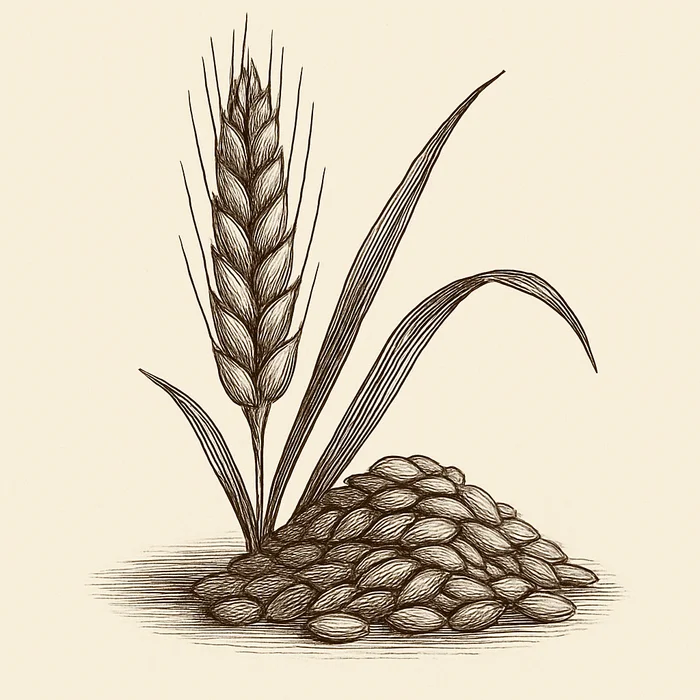
Farro
Ancient wheat variety (emmer, Triticum dicoccum) used as a complex carbohydrate source in the Longevity Diet; part of traditional Sardinian and Calabrian centenarian diets.
Why It Matters for Longevity
The Longevity Diet emphasizes complex carbohydrates from whole grains as the primary energy source, avoiding simple sugars and refined grains that activate pro-aging insulin/IGF-1 signaling. Farro delivers a suite of benefits that go beyond simple caloric provision: a distinctive fiber matrix, moderate protein content, bran polyphenols, and a gluten architecture meaningfully different from that of modern bread wheat.
Fiber Composition and Gut Microbiota
Farro's fiber profile is dominated by arabinoxylan — a hemicellulose built from arabinose and xylose sugar units — alongside smaller fractions of beta-glucan and resistant starch. Dry whole farro contains roughly 7–10 g of dietary fiber per 100 g (cooked: ~7 g/100 g), most of it insoluble in the intact grain but partially solubilized during cooking and digestion.
Arabinoxylan is not passively excreted. In the colon it is fermented by specialist bacteria, principally members of the Lachnospiraceae family. A 2023 mouse study found that dietary wheat-derived arabinoxylan significantly increased Lachnospiraceae abundance — bacteria that are both butyrate-producing and regulatory T-cell-inducing — and correspondingly elevated fecal butyrate concentrations while reducing colitis-associated inflammatory markers (Chudan et al., 2023, Molecules). Butyrate is the primary energy source for colonocytes, supports tight-junction integrity, and activates G-protein-coupled receptors that suppress mucosal inflammation — mechanisms directly relevant to reducing age-associated intestinal permeability ("leaky gut").
The fermentation of arabinoxylan also produces cross-feeding dynamics: Bifidobacterium spp. cleave arabinose side chains, releasing shorter oligosaccharides that downstream butyrate producers (Faecalibacterium prausnitzii, Eubacterium rectale) then convert to short-chain fatty acids (SCFAs). This two-step fermentation cascade is why whole-grain farro — retaining the intact bran arabinoxylan matrix — generates a more sustained prebiotic effect than pearled farro, which loses part of the outer bran layers.
Beta-glucan in farro is present at lower concentrations than in oat or barley (roughly 0.5–1 g/100 g dry weight vs. 3–5 g in oats) but still contributes to viscosity in the upper gut, slowing gastric emptying and blunting the postprandial glucose response.
Glycemic Response
Farro is a low-to-moderate glycemic grain. The dense protein–starch matrix in emmer wheat's endosperm, combined with its intact bran, slows amylase access to starch granules. Whole farro has a glycemic index in the range of 40–45 compared to ~70 for white bread — a meaningful gap for anyone managing insulin sensitivity or metabolic age.
Animal model evidence supports mechanistic advantages over modern wheat. Emmer-fed rats showed hepatic downregulation of the key glucose transporter GLUT2, the transcription factor SREBP-1c, and PPAR-α compared to controls fed refined modern wheat, suggesting that the ancient grain diet reshapes glucose and lipid regulatory gene expression rather than merely slowing glucose absorption acutely (Thorup et al., 2014, Rev Diabet Stud). Whole grain consumption more broadly is associated with sustained improvements in glycemia: each 15 g/day increment of dietary fiber is linked to meaningfully lower HbA1c in type 2 diabetes management (Reynolds et al., 2020, PLoS Med).
Protein Content and Amino Acid Profile
Dry whole farro contains approximately 14–17 g of protein per 100 g — notably higher than most other whole grains (brown rice: ~7 g; corn: ~9 g; quinoa: ~14 g). The protein consists primarily of glutenins and gliadins (storage proteins), with the albumin and globulin fractions (metabolic proteins) providing a broader amino acid range.
The limiting amino acid in emmer, as in most wheat, is lysine (typically 2.3–2.8 g/100 g protein), which constrains the protein's biological value when eaten alone. Methionine and cysteine (sulfur-containing amino acids) are comparatively well represented. The practical implication is pairing: combining farro with legumes (lentils, chickpeas, cannellini) supplies the complementary lysine surplus that pulses carry, yielding a complete amino acid profile without animal protein.
Polyphenols in the Bran
Farro's bran — the outer pericarp and aleurone layer — is rich in ferulic acid, a hydroxycinnamic acid that constitutes up to 90% of total phenolic acids in wheat bran and is esterified to arabinoxylan chains in the cell wall. At roughly 3,000–7,000 µg/g in whole wheat bran, ferulic acid is liberated by colonic esterases during fermentation and then absorbed in the large intestine. Its antioxidant activity is augmented by dehydrodimers (8-O-4-diferulic acid) present at lower concentrations but with superior radical-scavenging capacity.
Ferulic acid inhibits lipid peroxidation, chelates transition metals, and activates the Nrf2 pathway — the master regulator of cellular antioxidant gene expression. Whole-grain processing that retains the aleurone (including whole farro, as opposed to pearled) preserves this fraction; pearling removes roughly 30–50% of the ferulic acid alongside the outer bran.
Whole Grain Intake and Systemic Inflammation
The dose-response relationship between whole grain intake and all-cause mortality risk is well established. A meta-analysis of 45 prospective studies found that each 90 g/day increment in whole grain consumption was associated with substantially lower risks of cardiovascular disease, cancer, and all-cause mortality (Aune et al., 2016, BMJ).
A complementary meta-analysis of 9 randomized controlled trials (838 participants) quantified the anti-inflammatory effect specifically: whole grain diets reduced serum CRP by a standardized mean difference of 0.29 (95% CI: 0.08–0.50) and IL-6 by SMD 0.19 (95% CI: 0.03–0.36), with the CRP reduction strongest in overweight/obese participants and at doses exceeding 100 g whole grain per day (Xu et al., 2018, Medicine). The proposed mechanisms include SCFA-mediated suppression of NF-κB signaling, magnesium cofactor activity in inflammatory enzyme systems, and the direct antioxidant activity of grain polyphenols.
Ancient Grain Advantage
Farro is emmer wheat (Triticum dicoccum), a tetraploid species (4N = 28 chromosomes) domesticated approximately 10,000 years ago in the Fertile Crescent. Modern bread wheat (Triticum aestivum) is a hexaploid (6N = 42 chromosomes) produced by a later hybridization event and then subjected to intensive breeding from the mid-20th century onward that prioritized gluten network strength to support industrial bread-making.
The gluten strength index (the W value in alveographic testing) in modern bread wheats has risen from values below 100 in pre-1950 varieties to values exceeding 300 in modern cultivars. Emmer maintains W values typically below 100. This weaker gluten structure has two downstream consequences:
-
Different gliadin and glutenin subunit composition. A comparative proteomics analysis of ancient and modern wheats confirmed that high-molecular-weight glutenin subunit (HMW-GS) sequences in spelt and emmer differ from those in common wheat, producing a gluten network with lower elasticity and different digestibility characteristics (Chudan et al., 2023, Molecules; Spisni et al., 2019). Ancient varieties lack certain modern HMW-GS combinations (e.g., Dx5+Dy10) that confer strong, extensible dough but also produce immunogenic peptides more abundantly.
-
Anti-inflammatory and antioxidant activity in clinical trials. A systematic review of human intervention trials comparing heritage and ancient wheats to modern cultivars consistently found reductions in pro-inflammatory cytokines — including IL-1ra, IL-8, and TNF-α — after substitution with ancient grain products, despite the varieties having broadly similar total gluten content. The review authors conclude that "ancient and heritage wheat varieties have different anti-inflammatory and antioxidant properties" compared to modern cultivars, attributing effects to components beyond gluten — likely the polyphenol profile, the arabinoxylan structure, and the micronutrient density of the intact grain (Spisni et al., 2019, Nutrients).
This does not make farro safe for people with celiac disease or non-celiac gluten sensitivity — it still contains gluten. But the tolerability often reported anecdotally by non-celiac wheat-sensitive individuals eating farro in its traditional Italian form (slow-cooked, often soaked, consumed with olive oil and legumes) may partly reflect these structural and compositional differences.
How to Use It
Selecting the right form. Whole farro (unhulled) retains the maximum fiber and bran polyphenols but requires the longest cooking time. Semi-pearled farro (semi-perlato) has had part of the outer bran removed and cooks faster; pearled (perlato) has lost most of the bran and behaves more like a refined grain. For longevity purposes, whole or semi-pearled is preferred.
Soaking. Soak whole farro for 8–12 hours (or semi-pearled for 2–4 hours) before cooking. This hydration step reduces phytic acid by approximately 20–40%, improving the bioavailability of zinc, magnesium, and iron that would otherwise be chelated by phytate. It also shortens cooking time. Discard the soaking water.
Cooking. Use a 1:3 ratio of farro to water or unsalted broth. Bring to a boil, then reduce to a gentle simmer: whole farro takes 45–60 minutes; semi-pearled takes 25–35 minutes; pearled takes 15–20 minutes. The grain is done when it is chewy but not chalky at the center — farro should be firm like al dente pasta, not soft like porridge. Salt the water only after the grain is nearly cooked, as early salting can toughen the outer hull.
Pairing with legumes for complete protein. The farro-legume combination (fagioli e farro in Calabria, zuppa di farro e lenticchie in Tuscany) is not culinary folklore — it is a practical solution to lysine limitation. A 2:1 ratio by cooked weight of legumes to farro shifts the amino acid profile toward adequacy for all essential amino acids. Lentils and cannellini beans are the most traditional pairings; chickpeas also work and add complementary iron and folate.
Farrotto technique. For a risotto-style preparation, toast dry farro in olive oil for 2 minutes, then add hot broth in increments as with risotto. This gradual hydration draws starch from the grain surface into the cooking liquid, producing a creamy sauce without added cream or butter. Finish with a drizzle of extra-virgin olive oil — its oleic acid slows gastric emptying, extending the postprandial glucose curve further.
Storage. Store whole and semi-pearled farro in an airtight container away from light; the intact bran layer contains oils that can oxidize over months. Properly stored it keeps for 12 months. Cooked farro keeps refrigerated for 5 days and freezes well for 3 months.
What to Pair It With
| Ingredient | Why | Tradition |
|---|---|---|
| Legumes (lentils, cannellini, chickpeas) | Farro + legumes = complete amino acid profile; lysine from pulses corrects farro's limiting amino acid | Southern Italian |
| Extra-virgin olive oil | Slows gastric emptying, extends glucose curve; oleocanthal adds anti-inflammatory effect | Mediterranean |
| Leafy greens | Vitamin C from greens enhances non-heme iron absorption from farro; folate synergy | Mediterranean |
| Mushrooms | Complementary micronutrients (ergothioneine, selenium); traditional Italian pairing in farrotto | Italian |
| Tomatoes | Lycopene uptake enhanced by lipids in olive oil dressing; acidity brightens the grain's nuttiness | Mediterranean |
Flavor Profile
Nutty, earthy, mildly sweet, chewy-hearty. Aroma is wheaty, toasty, slightly grassy. Texture is chewy and firm, al dente when properly cooked. Pearled farro cooks faster but loses significant outer bran and its associated arabinoxylan, ferulic acid, and polyphenol content; whole farro retains maximum nutritional density at the cost of cooking time.
The Science
- Xu et al., 2018, Medicine (Baltimore): Meta-analysis of 9 RCTs (838 participants) found whole grain diets significantly reduced CRP (SMD 0.29) and IL-6 (SMD 0.19); effects strongest at >100 g/day and in overweight individuals.
- Chudan et al., 2023, Molecules: Wheat-derived arabinoxylan increased Lachnospiraceae (butyrate-producing bacteria) and elevated fecal butyrate; ameliorated inflammatory markers in colitis model.
- Thorup et al., 2014, Rev Diabet Stud: Emmer diet downregulated hepatic GLUT2, PPAR-α, and SREBP-1c vs. modern wheat control in a type 2 diabetes animal model, suggesting gene-level glucose regulation advantage.
- Spisni et al., 2019, Nutrients: Review of human trials with ancient/heritage wheats: consistent reductions in IL-1ra, IL-8, TNF-α vs. modern wheat; gluten strength index in ancient wheats typically <100 vs. >300 in modern cultivars.
- Aune et al., 2016, BMJ: Dose-response meta-analysis, 45 prospective studies: whole grain intake inversely associated with all-cause mortality, CVD, cancer, and type 2 diabetes risk.
- Reynolds et al., 2020, PLoS Med: Dietary fiber and whole grain intake associated with improved glycemia in diabetes management; each 15 g/day fiber associated with lower HbA1c.
References
- Xu Y, Wan Q, Feng J, Du L, Li K, Zhou Y. Whole grain diet reduces systemic inflammation: A meta-analysis of 9 randomized trials. Medicine (Baltimore). 2018;97(43):e12995. PMID: 30412134. doi:10.1097/MD.0000000000012995
- Chudan S, Ishibashi R, Nishikawa M, Tabuchi Y, Nagai Y, Ikushiro S, Furusawa Y. Effect of Wheat-Derived Arabinoxylan on the Gut Microbiota Composition and Colonic Regulatory T Cells. Molecules. 2023;28(7):3079. PMID: 37049841. doi:10.3390/molecules28073079
- Thorup AC, Gregersen S, Jeppesen PB. Ancient Wheat Diet Delays Diabetes Development in a Type 2 Diabetes Animal Model. Rev Diabet Stud. 2014;11(3-4):245-257. PMID: 26177485. doi:10.1900/RDS.2014.11.245
- Spisni E, Imbesi V, Giovanardi E, Petrocelli G, Alvisi P, Valerii MC. Differential Physiological Responses Elicited by Ancient and Heritage Wheat Cultivars Compared to Modern Ones. Nutrients. 2019;11(12):2879. PMID: 31779167. doi:10.3390/nu11122879
- Aune D, Keum N, Giovannucci E, et al. Whole grain consumption and risk of cardiovascular disease, cancer, and all cause and cause specific mortality: systematic review and dose-response meta-analysis of prospective studies. BMJ. 2016;353:i2716. PMID: 27301975. doi:10.1136/bmj.i2716
- Reynolds AN, Akerman AP, Mann J. Dietary fibre and whole grains in diabetes management: Systematic review and meta-analyses. PLoS Med. 2020;17(3):e1003053. PMID: 32142510. doi:10.1371/journal.pmed.1003053
Key Nutrients
| Nutrient | Per 100g | Notes |
|---|---|---|
| Dietary fiber | 7 g (cooked) / 10 g (dry whole) | Dominated by arabinoxylan; fermented to butyrate by colonic Lachnospiraceae |
| Protein | 14–17 g (dry) / 6 g (cooked) | Limiting amino acid is lysine; pair with legumes for complete profile |
| Ferulic acid | ~3,000–7,000 µg/g (dry bran) | Bound to arabinoxylan; liberated by colonic esterases; activates Nrf2 antioxidant pathway |
| Magnesium | 45 mg (cooked) | Cofactor for >300 enzymes; supports insulin sensitivity; bioavailability improved by soaking |
| Zinc | 1.5 mg (cooked) | Bioavailability improved by soaking or sprouting to reduce phytate |
| Niacin (B3) | 3.8 mg (cooked) | Supports NAD+ synthesis; critical for mitochondrial energy metabolism |