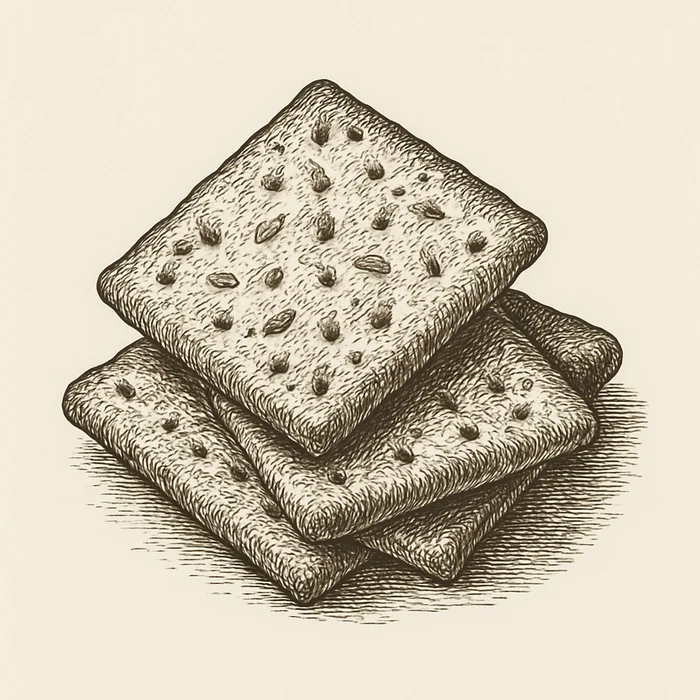
Spelt Crackers
Whole-grain cracker used as a side in the Longevity Diet, providing fiber, prebiotics, and a nutritional profile modestly superior to modern wheat.
Why It Matters for Longevity
Spelt (Triticum aestivum ssp. spelta) is an ancient wheat variety with a naturally higher mineral content than modern bread wheat. Galterio et al. (2005) found that spelt bran is naturally enriched in oleic acid and minerals, with higher calcium, magnesium, and zinc than conventional wheat bran, while its phytic acid content does not exceed modern wheat — meaning the minerals are relatively accessible.
Spelt's gluten structure differs from modern wheat: its gluten proteins are more water-soluble and more fragile, which may explain why some gluten-sensitive individuals tolerate spelt better, though it is not appropriate for celiac disease.
The arabinoxylan and resistant starch content of whole spelt acts as a prebiotic. Whole grain interventions consistently show bifidogenic effects — Barroso et al. demonstrated that a 12-week whole-grain wheat dietary intervention in postmenopausal women significantly increased Bifidobacterium, supporting the plausibility of similar effects from whole spelt.
Phenolic Acids and Antioxidant Capacity
Spelt is a meaningful source of phenolic acids, led by ferulic and sinapinic acids. A compositional study of six spelt cultivars found total phenolic acid content ranging from 506.6 to 1,257.4 μg/g dry weight, with total ferulic acid spanning 144.2 to 691.5 μg/g dry weight across varieties (Gawlik-Dziki et al., 2012, J Agric Food Chem). Ferulic acid is esterified to arabinoxylan in the cell wall and is released through enzymatic hydrolysis during digestion and colonic fermentation. In plasma, ferulic acid acts as a free-radical scavenger and inhibitor of LDL oxidation — the oxidative step in atherogenesis that converts LDL particles from circulating cholesterol carriers into vascular plaques.
The antioxidant potential of spelt's phenolic fraction is notably high across cultivars, but varies considerably by variety, which underscores the value of selecting spelt crackers made from bran-retaining whole grain flour rather than refined spelt.
Bioactive Compounds and Glycemic Control
Beyond fiber, spelt contains alkylresorcinols, phytic acid, and antioxidant vitamins that contribute to blood glucose management. A review by Biskup et al. (2017) identified spelt's high dietary fiber content as modulating postprandial glycemia, with alkylresorcinols and phytic acid contributing further to improved insulin sensitivity compared to refined grain products (Biskup et al., 2017, Adv Clin Exp Med). The mechanism involves slower starch digestion and reduced alpha-amylase activity, which blunts glucose entry rate and correspondingly lowers the insulin demand per gram of carbohydrate consumed.
Whole Grains and Type 2 Diabetes Risk
The epidemiological case for whole grains — the category spelt crackers belong to — is substantial. A 2022 dose-response meta-analysis of 11 prospective cohort studies (463,282 participants, 37,249 T2D cases) found a 21% lower type 2 diabetes risk in the highest versus lowest whole grain intake category (RR 0.79, 95% CI: 0.73–0.85). The dose-response analysis showed each additional 50 g/day of whole grain intake was associated with a 23% further reduction in T2D risk, with 60 g/day providing the steepest benefit (Ghanbari-Gohari et al., 2022, Food Sci Nutr). A standard serving of spelt crackers (~30 g) contributes meaningfully toward the 60 g/day threshold associated with maximum protection.
The mechanism linking whole grains to diabetes risk operates through multiple pathways: arabinoxylan fiber slows glucose absorption and reduces postprandial insulin demand; magnesium (at higher concentrations in spelt than modern wheat) is a cofactor for insulin receptor signaling; and ferulic acid inhibits protein glycation — the pathological process whereby excess glucose modifies proteins and accelerates vascular and metabolic damage.
How to Use It
Pairs well with hummus, avocado, olive oil and herbs. Use as a grain in your daily meals according to the Longevity Diet guidelines. Choose crackers made from 100% whole spelt flour with minimal ingredients.
What to Pair It With
| Ingredient | Why | Tradition |
|---|---|---|
| hummus | See synergies | traditional |
| avocado | See synergies | modern Mediterranean |
| olive oil and herbs | See synergies | traditional |
Synergies
- Hummus (synergy): Chickpea protein and spelt fiber create complete amino acid profile and combined prebiotic effect.
- Olive Oil (complement): Olive oil polyphenols reduce the modest glycemic response of spelt starch.
- Legumes (complement): Pairing spelt crackers with legume-based dips provides complementary fiber and complete plant protein.
Flavor Profile
Taste: nutty, slightly sweet, mildly wheaty. Aroma: toasted grain, earthy. Texture: crisp, crunchy, thin. Category: whole-grain cracker.
The Science
- Galterio et al., 2005, Plant Foods Hum Nutr: Spelt bran is naturally enriched in oleic acid and minerals; calcium, magnesium, and zinc are higher than in common wheat while phytic acid is comparable.
- Barroso et al., 2014, Br J Nutr: 12-week whole-grain wheat dietary intervention significantly increased Bifidobacterium populations, supporting the prebiotic potential of arabinoxylan-rich whole grains including spelt.
- Gawlik-Dziki et al., 2012, J Agric Food Chem: Six spelt cultivars: total phenolic acids 506.6–1,257.4 μg/g DW; ferulic acid 144.2–691.5 μg/g DW; high antioxidant potential; free phenolics more effective than bound fraction.
- Biskup et al., 2017, Adv Clin Exp Med: Spelt bioactive compounds (fiber, alkylresorcinols, phytic acid, antioxidants) modulate postprandial glycemia and improve insulin sensitivity compared to refined wheat products.
- Ghanbari-Gohari et al., 2022, Food Sci Nutr: 11-cohort meta-analysis (463,282 participants): highest whole grain intake associated with 21% lower T2D risk; each 50 g/day increment linked to 23% further reduction.
References
- Galterio G, Codianni P, Giusti AM, Cacciatori P, Pezzali G, Sgrulletta D. Spelt (Triticum aestivum ssp. spelta) as a source of breadmaking flours and bran naturally enriched in oleic acid and minerals but not phytic acid. Plant Foods Hum Nutr. 2005;60(2):51-7. PMID: 15796621. doi:10.1007/s11130-005-4580-3
- Barroso E, Cueva C, Peláez C, Martínez-Cuesta MC, Requena T. Development of human colonic microbiota in the computer-controlled dynamic human intestinal microbiota model SHIME® with the inulin-type fructan Synergy1. Br J Nutr. 2014;111(11):1956-65. PMID: 24149441. doi:10.1017/S0007114513004108
- Gawlik-Dziki U, Świeca M, Dziki D. Comparison of phenolic acids profile and antioxidant potential of six varieties of spelt (Triticum spelta L.). J Agric Food Chem. 2012;60(18):4603-4612. PMID: 22500695. doi:10.1021/jf300221g
- Biskup I, Gajcy M, Fecka I. The potential role of selected bioactive compounds from spelt and common wheat in glycemic control. Adv Clin Exp Med. 2017;26(8):1431-1438. PMID: 29068605. doi:10.17219/acem/66699
- Ghanbari-Gohari F, Mousavi SM, Esmaillzadeh A. Consumption of whole grains and risk of type 2 diabetes: A comprehensive systematic review and dose-response meta-analysis of prospective cohort studies. Food Sci Nutr. 2022;10(8):2574-2586. PMID: 35702290. doi:10.1002/fsn3.2860
Key Nutrients
| Nutrient | Per 100g | Notes |
|---|---|---|
| Arabinoxylan (prebiotic fiber) | ~4–6g | Fermented by gut microbiota to short-chain fatty acids; selectively feeds beneficial Bifidobacterium; also carries esterified ferulic acid released during fermentation |
| Ferulic acid | ~144–692 μg/g DW (raw grain) | Dominant phenolic acid; scavenges free radicals and inhibits LDL oxidation; varies substantially by cultivar |
| Zinc | ~2.5mg | Higher than modern wheat; phytate content reduced in whole-grain fermented products |
| Riboflavin (B2) | ~0.1mg | Retained in whole grain; supports mitochondrial energy metabolism and antioxidant recycling |