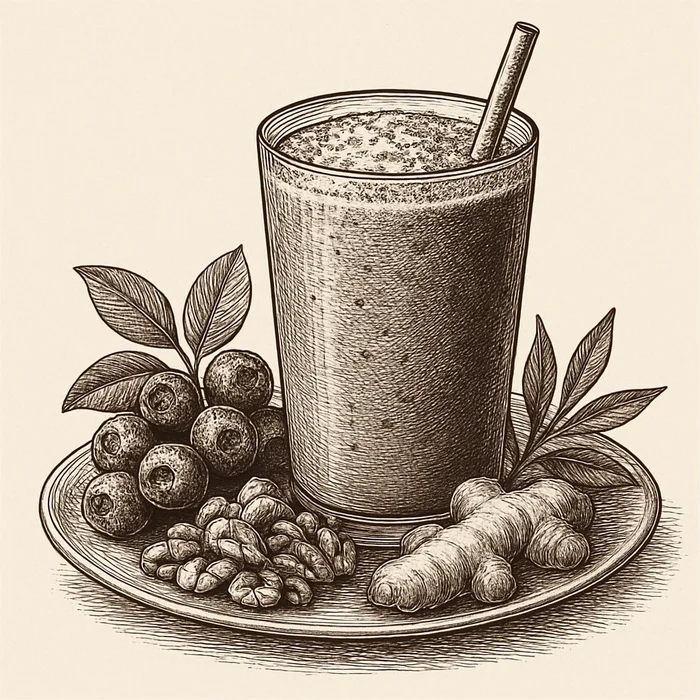
Blueberry Walnut Green Tea Smoothie
A thick, deeply purple morning smoothie that uses brewed green tea as the liquid base instead of water or milk -- stacking anthocyanins, EGCG, omega-3 fats, and gingerol into something that tastes like a blueberry milkshake with a ginger kick.
Why These Ingredients Together
This smoothie layers four distinct longevity compounds that work through complementary mechanisms. Blueberry anthocyanins (164-300mg per 100g in wild varieties) are potent antioxidants that cross the blood-brain barrier and have shown neuroprotective effects in clinical trials with older adults. Green tea's EGCG (30-80mg per cup) promotes apoptosis of damaged cells while sparing healthy ones, and has demonstrated cardiovascular mortality reduction in large cohort studies. Walnuts and flaxseeds together provide a concentrated omega-3 payload -- ALA from walnuts (9g per 100g) plus additional ALA from flaxseeds -- and the walnuts' ellagitannins are converted by gut bacteria into urolithins that promote mitophagy, the cellular cleanup of damaged mitochondria. Fresh ginger's gingerol adds a third anti-inflammatory pathway (COX-2 inhibition) and has been shown in meta-analyses to reduce CRP and TNF-alpha levels. Critically, the fats from walnuts and flaxseeds improve absorption of the blueberry anthocyanins, which are otherwise poorly bioavailable at roughly 1-2% absorption when consumed without fat.
Ingredients
- 1 cup (240ml) brewed green tea, cooled to room temperature
- 1 1/2 cups (225g) frozen wild blueberries (or regular frozen blueberries)
- 1/3 cup (40g) raw walnuts
- 2 tablespoons ground flaxseeds
- 1-inch piece fresh ginger, peeled and roughly sliced
- 1 small ripe banana (for body and sweetness)
- 1 tablespoon lemon juice (about half a small lemon)
- 4-5 ice cubes (fewer if using frozen blueberries)
Instructions
-
Brew the green tea properly. Heat water to 75-80C (170-175F) -- not boiling. Steep 2 teaspoons of loose-leaf green tea (or 2 tea bags) in 1 cup of water for 3 minutes, then remove the leaves. Let cool to room temperature, or brew the night before and refrigerate. (Boiling water scorches green tea, destroying EGCG and creating a bitter brew. At 75-80C, you extract maximum catechins with minimum tannin bitterness. Steeping longer than 3 minutes increases astringency without proportionally increasing EGCG.)
-
Grind the flaxseeds if using whole. If your flaxseeds are whole, pulse them in the blender for 10 seconds before adding anything else. (Whole flaxseeds pass through the digestive tract intact -- you absorb essentially nothing. Grinding breaks the hard seed coat, exposing the ALA omega-3 fats and lignans to digestive enzymes. Pre-ground flaxseed is fine, but oxidizes faster; store it in the freezer.)
-
Add the walnuts and ginger first. Drop the walnuts and sliced ginger into the blender with the cooled green tea. Blend on high for 20-30 seconds until the walnuts are fully broken down into a smooth, milky base. (Blending the walnuts with the tea first creates a creamy emulsion that will make the final smoothie thick and rich rather than gritty. The fat from the walnuts also begins to form micelles that will improve anthocyanin absorption from the blueberries.)
-
Add the remaining ingredients and blend. Add the frozen blueberries, ground flaxseeds, banana, lemon juice, and ice cubes. Blend on high for 45-60 seconds until completely smooth and uniformly purple. (The lemon juice does two things: its vitamin C stabilizes the EGCG from the green tea, which degrades rapidly at neutral and alkaline pH, and it enhances the bioavailability of the non-heme iron present in the flaxseeds.)
-
Taste and adjust. The smoothie should be naturally sweet from the banana and blueberries with a warming ginger finish. If it is too thick, add more green tea 2 tablespoons at a time. If not sweet enough, add half a frozen banana rather than honey -- honey's fructose will spike blood sugar faster than the fiber-bound sugars in the fruit.
-
Drink promptly. Pour into glasses and drink within 15-20 minutes. (Anthocyanins and EGCG both degrade with exposure to light and oxygen. A smoothie sitting on a counter for an hour has measurably fewer bioactive compounds than one consumed fresh. This is not precious health-food paranoia; the degradation kinetics are real and well-documented.)
What Can Go Wrong
-
Using boiling water for the green tea. This is the most common mistake and it ruins both the flavor and the chemistry. Boiling water makes green tea bitter and astringent (excess tannin extraction) and degrades a significant portion of the EGCG. Use a thermometer or let boiling water cool for 3-4 minutes before pouring -- 75-80C is the target. The resulting brew should taste smooth and slightly sweet, not harsh.
-
Using whole flaxseeds without grinding. Whole flaxseeds look pretty in a smoothie but contribute almost nothing nutritionally. The seed coat is too tough for human digestion to crack. Always grind them, or buy pre-ground and store in the freezer to prevent the omega-3 fats from going rancid.
-
Letting it sit. This is not a make-ahead recipe. The anthocyanins in blueberries and the catechins in green tea are both oxygen-sensitive. The smoothie will still taste fine after an hour, but you are losing the compounds that make it worth building this way rather than just throwing random fruit in a blender.
Science Notes
What makes this different from a random fruit smoothie is the deliberate use of green tea as the liquid base. Most smoothie recipes use water, juice, or milk -- none of which contribute meaningful bioactive compounds. Brewed green tea adds 60-160mg of total catechins per cup, with EGCG as the dominant fraction. The combination of EGCG with anthocyanins from blueberries creates a broader antioxidant profile than either alone, covering both water-soluble (catechins) and more lipophilic (anthocyanin metabolites) antioxidant activity. The walnut-flaxseed fat base is not just about creaminess -- the omega-3 ALA they provide is the same fatty acid class (though plant-derived, requiring conversion to EPA/DHA) that epidemiological studies associate with reduced cardiovascular mortality. The Nurses' Health Study found that consuming 5+ servings of walnuts per week was associated with 14% lower mortality risk. And pterostilbene in blueberries -- a resveratrol analogue with 4x higher bioavailability -- crosses the blood-brain barrier, which may explain why blueberry supplementation improves memory performance in older adults with mild cognitive impairment.
Nutrition Highlights
- Anthocyanins: ~250-450mg per serving from wild blueberries (or ~120-240mg from cultivated), with fat co-ingestion from walnuts and flaxseeds improving the otherwise low ~1-2% absorption rate
- EGCG: ~30-80mg per serving from the green tea base, stabilized by the lemon juice's vitamin C to slow degradation at gut pH
- Omega-3 (ALA): ~3.5g per serving combined from walnuts and flaxseeds, providing a substantial plant-based omega-3 dose
- L-theanine: ~20-60mg from the green tea, crossing the blood-brain barrier to promote alpha brain wave activity and calm alertness -- a gentler cognitive boost than coffee's caffeine-only hit