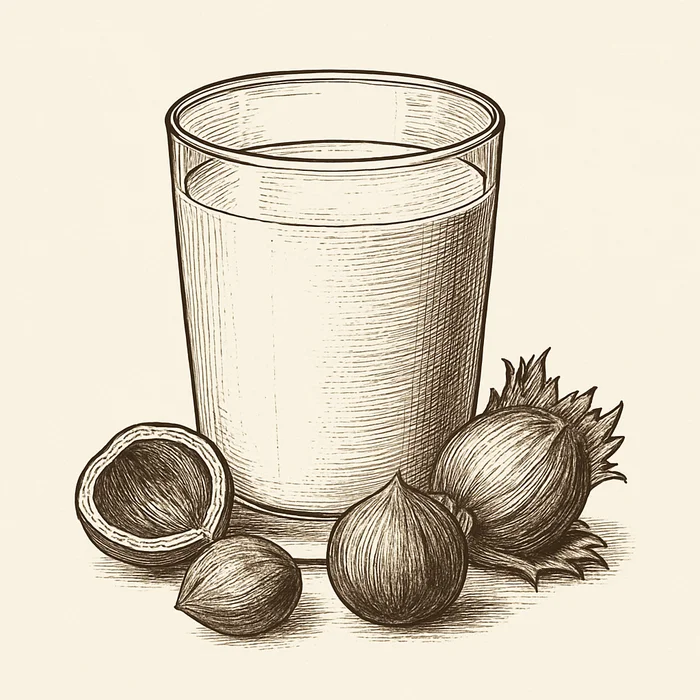
Hazelnut Milk
A plant-milk alternative the Longevity Diet leans on for its breakfast and snack rotation — chosen less for what it adds than for what it lets you avoid: the IGF-1 elevation that comes with cow's milk protein.
Why It Matters for Longevity
Hazelnut milk is a dilute delivery vehicle for a well-studied food. Most commercial unsweetened brands contain 2–4% hazelnuts (roughly 5–10 g per 240 mL glass) — a fraction of the 30–69 g daily doses used in the clinical literature. The longevity case is therefore a hybrid: the proven cardiometabolic effects of whole hazelnuts apply only proportionally, while the displacement of cow's milk delivers an independent, IGF-1-related benefit on its own.
The lipid evidence on whole hazelnuts is consistent. A Bayesian meta-analysis of nine controlled trials (Perna et al., 2016, Nutrients) — 425 participants, 28–84 days, 29–69 g/day — found a pooled LDL reduction of −0.150 mmol/L with no decrease in HDL or weight gain. The mechanism is well-characterised: hazelnuts are ~50% monounsaturated fat, almost entirely oleic acid, which displaces saturated fat in the diet and shifts hepatic LDL-receptor activity. They also carry phytosterols (~120 mg per 100 g), which compete with cholesterol for micellar incorporation in the small intestine.
Beyond the lipid panel: endothelium and oxidation
Two findings move hazelnuts out of "just another nut" territory and toward the longevity stack. The first is endothelial. A controlled crossover trial in 21 hypercholesterolemic adults (Orem et al., 2013, J Clin Lipidol) replaced 18–20% of daily calories with hazelnuts for four weeks and measured flow-mediated dilation — the standard ultrasound proxy for endothelial nitric oxide bioavailability. FMD rose 56.6% from baseline. Oxidized LDL, hs-CRP, and the adhesion molecule sVCAM-1 all fell significantly. The combination is suggestive: endothelial function is one of the earliest reversible markers in the atherogenic cascade, and a 50%+ FMD improvement at four weeks is a large effect for a single dietary change.
The second is at the gene-expression level. A six-week pilot (Di Renzo et al., 2019, Oxid Med Cell Longev) gave 24 healthy volunteers 40 g of hazelnuts daily and ran nutrigenomic profiling on 12 antioxidant and inflammatory genes. Seven were significantly upregulated: SOD1 and CAT (the cell's primary defenses against superoxide and hydrogen peroxide), MIF, PPAR-γ (metabolic regulator), VDR, MTHFR (one-carbon metabolism), and ACE. Importantly, the upregulation occurred without weight gain — the body composition concern that often accompanies energy-dense nut interventions did not materialise.
A separate randomized trial of a single hazelnut-enriched high-fat meal (Di Renzo et al., 2017, Lipids Health Dis) showed the postprandial picture is consistent: oxidized-LDL and the expression of inflammation- and oxidative-stress-related genes were attenuated four hours after eating, compared with a control high-fat meal of equivalent macronutrient profile. The signal is fast.
What this means for the milk form
Hazelnut milk delivers oleic acid, a small dose of vitamin E (~2–3 mg per glass when fortified), and trace polyphenols — but at perhaps a fifth to a tenth of the trial doses. Treat the cardiovascular effects as proportional. The harder argument for the milk specifically is what it replaces. A prospective cohort (Ma et al., 2001, J Natl Cancer Inst) found that milk intake was positively associated with circulating IGF-1 levels and colorectal cancer risk in men. IGF-1 is a central node in the growth-versus-repair tradeoff that pro-longevity interventions try to tilt toward repair. Cow's milk consistently raises it; plant milks do not. Hazelnut milk is one of several acceptable ways to make that swap.
The wider mortality data on whole nuts gives a sense of the ceiling. The Nurses' Health Study + Health Professionals Follow-up Study (Bao et al., 2013, NEJM) followed 118,962 participants for up to 30 years and found daily nut consumption associated with 20% lower all-cause mortality (HR 0.80, 95% CI 0.73–0.86). The PREDIMED Mediterranean trial cohort (Guasch-Ferré et al., 2013, BMC Medicine) reported 39% lower all-cause mortality at >3 servings/week vs. non-consumers (HR 0.61, 95% CI 0.45–0.83), with cancer and cardiovascular mortality reduced in parallel. Hazelnut milk is not a substitute for that intake — but used alongside whole nuts, it supports the same lipid environment.
How to Use It
Pour over oats with a handful of berries; froth into coffee; drink plain as a between-meal beverage when calories are bounded by a fasting-mimicking pattern. For the longest ingredient list of just hazelnuts, water, and salt, look at European brands — many North American versions are heavily diluted with rice or oat base. Shake before pouring; the natural lipid layer separates within minutes. Avoid sweetened, vanilla, and chocolate-flavored variants, which typically add 6–12 g of sugar per serving and erase most of the metabolic benefit of the swap.
If you want closer to the clinical dose without the carrier, eat 25–30 g of whole roasted hazelnuts a few times per week alongside the milk — this is what the Mediterranean cohorts were actually doing.
Dosage
- Hazelnut milk: 240 mL (one glass) up to twice daily as a dairy replacement.
- Whole hazelnut equivalent: 25–40 g per day to approach the doses used in the LDL, FMD, and gene-expression trials.
- Skip if: the label lists added sugar, oils other than the natural hazelnut content, or carrageenan you'd rather avoid (gellan gum is a less inflammatory thickener).
What to Pair It With
| Ingredient | Why | Tradition |
|---|---|---|
| Oats | Beta-glucan binds bile acids; combined fiber + MUFA improves the postprandial glucose curve | Longevity Diet breakfast |
| Coffee | Lower-IGF1 alternative to dairy creamer; chlorogenic acids complement hazelnut polyphenols | Modern Mediterranean |
| Cacao | Complementary polyphenol profiles; the natural pairing — gianduja exists for a reason | Italian (Piedmontese) |
| Berries | Anthocyanins + vitamin E for combined antioxidant coverage | Contemporary |
Flavor Profile
Mildly nutty, subtly sweet even unsweetened, creamy with a light hazelnut aroma. Thinner than oat milk, lighter-bodied than soy. The toasted hazelnut character makes it a natural complement to coffee and chocolate; in a smoothie it stays in the background. Unsweetened versions have a delicate, almost neutral taste with a faint praline finish.
The Science
- Perna et al., 2016, Nutrients: Bayesian meta-analysis of nine RCTs — hazelnut consumption significantly reduced LDL and total cholesterol with no adverse HDL effect and no weight gain.
- Orem et al., 2013, J Clin Lipidol: Crossover trial in hypercholesterolemic adults — hazelnut-enriched diet improved flow-mediated dilation by 56.6% and reduced oxidized LDL, hs-CRP, and sVCAM-1.
- Di Renzo et al., 2019, Oxid Med Cell Longev: 40 g/day for six weeks upregulated SOD1, CAT, MIF, PPAR-γ, VDR, MTHFR, and ACE expression without weight gain.
- Di Renzo et al., 2017, Lipids Health Dis: A single hazelnut-enriched high-fat meal attenuated postprandial oxidized LDL and inflammation gene expression at four hours.
- Bao et al., 2013, NEJM: 118,962 participants, ~30-year follow-up — daily nut consumption associated with 20% lower all-cause mortality.
- Guasch-Ferré et al., 2013, BMC Medicine: PREDIMED cohort — >3 servings/week of nuts associated with 39% lower all-cause mortality vs. non-consumers.
- Ma et al., 2001, J Natl Cancer Inst: Cow's milk intake positively associated with circulating IGF-1 and colorectal cancer risk — the cohort underpinning the IGF-1 argument for plant-milk substitution.
References
- Perna S, Giacosa A, Bonitta G, et al. Effects of Hazelnut Consumption on Blood Lipids and Body Weight: A Systematic Review and Bayesian Meta-Analysis. Nutrients. 2016;8(12):747. PMID: 27897978. doi:10.3390/nu8120747
- Orem A, Balaban Yucesan F, Orem C, et al. Hazelnut-enriched diet improves cardiovascular risk biomarkers beyond a lipid-lowering effect in hypercholesterolemic subjects. J Clin Lipidol. 2013;7(2):123-131. PMID: 23415431.
- Di Renzo L, Cioccoloni G, Bernardini S, et al. A Hazelnut-Enriched Diet Modulates Oxidative Stress and Inflammation Gene Expression without Weight Gain. Oxid Med Cell Longev. 2019;2019:4683723. PMID: 31354906. doi:10.1155/2019/4683723
- Di Renzo L, Marsella LT, Sarlo F, et al. Post-prandial effects of hazelnut-enriched high fat meal on LDL oxidative status, oxidative and inflammatory gene expression of healthy subjects: a randomized trial. Lipids Health Dis. 2017;16(1):86. PMID: 28429343. doi:10.1186/s12944-017-0481-y
- Bao Y, Han J, Hu FB, et al. Association of nut consumption with total and cause-specific mortality. N Engl J Med. 2013;369(21):2001-2011. PMID: 24256379. doi:10.1056/NEJMoa1307352
- Guasch-Ferré M, Bulló M, Martínez-González MÁ, et al. Frequency of nut consumption and mortality risk in the PREDIMED nutrition intervention trial. BMC Medicine. 2013;11:164. PMID: 23866098. doi:10.1186/1741-7015-11-164
- Ma J, Giovannucci E, Pollak M, et al. Milk intake, circulating levels of insulin-like growth factor-I, and risk of colorectal cancer in men. J Natl Cancer Inst. 2001;93(17):1330-1336. PMID: 11535708.
Key Nutrients
| Nutrient | Per 240 mL (commercial, unsweetened) | Notes |
|---|---|---|
| Oleic acid (MUFA) | ~3–4 g | Primary hazelnut fatty acid; displaces saturated fat, lowers LDL |
| Vitamin E (α-tocopherol) | ~2–3 mg | Fat-soluble antioxidant from hazelnut base; protects LDL from oxidation |
| Phytosterols | ~10–15 mg | Compete with cholesterol for micellar incorporation in the gut |
| Calcium (if fortified) | 120–300 mg | Added to commercial hazelnut milk; check the label |
| Vitamin D (if fortified) | 80–120 IU | Cofactor for calcium absorption; choose D3 fortified |
| Hazelnut content | ~2–4% by volume | The lever for cardiometabolic effects; higher = better |