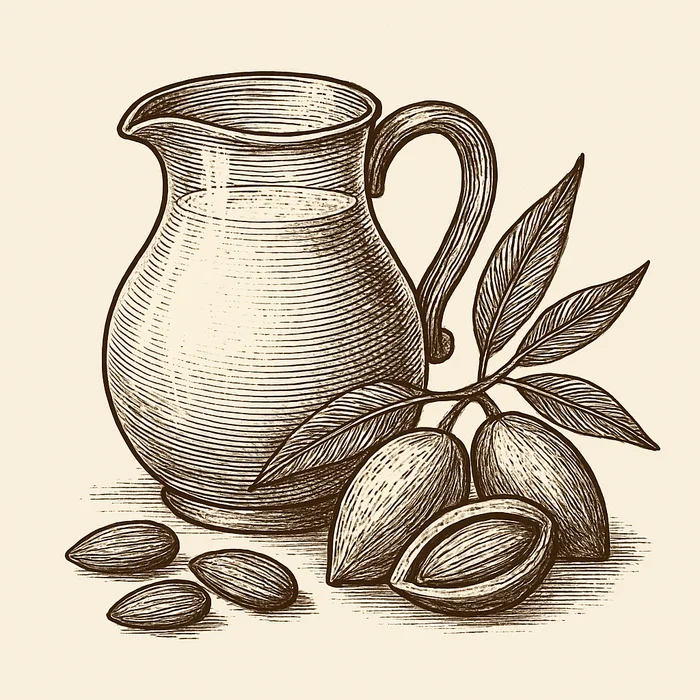
Almond Milk
The Longevity Diet's default dairy alternative — chosen less for what almond milk is than for what it lets you skip. Cow's milk reliably elevates IGF-1; almond milk does not. Everything else about it is bonus.
Why It Matters for Longevity
The strongest argument is structural. A prospective cohort (Ma et al., 2001, J Natl Cancer Inst) found cow's milk intake positively associated with circulating IGF-1 levels and colorectal cancer risk in men. IGF-1 (insulin-like growth factor 1) is one of the few hormones consistently linked to faster aging in mammals — animals with low IGF-1 signaling live longer, and human centenarians cluster in low-IGF-1 phenotypes. The longevity case for plant milks rests on this single substitution: keep the morning latte, skip the IGF-1 stimulus. Almond milk does that.
The second-order benefit comes from almonds themselves, but with a caveat the marketing rarely admits: most commercial almond milk is 2–3% almonds. A 240 mL glass contains the equivalent of roughly 5–7 g of almonds, against the 28–56 g daily doses used in the clinical literature. Treat the cardiometabolic effects below as proportional, not equivalent — the milk alone won't move your lipid panel. Pair it with a handful of whole almonds a few times a week and you start reaching trial doses.
What whole almonds actually do
The lipid evidence is solid. A meta-analysis of 15 RCTs in 534 subjects (Lee-Bravatti et al., 2019, Adv Nutr) found almond consumption reduced LDL cholesterol by a summary net 5.83 mg/dL (95% CI −9.91 to −1.75) and apolipoprotein B by 6.67 mg/dL — the latter is arguably the more important number, since apoB tracks the actual count of atherogenic lipoprotein particles rather than the cholesterol they carry. The mechanism is the same one that drives the rest of the tree-nut literature: oleic acid displaces saturated fat in the diet, phytosterols compete with cholesterol for micellar absorption in the gut, and viscous fiber binds bile acids — all of which reduce hepatic cholesterol output via the LDL-receptor pathway.
Body composition responds too. A six-week crossover trial in 48 adults with elevated LDL (Berryman et al., 2015, J Am Heart Assoc) substituted 1.5 oz (~43 g) of almonds for an isocaloric carbohydrate snack and found significant reductions in body weight, waist circumference, and abdominal fat mass — visceral fat being the more aging-relevant compartment, since it drives the inflammatory milieu (IL-6, TNF-α, free fatty acid spillover) that disrupts insulin sensitivity. The almonds did not cause weight gain despite their energy density, a recurring finding in nut-feeding trials and one of the more counterintuitive results in nutrition.
The microbiome angle
A 2022 RCT (Creedon et al., Am J Clin Nutr) gave 87 healthy adults 56 g/day of whole or ground almonds for four weeks and measured fecal short-chain fatty acids. Mean butyrate rose from 18.2 to 24.1 μmol/g — a 33% increase — without changing alpha diversity or Bifidobacterium abundance. Butyrate is the primary energy source for colonocytes and a known histone deacetylase inhibitor, with downstream effects on intestinal barrier integrity and systemic inflammation. The mechanism here is fermentable substrate: almond cell walls are physically tough and partially escape small-intestinal digestion, arriving in the colon as feedstock for Roseburia, Faecalibacterium, and other butyrate producers.
This signal is faint in almond milk — most of the cell-wall fiber is strained out — but it's another reason to treat the milk and the whole nuts as complementary rather than substitutable.
The mortality ceiling
The largest dataset on nut consumption and outcomes comes from the Nurses' Health Study and Health Professionals Follow-up Study (Bao et al., 2013, NEJM) — 118,962 participants, ~30-year follow-up — where daily nut consumption was associated with 20% lower all-cause mortality (HR 0.80, 95% CI 0.73–0.86). Cardiovascular, cancer, and respiratory mortality were all reduced. This is observational, with the usual healthy-user caveats, but the dose-response was monotonic across five consumption tiers and the effect held after adjustment for the obvious confounders (smoking, BMI, exercise, fruit/vegetable intake). Almonds were among the most-consumed nuts in the cohort.
How to Use It
Anywhere you'd use cow's milk: oatmeal, smoothies, coffee, cereal, plain. Shake well — the calcium settles and so do the natural almond solids in less-processed brands. Barista versions froth respectably for cappuccinos and lattes.
Two label tells: unsweetened is non-negotiable (sweetened versions add 7–14 g of sugar per cup, which neutralises the metabolic argument), and the ingredient list should be short — almonds, water, salt, calcium carbonate, and a tocopherol or D3 fortificant. Skip brands relying on carrageenan, "natural flavors" stacked five-deep, or vegetable oil padding the fat content. European brands tend to use 5–7% almond content; many US brands are closer to 2%.
If you want closer to the trial doses without the carrier, eat 30–45 g of whole almonds three or four times a week. The milk and the nuts complement each other — milk for the dairy displacement, nuts for the fiber, polyphenols, and visceral-fat signal.
Dosage
- Almond milk: 240 mL up to twice daily as a dairy replacement.
- Whole almond equivalent: 28–43 g (1–1.5 oz) per day to approach LDL- and waist-circumference-lowering trial doses.
- Calcium fortification: aim for ~300 mg per 240 mL serving if avoiding dairy entirely; pair with vitamin D3 for absorption.
What to Pair It With
| Ingredient | Why | Tradition |
|---|---|---|
| Oats | Beta-glucan + almond MUFA improves the postprandial glucose curve; combined fermentable fiber | Longevity Diet breakfast |
| Berries | Anthocyanins + vitamin E for combined antioxidant coverage; complementary polyphenol profiles | Contemporary |
| Coffee | Lower-IGF1 alternative to dairy creamer; chlorogenic acids stack with almond polyphenols | Modern Mediterranean |
| Cacao | Theobromine + flavanols complement vitamin E; a classic dessert pairing | Mediterranean |
| Cinnamon | Glucose-lowering effect compounds; almond milk is a vehicle that holds the spice well | Middle Eastern |
Flavor Profile
Mild, faintly nutty, clean. Much thinner than cow's milk — closer in mouthfeel to skimmed dairy than whole. Unsweetened versions have a faint almond finish without sweetness, which is the point: it disappears into coffee and cereal rather than competing. Higher-almond-content brands (5–7%) carry more of the marzipan note; mass-market versions are closer to flavored water with a mineral cling from the calcium fortification.
The Science
- Lee-Bravatti et al., 2019, Adv Nutr: Meta-analysis of 15 RCTs (534 subjects) — almonds reduced LDL by 5.83 mg/dL and apolipoprotein B by 6.67 mg/dL with no adverse HDL effect.
- Berryman et al., 2015, J Am Heart Assoc: Crossover RCT — 1.5 oz/day almonds for 6 weeks reduced waist circumference and abdominal fat mass without weight gain.
- Creedon et al., 2022, Am J Clin Nutr: RCT in 87 adults — 56 g/day almonds raised fecal butyrate by 33% over four weeks.
- Bao et al., 2013, NEJM: 118,962 participants, ~30-year follow-up — daily nut consumption associated with 20% lower all-cause mortality.
- Ma et al., 2001, J Natl Cancer Inst: Cow's milk intake positively associated with circulating IGF-1 and colorectal cancer risk in men — the IGF-1 substitution argument.
References
- Lee-Bravatti MA, Wang J, Avendano EE, et al. Almond Consumption and Risk Factors for Cardiovascular Disease: A Systematic Review and Meta-analysis of Randomized Controlled Trials. Adv Nutr. 2019;10(6):1076-1088. PMID: 31243439. doi:10.1093/advances/nmz043
- Berryman CE, West SG, Fleming JA, et al. Effects of Daily Almond Consumption on Cardiometabolic Risk and Abdominal Adiposity in Healthy Adults With Elevated LDL-Cholesterol: A Randomized Controlled Trial. J Am Heart Assoc. 2015;4(1):e000993. PMID: 25559009. doi:10.1161/JAHA.114.000993
- Creedon AC, Dimidi E, Hung ES, et al. The impact of almonds and almond processing on gastrointestinal physiology, luminal microbiology, and gastrointestinal symptoms: a randomized controlled trial and mastication study. Am J Clin Nutr. 2022;116(6):1790-1804. PMID: 36130222. doi:10.1093/ajcn/nqac265
- Bao Y, Han J, Hu FB, et al. Association of nut consumption with total and cause-specific mortality. N Engl J Med. 2013;369(21):2001-2011. PMID: 24256379. doi:10.1056/NEJMoa1307352
- Ma J, Giovannucci E, Pollak M, et al. Milk intake, circulating levels of insulin-like growth factor-I, and risk of colorectal cancer in men. J Natl Cancer Inst. 2001;93(17):1330-1336. PMID: 11535708.
Key Nutrients
| Nutrient | Per 100 mL | Notes |
|---|---|---|
| Vitamin E (α-tocopherol) | ~6.3 mg | Naturally from almonds; protects LDL from oxidation, membrane-protective |
| Oleic acid (MUFA) | ~1–2 g | Primary almond fatty acid; displaces saturated fat |
| Phytosterols | ~5–8 mg | Compete with cholesterol for micellar incorporation in the gut |
| Calcium (fortified) | 188 mg | Bioavailability comparable to cow's milk when fortified with calcium carbonate |
| Vitamin D (fortified) | ~42 IU | Essential cofactor for calcium absorption; choose D3 fortified |
| Almond content | ~2–7% by volume | The lever for cardiometabolic effects; higher = better |