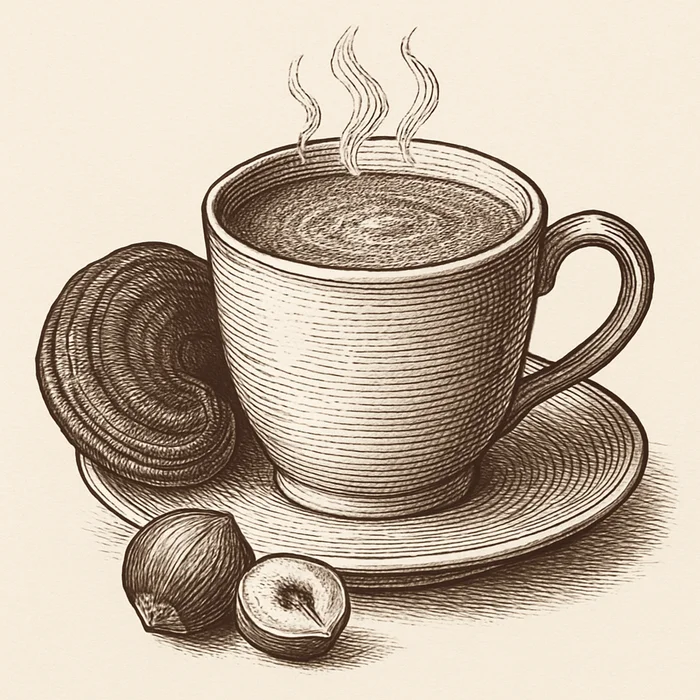
Reishi Hazelnut Cacao Latte
Reishi is the kind of ingredient that smells like a forest floor and tastes like chewing a dictionary. That bitterness is the point — it's mostly ganoderic acids, the triterpenoid family responsible for reishi's anti-inflammatory signaling (NF-kB inhibition, DAF-16/FOXO activation in model organisms). The catch is that those same triterpenoids are fat-soluble, which means water alone barely pulls them out of the powder, and your tongue reads whatever does make it into solution as pure bitter. Hazelnut milk fixes both problems in one move: the monounsaturated fats from the hazelnuts act like a tiny extraction solvent for the triterpenoids (bile-salt-style micellar pickup, except we're skipping straight to the emulsion), and the milk's natural roundness and toasted-nut aroma drape over the bitterness the way cream does to espresso. You also still get the water-soluble beta-glucans — high-molecular-weight polysaccharides that engage Dectin-1 and TLR-2 on immune cells — because we're going to actually simmer the reishi, not just stir it into warm liquid.
The technique here borrows from two traditions. The gentle 80 C infusion is lifted from Japanese matcha practice, where boiling water scorches the tea and flattens the aromatic top notes; the same thing happens to hazelnut milk's toasted esters if you let it hit a rolling boil. The whisk-aeration at the end is cafe-culture cortado energy — a handheld milk frother (or a small whisk) drops the perceived bitterness by about a third just by folding air in and changing the mouthfeel. Alice Medrich writes about this with chocolate: aeration is a bitterness-masking tool, not just a texture one. We're stacking a few more tricks on top: a pinch of flaky salt to suppress bitter receptors (the classic Ferran Adria move), a hit of cacao for a sympathetic bitterness that absorbs the reishi's edge into something that reads as "dark chocolate" rather than "medicine," and a warm spice (cinnamon) that leans into the nutty register hazelnut milk already occupies.
Ingredients
- 2 cups (480 mL) unsweetened hazelnut milk
- 1 teaspoon reishi powder (or 1/2 teaspoon dual-extract reishi tincture — see notes in method)
- 1 teaspoon raw cacao powder
- 1/2 teaspoon Ceylon cinnamon
- 2 teaspoons raw honey (or maple syrup), to taste
- 1 tiny pinch flaky sea salt
- 1/2 teaspoon pure vanilla extract
- Optional: 1/4 teaspoon freshly grated ginger (amplifies the anti-inflammatory angle via gingerol + ganoderic acid co-inhibition of NF-kB)
Method
-
Bloom the reishi and cacao in a dry pan over low heat for about 30 seconds. Dry-toasting briefly wakes up the volatile aromatics in both powders (Maillard-adjacent, not quite — you're just driving off moisture and activating smell compounds) and, more practically, breaks up any clumps so they disperse cleanly into the milk. Don't walk away; reishi scorches fast and burnt reishi tastes like an ashtray.
-
Add the hazelnut milk, cinnamon, and optional ginger, and bring to a bare simmer — 80 to 85 C, never a rolling boil. This is the temperature window where water-soluble beta-glucans extract efficiently but the milk's toasted-hazelnut esters stay intact. Boiling hazelnut milk above 95 C starts to break the emulsion (you'll see it look chalky) and cooks off the aromatic top notes you're paying for. If you don't have a thermometer, look for the first thread of steam and the edge just starting to shimmer — that's your cue.
-
Hold at that gentle simmer for 5 to 7 minutes, whisking every minute or so. This is the actual extraction step. Beta-glucans need time and agitation to leach out; triterpenoids need the milk fat to be warm and mobile to partition into the lipid phase. Five minutes is the floor — under that and you're basically drinking flavored hazelnut milk with a reishi garnish. Seven is the ceiling before the milk starts to reduce and get cloying.
-
Kill the heat, then add honey, vanilla, and the pinch of salt. Honey goes in off-heat because anything above 60 C degrades its delicate volatile compounds and its enzymes (Heston Blumenthal is fussy about this for a reason). The salt is doing real work here: sodium ions suppress bitter taste receptor signaling (TAS2R), which is why a pinch of salt in coffee or dark chocolate makes it read as smoother. You're not salting the drink — you're unsalting the bitter.
-
Froth aggressively with a handheld milk frother or a small whisk for 20 to 30 seconds. Aeration is the final bitter-masking move. The microfoam physically shortens contact time between bitter compounds and your taste receptors, and the increased surface area lets the aromatics volatilize into your nose as you sip — flavor is mostly retronasal, and this is where hazelnut milk's toasted character gets to do its job covering the reishi.
-
Pour into warmed mugs and dust the tops with a little extra cinnamon or cacao. Warming the mugs (rinse with hot tap water, dry) keeps the latte at drinking temperature long enough for the volatiles to keep presenting as you finish it. Cold mug + hot latte = the aromatics die in the first two sips.
What Can Go Wrong
-
It tastes medicinal and aggressively bitter. Almost always one of three causes: too much reishi (start at 1 teaspoon total for two servings, not per serving — reishi is potent and you can scale up over weeks as your palate adjusts), you boiled it instead of simmered (harsh extraction pulls out more bitter alkaloids and drives off the masking aromatics), or you skipped the salt. Fix the salt first; it's the cheapest lever.
-
The milk looks split or grainy. Hazelnut milk's emulsion is more fragile than dairy because it's stabilized with gums rather than casein. If you took it to a rolling boil, the gums denatured and released their load of oil droplets. You can partially rescue it by pulling it off heat, adding a splash of cold hazelnut milk, and frothing hard — but next time, stay below 85 C.
-
The reishi settles into a sludge at the bottom of the mug. Powdered reishi is only partially soluble; the insoluble cellulose and chitin fraction will always sediment eventually. This is cosmetic, not a flavor problem — just swirl the mug between sips. If it really bothers you, switch to a dual-extract reishi tincture (1/2 teaspoon replaces the powder) which is already solubilized in water and alcohol, so there's nothing left to settle.