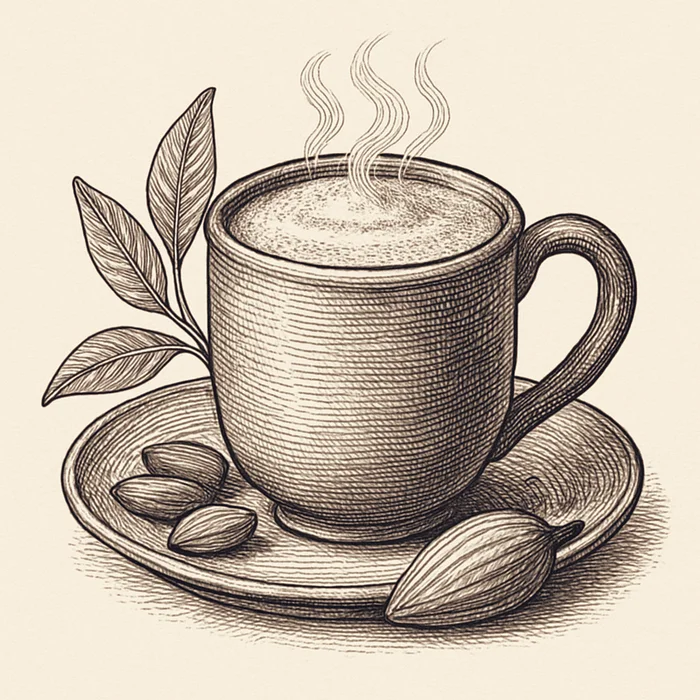
Transitional Golden Milk Latte
This is a "transition" latte — half cow's milk, half fortified almond milk — built for the person who loves the cling of dairy foam but is trying to drift toward a plant-forward cup. Blending the two isn't a compromise, it's a technique. Whole milk brings casein (the protein that builds tight, glossy microfoam) and lactose (which caramelizes a hair at the edges of the pan for that faintly sweet toasted-cream note). Almond milk brings vitamin E, fortified calcium and D3, and a thinner body that lets the spices actually speak. Over time you can shift the ratio — 50/50, then 30/70, then all almond — without ever losing the mouthfeel your tongue is trained to expect.
The second non-negotiable is the spice bloom. Turmeric's curcumin and the volatile oils in cardamom, ginger, and black pepper are fat-soluble; dumping dry powder into cold milk gives you a dusty, grassy drink. Instead we do what cooks on the Indian subcontinent have done for centuries in haldi doodh (and what French saucemakers call "sweating aromatics"): bloom the spices in a little fat first, off the direct flame, so the oils dissolve into the fat phase before the milk arrives. Piperine from the black pepper then boosts curcumin bioavailability roughly twentyfold, which is why every serious golden-milk recipe insists on it. Keep the whole drink under a bare simmer — 65-70C / 150-160F — because above that you start denaturing whey proteins and driving off the very aromatics you just coaxed out.
Ingredients
- 1 cup (240 ml) whole cow's milk
- 1 cup (240 ml) unsweetened fortified almond milk (shake the carton hard)
- 1 tsp coconut oil or ghee
- 1 tsp ground turmeric
- 1/2 tsp ground cinnamon
- 1/4 tsp ground cardamom
- 1/4 tsp ground ginger (or 1 tsp freshly grated)
- 1 generous pinch freshly cracked black pepper
- 1-2 tsp raw honey or maple syrup, to taste (off heat)
- Pinch of flaky salt
- Optional: 1/2 tsp vanilla extract, added off heat
Method
-
Shake the almond milk carton like you mean it. Fortified almond milks settle — calcium carbonate is heavier than water and sinks to the bottom. If you pour off the top of an unshaken carton you get watery, under-fortified liquid and a calcium sludge you'll throw away. Shake for a full ten seconds before measuring.
-
Bloom the spices in fat over low heat. Warm the coconut oil or ghee in a small saucepan until it just glistens — you want maybe 60C, not smoking. Add turmeric, cinnamon, cardamom, ginger, and pepper, and stir for 30-45 seconds until it smells like a spice market and the mixture turns into a fragrant paste. This is the same move as a South Indian tadka or a French pincage: fat-soluble aromatics need fat to unlock, and dry heat drives off the raw, bitter top notes.
-
Add the cow's milk first, then the almond milk. Whisk the warm milk in slowly so the spice paste emulsifies instead of seizing into clumps. Cow's milk first because its fat and casein act as a carrier — they grab the oil-bound spice particles and hold them in suspension. If you add the almond milk first (low fat, low protein), the bloomed spices have nothing to bind to and you get speckled separation.
-
Hold it at a bare whisper of a simmer, 65-70C / 150-160F, for 3-4 minutes. This is the Ayurvedic "doodh ubaalna" step — you're pasteurizing, letting the spices fully infuse, and starting a very gentle Maillard reaction on the milk sugars that gives haldi doodh its signature sweet-toasted backbone. A thermometer is ideal; without one, watch for wisps of steam and the first tremor of bubbles at the edge, never a rolling boil. Above 80C you scorch the lactose, crack the casein micelles, and release sulfurous cooked-milk notes.
-
Kill the heat, then sweeten and finish. Pull the pan off the burner and let it drop for 30 seconds before adding honey (raw honey loses its enzymatic nuance above 40C) and vanilla. The salt goes in now too — a pinch makes the spices read three-dimensionally instead of flat.
-
Froth, then strain if you like. Use a milk frother, an immersion blender, or a French press with a few vigorous plunges. You're chasing microfoam, not cappuccino-style stiff peaks: the dairy casein in the cow's milk gives you just enough structure. For a silky mouth, pour through a fine-mesh sieve to catch any gritty spice particles, then divide between two warmed mugs. Dust with a final hit of cinnamon.
What Can Go Wrong
- Curdled, grainy milk. You boiled it. Cow's milk casein destabilizes past ~82C, and the acid from spices like ginger accelerates the break. Solution: lower heat, use a thermometer, and pull the pan the instant you see the first bubble trace the perimeter.
- Dusty, bitter turmeric note. You skipped or rushed the bloom. Raw turmeric powder is clay-like and grassy; it needs fat and gentle heat to convert. Next time, bloom longer (45-60 seconds) until the paste actually darkens a shade and smells sweet rather than musty.
- Thin, watery foam. You used unshaken almond milk, or tipped the ratio too far plant-side for your current equipment. Home frothers lean on dairy protein for stability. Shake the carton, and if you're below 40% cow's milk, switch to a barista-formulated almond milk (they add pea protein or gellan gum specifically to foam).