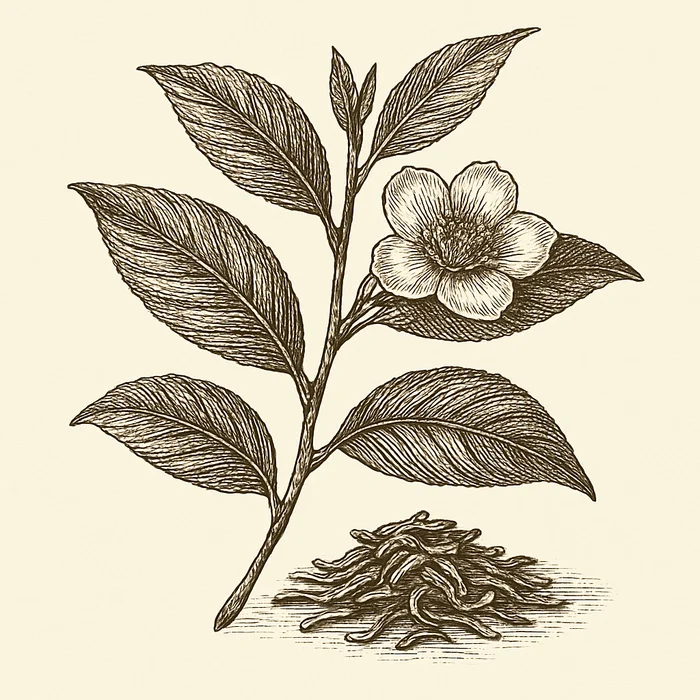
Green Tea
Few foods have as direct a connection to measured lifespan in humans as green tea -- a Chinese cohort of over 100,000 people (Wang et al., 2020, Eur J Prev Cardiol) linked habitual consumption to lower atherosclerotic cardiovascular disease and all-cause mortality, with an estimated increase in disease-free life expectancy. The Japanese evidence is equally compelling: the landmark Ohsaki cohort study (Kuriyama et al., 2006, JAMA) followed 40,530 adults for up to 11 years and found that women drinking 5+ cups per day had a 23% lower all-cause mortality (HR 0.77; 95% CI 0.67–0.89) and a 31% lower cardiovascular mortality (HR 0.69; 95% CI 0.53–0.90) compared to those drinking less than one cup per day. Those are unusually large effect sizes for a dietary factor in a well-powered prospective cohort.
Why It Matters for Longevity
The star compound is EGCG (epigallocatechin gallate), which makes up roughly 60% of green tea's catechin content. EGCG promotes apoptosis in tumor cells while leaving healthy cells alone -- a selective toxicity that has shown cancer-preventive effects across skin, lung, stomach, colon, prostate, and several other organ sites in animal models. A systematic review and meta-analysis (Guo et al., 2017, Medicine) found a significant inverse association between green tea consumption and prostate cancer in human populations, consistent with broader observational evidence across cancer sites.
At the molecular level, EGCG activates AMPK (AMP-activated protein kinase) -- the cellular energy sensor that triggers autophagy and inhibits mTOR, the growth-and-replication pathway that, when chronically overactive, accelerates cellular aging. EGCG has also been identified as a dual PI3K/mTOR inhibitor. This AMPK/mTOR axis is central to several proposed longevity interventions, and the fact that a common dietary polyphenol modulates it at physiologically achievable concentrations is significant. Longer-term animal data underscore the point: EGCG-fed mice showed markedly reduced DNA damage, lower senescence-associated secretory phenotype markers, enhanced SIRT3/5 expression, improved autophagy flux, and -- critically -- a nearly 47% lower hazard of death compared to controls.
The cardiovascular evidence is equally strong. A large dose-response meta-analysis (Chung et al., 2020, Adv Nutr) pooled prospective tea studies and confirmed inverse associations with cardiovascular disease and all-cause mortality. On the lipid side, a meta-analysis of 14 RCTs (Zheng et al., 2011, Am J Clin Nutr) showed that green tea intake lowers fasting total and LDL cholesterol. Blood pressure is another downstream benefit: a meta-analysis of 24 RCTs (Xu et al., 2020, Medicine) involving 1,697 subjects found statistically significant reductions in both systolic BP (−1.17 mmHg; 95% CI −2.18 to −0.16) and diastolic BP (−1.24 mmHg; 95% CI −2.07 to −0.40). These are modest absolute values but consistent across a large number of trials, and even small sustained blood pressure reductions translate into meaningful reductions in stroke and coronary events at the population level.
L-Theanine and the Caffeine Synergy
Then there is L-theanine, an amino acid that crosses the blood-brain barrier and promotes alpha brain waves -- the pattern associated with calm focus. Combined with green tea's moderate caffeine (~25–50 mg per cup, about half of coffee), it delivers alertness without the jitters. This is not merely anecdotal: a systematic review and meta-analysis (Camfield et al., 2014, Nutr Rev) analyzed 11 placebo-controlled RCTs and found moderate effect sizes favoring combined L-theanine + caffeine over placebo for alertness and attentional switching accuracy, with benefits appearing in the first two hours post-dose. The combination outperformed caffeine or L-theanine alone. Shade-grown teas -- gyokuro, matcha, and kabusecha -- are particularly rich in L-theanine because the leaf accumulates the amino acid in the absence of sunlight.
This cognitive dimension matters for long-term brain health beyond acute performance. Sustained improvement in attention control and reduced anxiety load over years may contribute to the overall mortality reduction seen in cohort studies, though disentangling specific pathways in observational data is not possible.
How to Use It
Brew at 70–80°C (not boiling) for 2–3 minutes to extract catechins without excessive bitterness. Three cups daily is the dose most consistently linked to mortality reduction in the epidemiological data. Adding a squeeze of lemon stabilizes EGCG in the gut. For maximum catechin intake, matcha (stone-ground whole leaf) delivers the entire leaf's contents. Drink between meals -- an empty stomach improves EGCG absorption, but tannins can block iron uptake from food.
What to Pair It With
| Ingredient | Why | Tradition |
|---|---|---|
| Lemon | Vitamin C stabilizes catechins and boosts absorption | Western / Global |
| Ginger | Complementary anti-inflammatory pathways; classic health tonic | Japanese / Chinese |
| Mint | Digestive support; masks astringency | Moroccan |
| Rice | Genmaicha tradition; toasted rice adds nutty depth | Japanese |
| Honey | Tempers astringency without destroying catechins (add after cooling slightly) | Global |
Flavor Profile
Vegetal and grassy with a pleasant astringency from tannins. High-grade teas (gyokuro, top-shelf sencha) lean umami and almost marine. Genmaicha adds toasted-rice warmth. The aroma ranges from fresh-cut grass to floral, depending on cultivar and processing. Body is light; mouthfeel can be smooth and silky in shade-grown varieties or slightly drying in more astringent brews.
The Science
- Kuriyama et al., 2006, JAMA (Ohsaki): 40,530 Japanese adults, 11-year follow-up — 5+ cups/day linked to 23% lower all-cause mortality in women (HR 0.77) and 31% lower CVD mortality (HR 0.69).
- Wang et al., 2020, Eur J Prev Cardiol (China-PAR): Habitual tea drinking linked to lower atherosclerotic CVD and all-cause mortality in >100,000 adults.
- Chung et al., 2020, Adv Nutr: Dose-response meta-analysis — tea intake inversely associated with CVD and all-cause mortality.
- Xu et al., 2020, Medicine: Meta-analysis of 24 RCTs (n=1,697) — green tea reduces systolic BP by −1.17 mmHg and diastolic BP by −1.24 mmHg.
- Zheng et al., 2011, Am J Clin Nutr: Meta-analysis of 14 RCTs — green tea lowers fasting total and LDL cholesterol.
- Camfield et al., 2014, Nutr Rev: Meta-analysis of 11 RCTs — L-theanine + caffeine combination produces moderate effect-size improvements in alertness and attentional switching vs. placebo.
- Guo et al., 2017, Medicine: Systematic review — green tea consumption inversely associated with prostate cancer risk.
- Examine.com: strong evidence for fat oxidation; moderate for cardiovascular and cancer risk reduction.
References
- Kuriyama S, Shimazu T, Ohmori K, et al. Green tea consumption and mortality due to cardiovascular disease, cancer, and all causes in Japan: the Ohsaki study. JAMA. 2006;296(10):1255-1265. PMID: 16968850. doi:10.1001/jama.296.10.1255
- Wang X, Liu F, Li J, et al. Tea consumption and the risk of atherosclerotic cardiovascular disease and all-cause mortality: The China-PAR project. Eur J Prev Cardiol. 2020;27(18):1956-1963. PMID: 31914807. doi:10.1177/2047487319894685
- Chung M, Zhao N, Wang D, et al. Dose-Response Relation between Tea Consumption and Risk of Cardiovascular Disease and All-Cause Mortality: A Systematic Review and Meta-Analysis of Population-Based Studies. Adv Nutr. 2020;11(4):790-814. PMID: 32073596. doi:10.1093/advances/nmaa010
- Xu R, Yang K, Ding J, Chen G. Effect of green tea supplementation on blood pressure: A systematic review and meta-analysis of randomized controlled trials. Medicine (Baltimore). 2020;99(6):e19047. PMID: 32028419. doi:10.1097/MD.0000000000019047
- Zheng XX, Xu YL, Li SH, Liu XX, Hui R, Huang XH. Green tea intake lowers fasting serum total and LDL cholesterol in adults: a meta-analysis of 14 randomized controlled trials. Am J Clin Nutr. 2011;94(2):601-610. PMID: 21715508. doi:10.3945/ajcn.110.010926
- Camfield DA, Stough C, Farrimond J, Scholey AB. Acute effects of tea constituents L-theanine, caffeine, and epigallocatechin gallate on cognitive function and mood: a systematic review and meta-analysis. Nutr Rev. 2014;72(8):507-522. PMID: 24946991. doi:10.1111/nure.12120
- Guo Y, Zhi F, Chen P, et al. Green tea and the risk of prostate cancer: A systematic review and meta-analysis. Medicine (Baltimore). 2017;96(13):e6426. PMID: 28353571. doi:10.1097/MD.0000000000006426
Key Nutrients
| Nutrient | Per cup (240ml) | Notes |
|---|---|---|
| EGCG | 30-80 mg | Low oral bioavailability (~2-5%); enhanced by vitamin C and piperine |
| Total catechins | 100-200 mg | Includes EGCG, ECG, EGC, EC -- collectively drive antioxidant effects |
| L-theanine | 20-60 mg | Higher in shade-grown (gyokuro, matcha); crosses blood-brain barrier |
| Caffeine | 25-50 mg | Modulated by L-theanine for smoother alertness than coffee |