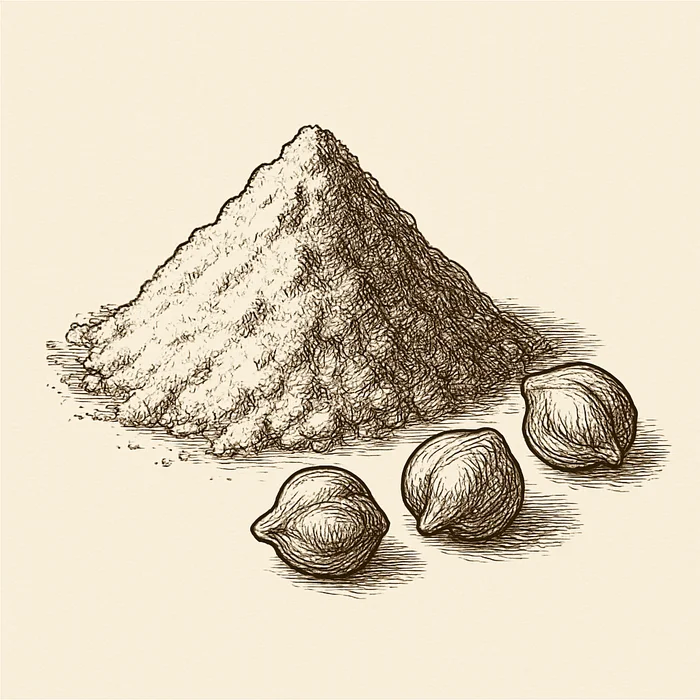
Garbanzo Bean Flour
Used to make farinata — a traditional Ligurian flatbread eaten in the Longevity Diet. Farinata provides gluten-free plant protein and complex carbohydrates from chickpeas, preserving the fiber and polyphenol content of the whole legume.
Why It Matters for Longevity
Chickpea flour (garbanzo bean flour) offers the complete nutritional package of chickpeas — plant protein, soluble fiber, resistant starch, and phytochemicals — in a versatile baking form. Farinata, made from chickpea flour, water, olive oil, and rosemary, represents a traditional longevity food from Liguria that provides a gluten-free alternative to wheat bread.
Glycemic advantage
In vitro carbohydrate digestibility studies found that whole chickpea and chickpea bread products had significantly slower starch digestion rates and lower glycemic responses than refined wheat bread, with the intact cell structure of chickpeas being key to this effect (Hawkins et al., 2005, Int J Food Sci Nutr). The mechanism is physical entrapment: intact legume cell walls restrict enzyme access to starch granules inside cells, creating a physical barrier to amylase that persists even after cooking. This differs from simple fiber dilution effects seen in most "low-GI" foods.
Replacing wheat flour with cellular legume powder (chickpea-derived) significantly reduced starch bioaccessibility and slowed glucose release in both in vitro and in vivo models, confirming that legume cellular architecture is the primary driver of its low glycemic impact — preserved even after milling into flour when cellular structure remains intact (Bajka et al., 2021, Food Hydrocoll). The distinction between fully milled (particle size reduced below cellular scale) and partially milled (cellular structure retained) flour is therefore practically significant: chickpea flour that retains some cellular architecture maintains the glycemic advantage of the whole legume.
LDL cholesterol and lipid profile
Clinical evidence supports a direct cholesterol-lowering effect from regular chickpea consumption independent of general dietary fat changes. Pittaway et al. (2006) conducted a randomized controlled crossover trial in 47 free-living adults comparing a chickpea-supplemented diet to a wheat-based control diet for at least 5 weeks each. The chickpea diet reduced total serum cholesterol by 3.9% and LDL cholesterol by 4.6% (p < 0.01 for both), attributing the improvement to differences in polyunsaturated fatty acid content and dietary fiber between the two diets (Pittaway et al., 2006, Ann Nutr Metab). A related crossover trial in 27 adults found LDL reduced by 0.20 mmol/L (p=0.02) during the chickpea phase (Pittaway et al., 2007, J Am Coll Nutr).
These chickpea-specific findings are consistent with the broader resistant starch literature. A 2018 meta-analysis of 20 trials found that resistant starch supplementation reduced serum LDL by a mean of 3.40 mg/dL (95% CI: −6.74 to −0.07 mg/dL) and total cholesterol by 7.33 mg/dL (95% CI: −12.15 to −2.52 mg/dL), with larger effects seen at durations exceeding 4 weeks and doses above 20 g/day (Yuan et al., 2018, Nutr Res). The proposed mechanisms involve two pathways: (1) resistant starch fermentation in the colon to short-chain fatty acids (SCFAs) — principally propionate — which travels via the portal vein to the liver where it inhibits cholesterol synthesis; (2) soluble fiber (a component of chickpea's fiber fraction) forming a viscous gel in the small intestine that reduces bile acid reabsorption, forcing the liver to draw on cholesterol to synthesize new bile acids.
Gut microbiome and butyrate production
Approximately 5–8 g per 100 g of chickpea flour is resistant starch — starch that escapes small intestinal digestion and reaches the colon largely intact. There, resident Firmicutes (principally Ruminococcus bromii and butyrate-producing genera including Faecalibacterium prausnitzii and Roseburia intestinalis) ferment it to SCFAs: acetate, propionate, and butyrate. Butyrate is the primary energy substrate for colonocytes, supporting the integrity of the epithelial barrier, downregulating NF-κB inflammatory signaling in gut tissue, and stimulating production of mucins that limit pathogen adhesion. Pulse fiber more broadly — including from chickpeas — has been shown to shift microbial composition toward fiber-fermenting species in human intervention studies, though published data specifically on chickpea flour's microbiome effects remain limited and heterogeneous in methodology (Marinangeli et al., 2020, Benef Microbes).
Protein quality and completeness
At ~22 g protein per 100 g flour, chickpea flour is among the highest-protein gluten-free flours available. The protein digestibility-corrected amino acid score (PDCAAS) is approximately 0.71, reflecting a relatively limited methionine content. Combined with a grain-based food (e.g., the rosemary-olive oil farinata served alongside a grain-based meal), the complementary amino acid profiles create a complete protein — all nine essential amino acids above threshold — without requiring any single plant source to carry the full load.
Saponins: cardiovascular context
Chickpeas contain saponins at levels of approximately 0.1–0.5 g per 100 g. At food-level intakes, saponins appear to reduce cholesterol absorption by forming insoluble complexes with bile acids and cholesterol in the intestinal lumen, contributing to the lipid-lowering effects documented in the clinical trials above. At very high isolated doses, saponins can disrupt cell membranes — an effect that is not observed at normal dietary exposures and that is substantially reduced by cooking.
How to Use It
Mix chickpea flour with water, olive oil, salt, and rosemary for farinata batter; rest 4–8 hours, bake in a hot oven at 220°C in a shallow oiled pan. The surface should be golden and slightly crispy. Slice and serve warm. Can also be used in soups or as a thickener. Resting time allows the batter to fully hydrate, improving the texture and reducing any residual raw legume flavor.
What to Pair It With
| Ingredient | Why | Tradition |
|---|---|---|
| Extra-virgin olive oil | Oleic acid enhances absorption of chickpea's fat-soluble phytosterols; critical farinata ingredient | Traditional Ligurian |
| Rosemary | Carnosic acid complements chickpea's isoflavones for combined antioxidant activity | Traditional Italian |
| Black pepper | Traditional farinata topping; piperine may enhance nutrient bioavailability | Traditional |
Flavor Profile
Nutty, slightly earthy, savory. Aroma is toasted legume, earthy. Texture is dense and slightly grainy when raw, crisp-tender when baked as farinata. The flavor is distinctly chickpea with a pleasant nuttiness that pairs well with herbs and olive oil.
The Science
- Hawkins et al., 2005, Int J Food Sci Nutr: Whole chickpea and chickpea bread products had slower starch digestion and lower glycemic index than refined wheat bread in in vitro digestibility testing; intact cell walls restrict amylase access to intracellular starch granules.
- Bajka et al., 2021, Food Hydrocoll: Replacing wheat flour with cellular legume (chickpea) powder significantly reduced starch bioaccessibility and slowed postprandial glucose release; cellular architecture is key to glycemic advantage, preserved after milling if cellular structure remains intact.
- Pittaway et al., 2006, Ann Nutr Metab: Randomized crossover trial (n=47, ≥5 weeks): chickpea diet reduced total cholesterol 3.9% and LDL 4.6% vs. wheat control (p < 0.01); attributable to fiber and polyunsaturated fat differences.
- Pittaway et al., 2007, J Am Coll Nutr: Randomized crossover trial (n=27, 5 weeks): chickpea diet reduced LDL by 0.20 mmol/L (p=0.02) and total cholesterol by 0.25 mmol/L (p < 0.01) vs. wheat.
- Yuan et al., 2018, Nutr Res: Meta-analysis of 20 trials: resistant starch supplementation reduced serum LDL by mean 3.40 mg/dL (95% CI: −6.74 to −0.07) and total cholesterol by 7.33 mg/dL (95% CI: −12.15 to −2.52); effects larger at doses >20 g/day and duration >4 weeks.
- Marinangeli et al., 2020, Benef Microbes: Systematic review: whole pulses including chickpeas alter human large intestinal microbial composition; fiber fermentation supports SCFA-producing species; more human data needed.
References
- Hawkins A, Johnson SK, McQuillan J. In vitro carbohydrate digestibility of whole-chickpea and chickpea bread products. Int J Food Sci Nutr. 2005;56(3):147-155. PMID: 16009629. doi:10.1080/09637480500103920
- Bajka BH, Miles SP, Bridgeman SC, et al. The impact of replacing wheat flour with cellular legume powder on starch bioaccessibility, glycaemic response and gut microbiota. Food Hydrocoll. 2021;114:106565. PMID: 33941996. doi:10.1016/j.foodhyd.2020.106565
- Pittaway JK, Ahuja KDK, Cehun M, Chronopoulos A, Robertson IK, Nestel PJ, Ball MJ. Dietary supplementation with chickpeas for at least 5 weeks results in small but significant reductions in serum total and low-density lipoprotein cholesterols in adult women and men. Ann Nutr Metab. 2006;50(6):512-518. PMID: 17191025. doi:10.1159/000098145
- Pittaway JK, Ahuja KDK, Robertson IK, Ball MJ. Effects of a controlled diet supplemented with chickpeas on serum lipids, glucose tolerance, satiety and bowel function. J Am Coll Nutr. 2007;26(4):334-340. PMID: 17906185. doi:10.1080/07315724.2007.10719625
- Yuan HC, Meng Y, Bai H, Shen DQ, Wan BC, Chen LY. Meta-analysis indicates that resistant starch lowers serum total cholesterol and low-density cholesterol. Nutr Res. 2018;54:1-11. PMID: 29914662. doi:10.1016/j.nutres.2018.02.005
- Marinangeli CPF, Harding SV, Zafron M, Rideout TC. A systematic review of the effect of dietary pulses on microbial populations inhabiting the human gut. Benef Microbes. 2020;11(5):457-468. PMID: 32865026. doi:10.3920/BM2020.0023
Key Nutrients
| Nutrient | Per 100g | Notes |
|---|---|---|
| Plant protein | ~22 g | PDCAAS ~0.71; combining with grains creates complete protein |
| Resistant starch | ~5–8 g | Escapes small intestine; fermented by colonic bacteria to SCFAs (principally butyrate and propionate) supporting epithelial health and inhibiting hepatic cholesterol synthesis |
| Dietary fiber | ~10 g | Includes both soluble and insoluble fractions; soluble fraction forms viscous gel reducing bile acid reabsorption and LDL; supports gut microbiome diversity |
| Saponins | ~0.1–0.5 g | At food levels form complexes with bile acids and cholesterol in intestinal lumen, contributing to measured LDL reductions in clinical trials |