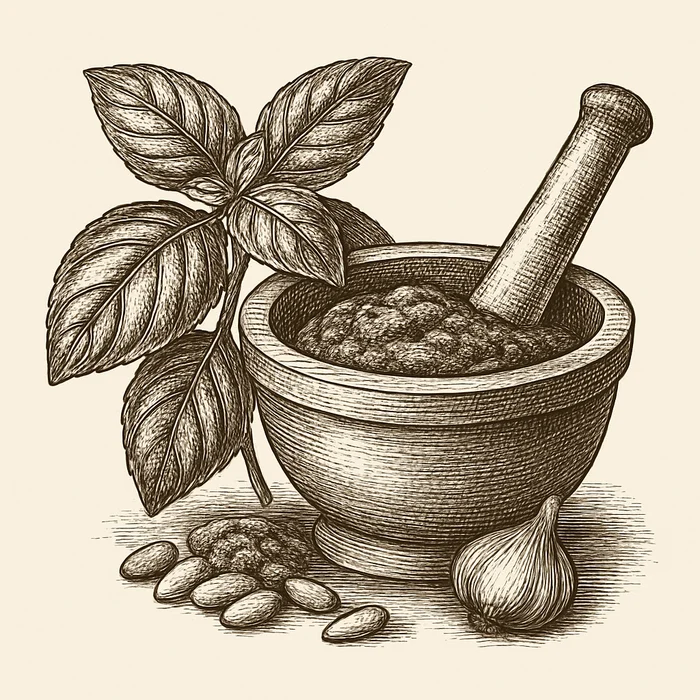
Pesto
Used as a finishing ingredient in Ligurian minestrone and rice dishes. Pesto's primary longevity-relevant components are its extra-virgin olive oil base (oleocanthal, oleic acid), basil (rosmarinic acid, apigenin), garlic (allicin, alliin), and pine nuts (unsaturated fats, vitamin E, alpha-linolenic acid).
Why It Matters for Longevity
Pesto is a concentrated delivery of Mediterranean polyphenols and healthy fats in a traditional culinary form. Its longevity case rests on the evidence base for its components as part of the overall Mediterranean dietary pattern.
The PREDIMED trial — the largest Mediterranean diet RCT — found that a Mediterranean dietary pattern including olive oil, herbs, and plant-based sauces like pesto reduced major cardiovascular events by 28–30% over 4.8 years, establishing the overall Mediterranean pattern as evidence-based for cardiovascular longevity (Estruch et al., 2018, N Engl J Med).
Flavonoids from basil and other culinary herbs — including apigenin and luteolin — are associated with reduced cardiovascular disease mortality in large prospective cohort studies. McCullough et al. (2012) found that higher dietary flavonoid intake was significantly associated with reduced CVD mortality across food sources including herbs, supporting the inclusion of herb-based preparations like pesto in a longevity diet (McCullough et al., 2012, Am J Clin Nutr).
Oleocanthal: Olive Oil's Anti-Inflammatory Compound
Extra-virgin olive oil — the dominant ingredient by weight in most pesto recipes — delivers oleocanthal, a phenolic aldehyde with a mechanism of action remarkably similar to ibuprofen. Beauchamp et al. (2005) identified oleocanthal as a non-selective inhibitor of both cyclooxygenase-1 (COX-1) and COX-2, the prostaglandin-biosynthesis enzymes targeted by NSAIDs. The sensory sting of fresh EVOO at the back of the throat is produced by oleocanthal activating the same oropharyngeal receptor (TRPA1) as ibuprofen — the sensation that led Beauchamp to investigate its pharmacological properties (Beauchamp et al., 2005, Nature). A 50 ml serving of oleocanthal-rich EVOO delivers a dose estimated to correspond to approximately 10% of the adult ibuprofen dose for pain relief, suggesting that daily EVOO consumption contributes meaningful chronic COX inhibition via diet rather than pharmaceutical intervention.
Chronic low-grade inflammation — marked by elevated CRP, IL-6, and prostaglandin E2 — is one of the most robustly supported drivers of biological aging ("inflammaging"). The COX-2 pathway directly generates prostaglandin E2, a key mediator of vascular inflammation and platelet aggregation. Oleocanthal's dietary COX inhibition thus connects to a concrete molecular pathway for longevity benefit.
Garlic's Allicin and Blood Pressure
Garlic in pesto (typically 2–3 crushed cloves per batch) provides allicin, a thiosulfinate compound generated when garlic cells are damaged by crushing or chopping. A meta-analysis of 17 randomized controlled trials found that garlic supplementation reduced systolic blood pressure by 3.75 mmHg (95% CI: −5.04 to −2.45) and diastolic blood pressure by 3.39 mmHg (95% CI: −4.14 to −2.65) versus placebo (Wang et al., 2015, J Clin Hypertens). In hypertensive patients specifically, systolic reduction reached 4.4 mmHg. The mechanism involves allicin's conversion to hydrogen sulfide in vascular tissue, which promotes vasodilation, and inhibition of angiotensin-converting enzyme (ACE) by S-allylcysteine (SAC), reducing vasoconstriction. Every 2–3 mmHg population-level reduction in systolic BP is associated with approximately 10% reduction in stroke risk in epidemiological modeling.
The allicin content of crushed fresh garlic is highest immediately after crushing and decays with heat. Pesto prepared without cooking and stirred in at the end of a dish preserves allicin better than garlic added to a hot pan.
Pine Nuts, ALA, and Cardiovascular Mortality
Pine nuts contribute alpha-linolenic acid (ALA), the short-chain plant omega-3, at roughly 100 mg per tablespoon. A meta-analysis of 41 prospective cohort studies (1,197,564 participants; follow-up 2–32 years) found that each additional 1 g/day of ALA intake was associated with a 5% lower risk of all-cause mortality and CVD mortality; high versus low ALA intake was associated with a relative risk of 0.90 (95% CI: 0.83–0.97) for all-cause mortality and 0.92 (95% CI: 0.86–0.99) for CVD mortality (Naghshi et al., 2021, BMJ). ALA provides substrate for partial conversion to EPA and DHA in humans (conversion rates ~8–20%), and exerts independent anti-inflammatory effects via reduced leukotriene B4 synthesis and platelet aggregation inhibition.
Pine nuts also supply tocopherols (vitamin E), which protect the EVOO fatty acids in pesto from oxidation during storage and, at a biological level, protect LDL particles and cell membrane phospholipids from peroxidation — a key mechanism in atherosclerosis.
Basil's Rosmarinic Acid: Pharmacokinetics and NF-κB Inhibition
Rosmarinic acid, the dominant polyphenol in sweet basil (Ocimum basilicum), is absorbed orally after metabolism by gut microflora, with renal excretion as the primary elimination route. A pharmacokinetic review confirmed peroral bioavailability and documented clinical studies showing benefits in allergic, dermatological, and osteoarthritic conditions without serious adverse effects (Hitl et al., 2021, Planta Med). Mechanistically, rosmarinic acid inhibits IκB-α phosphorylation, blocking NF-κB nuclear translocation and downstream transcription of pro-inflammatory cytokines (IL-1β, TNF-α, IL-6). It also activates Nrf2/HO-1 signaling, increasing cellular antioxidant defenses. Basil provides approximately 100–300 mg of rosmarinic acid per 100 g fresh weight, and pesto concentrates basil relative to its typical fresh use in salads or garnishes.
How to Use It
Use as a finishing ingredient: 1–2 tablespoons stirred into Ligurian minestrone at the end of cooking (traditional), tossed with whole-grain pasta, or spooned over roasted vegetables. The olive oil matrix in pesto protects the basil polyphenols from oxidation during brief heat exposure. Avoid cooking pesto at high temperatures for prolonged periods — both allicin and rosmarinic acid degrade with sustained heat.
What to Pair It With
| Ingredient | Why | Tradition |
|---|---|---|
| Minestrone | Traditional Ligurian finishing; polyphenol depth from olive oil + herbs | Ligurian |
| Whole-grain pasta | Olive oil in pesto slows starch digestion; polyphenols add anti-inflammatory benefit | Italian |
| Grilled fish | Basil rosmarinic acid and fish omega-3s reduce oxidative stress via complementary mechanisms | Italian |
| White beans | Classic pasta al pesto e fagioli; legume protein + herb polyphenols | Ligurian |
Flavor Profile
Herbaceous, savory, garlicky, slightly bitter, and rich. Aroma is fresh basil with garlic and pine nut. Texture is smooth paste, slightly grainy from nuts. Category: Italian herb sauce / condiment.
The Science
- Estruch et al., 2018, N Engl J Med: PREDIMED trial — Mediterranean dietary pattern including olive oil and herb-based preparations reduced major cardiovascular events by 28–30% versus low-fat control diet.
- McCullough et al., 2012, Am J Clin Nutr: Prospective cohort study — higher dietary flavonoid intake (including from herbs like basil) significantly associated with reduced cardiovascular disease mortality.
- Beauchamp et al., 2005, Nature: Identified oleocanthal in EVOO as a non-selective COX-1/COX-2 inhibitor with ibuprofen-like anti-inflammatory potency and pharmacological profile.
- Wang et al., 2015, J Clin Hypertens: Meta-analysis of 17 RCTs — garlic supplementation reduced systolic BP by 3.75 mmHg and diastolic BP by 3.39 mmHg versus placebo; allicin/hydrogen sulfide and ACE inhibition as mechanism.
- Naghshi et al., 2021, BMJ: Meta-analysis of 41 cohort studies (1.2M participants) — each 1 g/day ALA increment associated with 5% lower CVD mortality; high vs. low ALA intake RR=0.92 for CVD mortality.
- Hitl et al., 2021, Planta Med: Review of rosmarinic acid pharmacokinetics in humans — oral bioavailability confirmed, NF-κB/IκB-α inhibition and Nrf2/HO-1 activation as primary anti-inflammatory mechanisms.
References
- Estruch R, Ros E, Salas-Salvadó J, et al. Primary prevention of cardiovascular disease with a Mediterranean diet supplemented with extra-virgin olive oil or nuts. N Engl J Med. 2018;378(25):e34. PMID: 29897866. doi:10.1056/NEJMoa1800389
- McCullough ML, Peterson JJ, Patel R, et al. Flavonoid intake and cardiovascular disease mortality in a prospective cohort of US adults. Am J Clin Nutr. 2012;95(2):454-464. PMID: 22218162. doi:10.3945/ajcn.111.016634
- Beauchamp GK, Keast RSJ, Morel D, et al. Phytochemistry: ibuprofen-like activity in extra-virgin olive oil. Nature. 2005;437(7055):45-46. PMID: 16136122. doi:10.1038/437045a
- Wang HP, Yang J, Qin LQ, Yang XJ. Effect of garlic on blood pressure: a meta-analysis. J Clin Hypertens (Greenwich). 2015;17(3):223-231. PMID: 25557383.
- Naghshi S, Aune D, Beyene J, et al. Dietary intake and biomarkers of alpha linolenic acid and risk of all cause, cardiovascular, and cancer mortality: systematic review and dose-response meta-analysis of cohort studies. BMJ. 2021;375:n2213. PMID: 34645650.
- Hitl M, Kladar N, Gavarić N, Božin B. Rosmarinic acid — human pharmacokinetics and health benefits. Planta Med. 2021;87(4):273-282. PMID: 33285594.
Key Nutrients
| Nutrient | Per 100g | Notes |
|---|---|---|
| Rosmarinic acid (from basil) | ~100–300 mg | Well-absorbed polyphenol; inhibits IκB-α phosphorylation, blocking NF-κB; activates Nrf2/HO-1 antioxidant defense |
| Allicin (from garlic) | Variable | Formed when garlic is crushed; generates H2S in vascular tissue for vasodilation; inhibits ACE via S-allylcysteine |
| Oleic acid (from olive oil) | ~30–40 g | Dominant fatty acid in pesto; anti-inflammatory, improves fat-soluble phytonutrient absorption |
| Oleocanthal (from olive oil) | ~50–200 mg | Phenolic aldehyde; dual COX-1/COX-2 inhibitor with ibuprofen-like mechanism; content varies with olive variety and harvest time |
| Alpha-linolenic acid (from pine nuts) | ~0.5–1 g | Plant omega-3; each 1 g/day increment associated with 5% lower CVD mortality in meta-analysis; anti-inflammatory via reduced leukotriene synthesis |