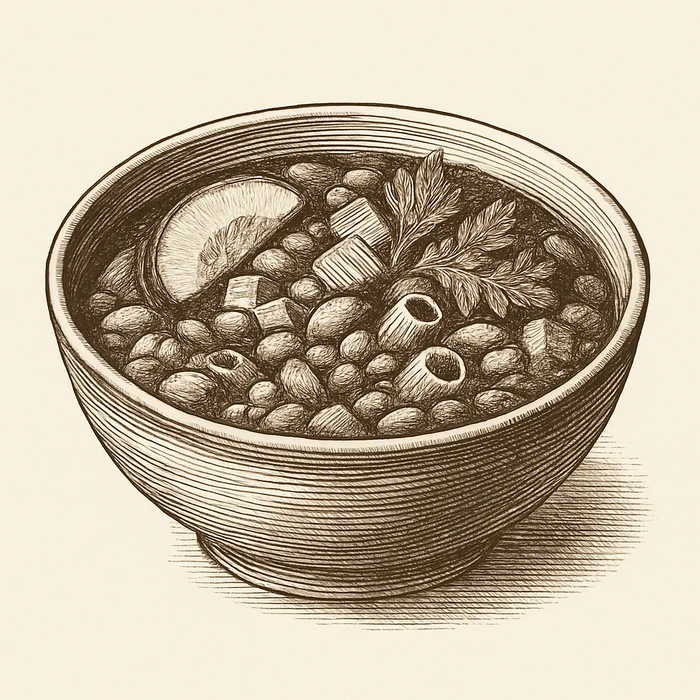
Minestrone
Minestrone was a major part of Emma Morano's earlier diet. The traditional Italian vegetable-legume soup represents one of the most complete expressions of the Mediterranean dietary pattern in a single dish.
Why It Matters for Longevity
Minestrone combines vegetables, legumes, whole grain pasta or barley, and extra-virgin olive oil in proportions that mirror the protective Mediterranean dietary pattern associated with longevity in Italian centenarian populations. It delivers dietary fiber, polyphenols, plant protein, vitamins, and minerals within a low-glycemic, high-satiety format.
The landmark PREDIMED randomized controlled trial demonstrated that a Mediterranean dietary pattern rich in vegetables, legumes, and olive oil -- the core components of minestrone -- reduced major cardiovascular events by approximately 30% compared to a low-fat control diet, with total cardiovascular mortality significantly reduced (Estruch et al., 2018, N Engl J Med).
Across 95 prospective studies, vegetable intake including the diverse plant foods in minestrone was inversely associated with all-cause mortality, cardiovascular disease, and cancer in a dose-dependent relationship; the soup format concentrates water-soluble polyphenols from vegetables in the broth, which should be consumed for maximum benefit (Aune et al., 2017, Int J Epidemiol).
Legumes: The Mortality Signal
The bean and lentil content of minestrone is the ingredient class with the clearest longevity signal in large cohort data. A systematic review and dose-response meta-analysis of 32 cohorts encompassing 1,141,793 participants and 93,373 deaths found that comparing highest versus lowest legume intake categories produced a hazard ratio of 0.94 (95% CI 0.91–0.98) for all-cause mortality. Expressed as a dose-response, each 50 g/day increase in legume intake was associated with a 6% reduction in all-cause mortality (HR 0.94; 95% CI 0.89–0.99). Stroke mortality was specifically reduced (HR 0.91; 95% CI 0.84–0.99). The evidence was rated low-to-moderate certainty, reflecting confounding limitations in cohort data (Zargarzadeh et al., 2023, Adv Nutr). A typical serving of minestrone delivers 80–120 g of cooked beans or lentils, meeting or exceeding the dose associated with the observed survival signal.
The mechanism for this association involves multiple pathways: soluble fiber from legumes (predominantly pectin and resistant starch) feeds butyrate-producing bacteria in the colon, raising luminal butyrate concentrations. Butyrate acts as a histone deacetylase inhibitor, reducing expression of pro-inflammatory genes in colonocytes and systemically. Legume protein is rich in arginine and lysine, with a different amino acid profile from animal protein, supporting evidence that plant protein substitution reduces cardiovascular risk. Legumes also deliver phytosterols that competitively inhibit cholesterol absorption at intestinal brush-border transporters.
Postprandial Glucose and Short-Chain Fatty Acids
A diet resembling the Mediterranean pattern reduces postprandial glucose acutely and strengthens that effect after eight weeks of adherence. An 8-week RCT (n=29) comparing a Mediterranean-style diet to a control diet found that glucose and insulin responses to a test meal were significantly lower in the Mediterranean group at baseline (p < 0.05) and improved further after the intervention period. Postprandial butyric acid area under the curve rose significantly in the Mediterranean group (p = 0.019), and gut microbiota shifted toward increased relative abundance of butyrate-producing genera including Intestinimonas butyriciproducens and Akkermansia muciniphila. Butyrate correlated inversely with plasma insulin (r = −0.411, p = 0.046) and directly with insulin sensitivity (r = 0.397, p = 0.050), pointing to the gut microbiome as a key mediating pathway (Vitale et al., 2021, Clin Nutr). Minestrone with beans and whole-grain pasta delivers precisely the mixed soluble fiber, vegetable polyphenols, and olive oil fat that constitute this dietary pattern.
Vegetable Diversity and the Soup Format
Minestrone's claim to represent a complete Mediterranean meal rests partly on the density of distinct plant foods it can contain in one bowl: tomatoes, carrots, celery, zucchini, spinach, onion, garlic, beans, lentils, and whole-grain pasta can all appear together. Each vegetable family contributes distinct polyphenol classes -- hydroxycinnamic acids from tomatoes, flavonols from onions, glucosinolates from cabbage, carotenoids from carrots -- that interact with different receptor and enzyme systems. The aqueous cooking medium extracts water-soluble polyphenols from the vegetables into the broth; consuming the broth is therefore critical, not incidental, to realizing the full polyphenol content.
Tomatoes supply lycopene, which becomes substantially more bioavailable when cooked in oil -- a state that minestrone's olive oil and cooking process naturally achieves. The heat breaks down the tomato cell wall, releasing lycopene from chromoplasts, and the oil facilitates micellar incorporation in the gut. Lycopene in adipose tissue has been inversely associated with myocardial infarction risk in European cohort data.
Whole Grains and Glycemic Modulation
When barley or whole-grain pasta replaces white pasta in minestrone, the beta-glucan content of barley or the retained bran of whole-grain pasta adds a layer of glycemic modulation. The soluble fiber increases intestinal viscosity, slowing both gastric emptying and the rate at which digestive enzymes access starch, producing a flatter postprandial glucose curve. Combined with the legume fiber, the total fiber load of a typical serving (8–12 g) positions minestrone in the glycemic response range associated with reduced postprandial insulin demand -- a feature relevant to long-term metabolic health.
How to Use It
Pairs with pesto (stirred in at the end for maximum aromatic benefit), Parmesan rind (adds umami to the broth), and whole-grain bread. Use seasonal vegetables. Consume the broth — water-soluble polyphenols from vegetables are concentrated in it. Olive oil drizzled at the end provides fat-soluble vitamin enhancement and oleocanthal anti-inflammatory benefit. Use whole-grain pasta or barley rather than white pasta to maximize fiber and glycemic benefit.
What to Pair It With
| Ingredient | Why | Tradition |
|---|---|---|
| Pesto | Basil and garlic add allicin and rosmarinic acid, extending the soup's anti-inflammatory profile | Italian |
| Parmesan rind | Adds umami depth and trace calcium to the broth | Italian |
| Whole-grain bread | Fiber moderates glycemic response of the meal | Traditional |
Flavor Profile
Savory, umami, slightly sweet from vegetables. Aroma is herbaceous, tomato, and basil. Texture is brothy and chunky with varied vegetable textures. Quality increases significantly with homemade broth, fresh vegetables, and a final olive oil drizzle.
The Science
- Estruch et al., 2018, N Engl J Med: PREDIMED trial -- Mediterranean dietary pattern (vegetables, legumes, olive oil, the core of minestrone) reduced major cardiovascular events by ~30% vs low-fat control diet.
- Aune et al., 2017, Int J Epidemiol: Meta-analysis of 95 prospective studies -- vegetable intake dose-dependently associated with reduced all-cause mortality, cardiovascular disease, and cancer.
- Zargarzadeh et al., 2023, Adv Nutr: Dose-response meta-analysis (32 cohorts, n=1,141,793) -- per 50g/day legume intake: 6% lower all-cause mortality (HR 0.94; 95% CI 0.89–0.99); stroke mortality HR 0.91 (95% CI 0.84–0.99).
- Vitale et al., 2021, Clin Nutr: 8-week RCT (n=29) -- Mediterranean diet reduced postprandial glucose and insulin (p < 0.05); postprandial butyrate area under curve increased (p = 0.019); butyrate correlated inversely with plasma insulin (r = −0.411, p = 0.046).
References
- Estruch R, Ros E, Salas-Salvadó J, et al. Primary prevention of cardiovascular disease with a Mediterranean diet supplemented with extra-virgin olive oil or nuts. N Engl J Med. 2018;378(25):e34. PMID: 29897866. doi:10.1056/NEJMoa1800389
- Aune D, Giovannucci E, Boffetta P, et al. Fruit and vegetable intake and the risk of cardiovascular disease, total cancer and all-cause mortality -- a systematic review and dose-response meta-analysis of prospective studies. Int J Epidemiol. 2017;46(3):1029-1056. PMID: 28338764. doi:10.1093/ije/dyw319
- Zargarzadeh N, Mousavi SM, Santos HO, Aune D, Hasani-Ranjbar S, Larijani B, Esmaillzadeh A. Legume Consumption and Risk of All-Cause and Cause-Specific Mortality: A Systematic Review and Dose-Response Meta-Analysis of Prospective Studies. Adv Nutr. 2023;14(1):64-76. PMID: 36811595.
- Vitale M, Giacco R, Laiola M, et al. Acute and chronic improvement in postprandial glucose metabolism by a diet resembling the traditional Mediterranean dietary pattern: Can SCFAs play a role? Clin Nutr. 2021;40(2):428-437. PMID: 32698959.
Key Nutrients
| Nutrient | Per 100g | Notes |
|---|---|---|
| Dietary fiber (from legumes + vegetables) | ~2-3g | Mixed soluble/insoluble fiber; soluble fraction from beans feeds butyrate-producing microbiota; butyrate inversely correlates with plasma insulin |
| Lycopene (from tomatoes) | ~1-3mg | Bioavailability enhanced by cooking and presence of olive oil; associated with reduced myocardial infarction risk |
| Polyphenols (from diverse vegetables) | variable | Aqueous cooking matrix extracts water-soluble polyphenols; consume the broth to capture them |
| Plant protein (from legumes) | ~3-5g per serving | Arginine- and lysine-rich; different amino acid profile from animal protein supports cardiovascular benefit of substitution |