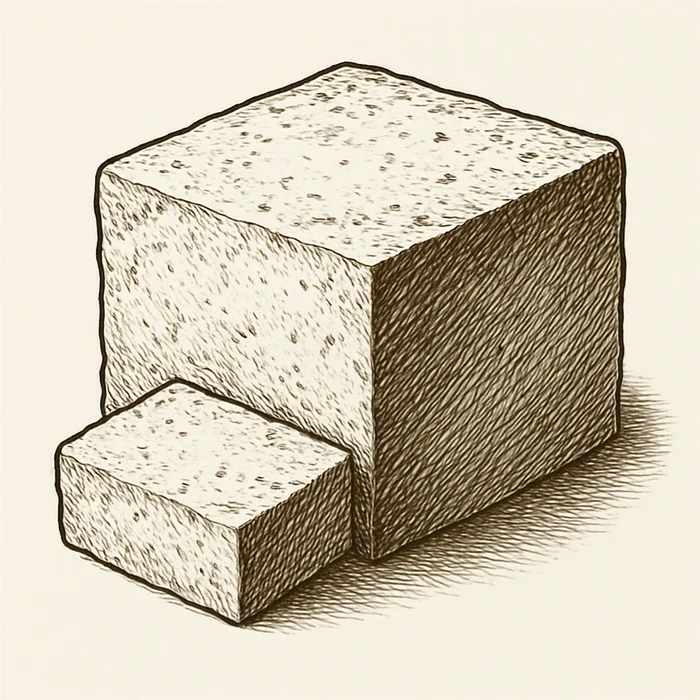
Tofu (Calcium Sulphate Set)
Calcium-sulphate-set tofu delivers 350-680 mg calcium per 100g with 31% bioavailability -- matching dairy at 32% and solving the biggest nutritional gap in plant-based diets.
Why It Matters for Longevity
Calcium inadequacy is the primary bone-health concern for people reducing or eliminating dairy. Tofu made with calcium sulphate coagulant closes this gap effectively: 100g provides as much bioavailable calcium as a glass of milk. The coagulant type matters enormously -- nigari (magnesium chloride) set tofu contains only 100-200 mg calcium per 100g, roughly a third of the calcium sulphate version. Check the label.
Protein Quality: Complete but Not Identical to Animal Protein
Soy is one of the few plant proteins that qualifies as nutritionally complete. It contains all nine essential amino acids in proportions sufficient to meet adult requirements -- something almost no other plant food can claim. This is measured formally by the Digestible Indispensable Amino Acid Score (DIAAS), which replaced the older PDCAAS standard because it accounts for actual digestibility in the small intestine rather than just amino acid composition. Soy protein isolate scores around 0.90-1.0 on the DIAAS scale, placing it in the same tier as eggs and dairy and well above most other plant proteins (lentils score around 0.59, wheat gluten around 0.45).
Whole tofu scores slightly lower than isolate because the food matrix reduces digestibility modestly. At 100g of firm tofu -- roughly a half-block -- you get 10-15g of this complete protein at 91 calories, one of the most efficient protein-to-calorie ratios available in plant foods. For older adults eating lower overall calories, this efficiency matters.
Cardiovascular Effects: What the RCT Data Shows
The best evidence on soy and cardiovascular risk comes from a 2019 meta-analysis of 46 RCTs assembled from FDA-identified studies. At a median dose of 25g/day of soy protein over a median 6-week follow-up, LDL cholesterol fell by 4.76 mg/dL (approximately 3-4%) and total cholesterol by 6.41 mg/dL, both statistically significant (p < 0.0001). About 75% of individual trials showed LDL reductions, suggesting a consistent rather than outlier-driven effect. The mechanism is not isoflavones alone -- soy peptides generated during digestion appear to upregulate LDL receptors in the liver, increasing clearance from circulation (Blanco Mejia et al., 2019, Journal of Nutrition).
At the population level, a prospective study of 210,000+ U.S. health professionals found one or more servings of tofu per week associated with an 18% lower coronary heart disease risk (Ma et al., Circulation 2020). The association was particularly pronounced in postmenopausal women not on hormone therapy, suggesting that isoflavones may partly substitute for the cardioprotective effects of endogenous estrogen -- a plausible mechanism given that both act via estrogen receptor beta in vascular endothelium.
Mortality Data from Japanese Cohorts
Japan provides a natural long-term experiment: soy has been a dietary staple there for centuries, eaten as whole food from childhood. A landmark 2020 prospective cohort study of 92,915 Japanese adults aged 45-74, followed for nearly 15 years (1,380,000 person-years of follow-up), found that total soy product intake was not significantly associated with all-cause mortality on its own (HR 0.98 in men, similar in women). However, fermented soy products showed a meaningful inverse association with mortality in both sexes (Katagiri et al., 2020, BMJ). The authors caution that residual confounding cannot be excluded -- people who eat more soy in Japan tend to follow healthier dietary patterns overall.
Zooming out to a dose-response meta-analysis of 23 prospective cohort studies covering 330,826 participants: the highest category of dietary soy isoflavone intake was associated with 10% lower all-cause mortality, 12% lower cardiovascular mortality, and a 7% lower cancer mortality risk per 10 mg/day increase in isoflavone intake (Nachvak et al., 2019, Journal of the Academy of Nutrition and Dietetics). These are observational associations, not causal proof -- but they are directionally consistent across independent populations.
The Isoflavone Question
Soy's most contested feature is its isoflavone content. Genistein and daidzein -- the two main isoflavones in soy -- are phytoestrogens: plant-derived compounds that bind estrogen receptors and produce weak estrogenic and anti-estrogenic effects depending on tissue type, receptor subtype, and circulating estrogen levels. This has generated decades of concern that soy consumption might promote hormone-sensitive cancers, particularly breast cancer.
The concern originates from cell culture and rodent studies showing that high-dose genistein can stimulate estrogen-receptor-positive cancer cell lines in vitro. But rodents metabolize isoflavones differently from humans, and the doses used in many animal studies vastly exceed dietary exposures. The translation to human outcomes has been tested directly -- and the direction of the evidence is the opposite of the concern.
A 2022 meta-analysis of prospective studies found an inverse correlation between isoflavone intake and breast cancer occurrence in both pre- and postmenopausal women (Boutas et al., 2022, In Vivo). An updated systematic review and meta-analysis of 30 studies on prostate cancer found total soy food intake significantly associated with reduced prostate cancer risk (p < 0.001), with genistein and daidzein individually each showing significant protective associations (Applegate et al., 2018, Nutrients). The dose-response meta-analysis by Nachvak et al. found each 10 mg/day increase in isoflavone intake associated with 9% lower breast cancer mortality.
Why does the population evidence diverge from the in-vitro signal? Several mechanisms are proposed. First, isoflavones bind preferentially to estrogen receptor beta (ERb) rather than alpha (ERa); ERb activation tends to be anti-proliferative, whereas ERa drives cell growth. Second, the metabolite equol -- produced from daidzein by intestinal bacteria in roughly 30-50% of people who eat soy regularly -- has a distinct receptor-binding profile that may account for much of the protective effect in frequent consumers. Third, the dose matters: pharmacological doses from supplements are not equivalent to food-matrix doses from tofu, tempeh, or edamame.
The practical implication: whole-food soy consumed in dietary amounts -- a few servings per week, as in traditional Asian diets -- has not been shown to increase cancer risk in any population study and shows consistent neutral-to-protective associations. Isolated soy supplements taken in large doses represent a different exposure and should not be conflated with food. For breast cancer survivors specifically, current evidence does not support avoiding soy foods, and some guidelines now explicitly state this based on survival data.
One real concern that does stand up: high-dose soy isoflavone supplements may interact with thyroid function in people with existing hypothyroidism by interfering with levothyroxine absorption. This is a supplement issue, not a food issue at normal dietary intake.
Muscle Preservation in Aging
The adequacy of soy protein for preserving muscle in older adults -- the population where this matters most -- has been tested directly. A 2024 randomized clinical trial enrolled 84 adults with a mean age of nearly 85 years in long-term care facilities. The intervention group consumed three daily meals containing 10g of soy protein each (30g/day total) for 12 weeks; controls continued their usual diet. The intervention group gained approximately 1.43 kg of soft lean mass and 1.20 kg of skeletal muscle mass, while calf circumference decreased in the control group but was preserved in the treatment group. Walking performance at 6 meters also differed meaningfully between groups (Yuan et al., 2024, Nutrition).
This does not mean soy protein is equivalent to whey for maximally stimulating acute muscle protein synthesis. It is not: whey's higher leucine content and faster digestion produce a larger anabolic response per gram in controlled studies. But the relevant question for longevity is not peak synthesis response -- it is whether regular soy protein consumption, as part of a whole-food diet, can slow the muscle loss (sarcopenia) that accelerates frailty and disability with age. The clinical trial evidence says yes, at least in institutionalized elderly.
The Longevity Diet developed by Valter Longo specifically includes tofu as a plant protein source, partly on these grounds: it contributes complete protein, limits the IGF-1 stimulation associated with high animal protein intake, and fits a dietary pattern associated with longevity in the longest-lived populations.
How to Use It
Grill thin slices for crispy texture. Add cubes to soups in the last 10-15 minutes. Press firm tofu to remove water before stir-frying. Freeze and thaw to create a chewier, more absorbent texture. Always choose calcium-sulphate-set varieties for bone health.
What to Pair It With
| Ingredient | Why | Tradition |
|---|---|---|
| Dark leafy greens | Dual calcium sources; vitamin K supports bone metabolism | East Asian / Global |
| Ginger | Classic aromatic; anti-inflammatory complement | East Asian |
| Mushrooms | Combined umami; sun-exposed mushrooms add vitamin D for calcium absorption | East Asian |
| Sesame oil | Complementary plant fats; traditional finishing oil | East Asian |
| Chilli pepper | Classic heat + neutral tofu contrast (mapo tofu) | Sichuan / Korean |
Flavor Profile
Deliberately neutral with a mild beany sweetness. This is a feature, not a flaw -- tofu absorbs surrounding flavors completely. Texture varies from silky and custard-like (silken) to firm and sliceable (pressed). Freezing then thawing creates a spongy, chewy texture that holds sauces. Pan-frying develops a crispy golden exterior with creamy interior.
The Science
- 210,000+ participants: 1+ serving/week tofu = 18% lower CHD risk (Ma et al., Circulation 2020)
- Calcium bioavailability of CaSO4-set tofu: ~31%, comparable to dairy at 32% (Weaver et al., 2019)
- 46 RCTs: soy protein 25g/day reduces LDL by 4.76 mg/dL (~3-4%) (Blanco Mejia et al., 2019, J Nutr)
- 330,826 participants: highest isoflavone intake = 10% lower all-cause mortality (Nachvak et al., 2019, J Acad Nutr Diet)
- Prospective meta-analysis: soy isoflavones inversely correlated with breast cancer in pre- and post-menopausal women (Boutas et al., 2022, In Vivo)
- 30-study meta-analysis: soy food intake associated with reduced prostate cancer risk (Applegate et al., 2018, Nutrients)
- 12-week RCT (mean age 85): 30g/day soy protein preserved muscle mass, improved lean body composition (Yuan et al., 2024, Nutrition)
- Isoflavones support bone density and cardiovascular function via estrogen receptor beta modulation
- 100g tofu: 10-15g complete protein, 91 calories -- excellent nutrient-to-calorie ratio
- DIAAS ~0.90-1.0 for soy protein isolate; one of the highest scores among plant proteins
Key Nutrients
| Nutrient | Per 100g | Notes |
|---|---|---|
| Calcium | 350-680 mg (CaSO4 set) | 31% bioavailability, matching dairy; nigari set has far less |
| Isoflavones | 20-50 mg | Pharmacologically active; supports equol-producing gut bacteria |
| Protein | 8-15 g | Complete protein (DIAAS ~0.90+); firm varieties have more than silken |