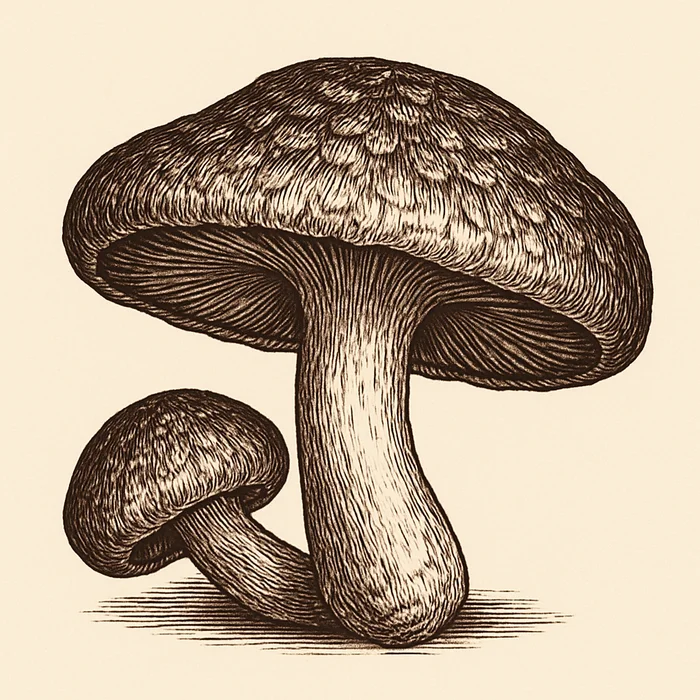
Shiitake
Shiitake mushrooms are used across multiple Longevity Diet dishes and provide 41 IU of vitamin D per cup cooked. Mushrooms synthesize vitamin D upon UV light exposure, making them a significant dietary vitamin D source for those limiting animal products.
Why It Matters for Longevity
Shiitake's longevity case runs on multiple tracks: immune modulation, vitamin D synthesis, cholesterol reduction, and a relatively unusual dietary source of ergothioneine — a compound now being studied as a candidate micronutrient for healthy aging.
Dai et al. (2015) ran a 4-week randomized intervention in healthy young adults eating 5–10 g dried shiitake daily. The result: 60% more γδ-T cell proliferation, 2-fold more NK-T cell proliferation, increased secretory IgA (gut immunity), and reduced C-reactive protein. These are measurable immunological improvements from a food, not a supplement.
The mechanism behind shiitake's immune effects is well-characterized: its beta-glucan (lentinan) activates macrophages and NK cells, enhances tumor surveillance, and modulates Th1/Th2 balance. Wasser's 2002 review of medicinal mushrooms established lentinan as the most clinically documented of the immunostimulating fungal polysaccharides, with its antitumor effects operating through T-cell-mediated host immune mechanisms.
Eritadenine — a compound unique to shiitake — reduces LDL cholesterol by modifying hepatic phospholipid metabolism. This mechanism is distinct from statins and acts at dietary doses.
Vitamin D2: UV Exposure and Bioavailability
Standard commercially-grown shiitake delivers modest vitamin D2 levels — around 18 IU per 100 g cooked — because it is grown in controlled light conditions. Brief UV-B exposure dramatically changes this. After UV-B irradiation at 25 kJ/m², the vitamin D2 concentration in the gill portions of shiitake mushroom reaches 68–106 μg per gram dry weight, compared to negligible amounts in unexposed mushrooms. Simply placing fresh shiitake gills-up in direct sunlight for 15–60 minutes replicates this effect at home.
The D2 produced in UV-exposed mushrooms is bioavailable at a level comparable to vitamin D2 supplements. A randomized controlled trial in 26 vitamin D-deficient healthy adults assigned to either UV-B-irradiated button mushrooms or a vitamin D2 supplement (both at 28,000 IU/week) found that serum 25(OH)D concentrations rose similarly in both groups — approximately 3.9 nmol/L per week in the mushroom group versus 4.7 nmol/L in the supplement group, with no statistically significant difference between the two (Urbain et al., 2011, Eur J Clin Nutr). This was the first human trial to demonstrate that UV-irradiated mushrooms are not merely a source of vitamin D2 in the sense of containing it, but are effective at raising serum 25(OH)D to the same degree as supplemental D2.
Vitamin D2 from mushrooms is somewhat less potent than D3 at raising serum 25(OH)D at equivalent doses — D3 is the form synthesized in human skin and the preferred supplement form — but the gap narrows with regular, daily consumption rather than bolus dosing. For those following plant-exclusive diets, UV-treated shiitake provides a food-form source that is otherwise largely absent from plant foods.
Ergothioneine and Healthy Aging
Ergothioneine is a sulfur-containing amino acid and thiol antioxidant that fungi synthesize and that animals — including humans — acquire exclusively from diet. The transporter responsible for cellular uptake (OCTN1, encoded by SLC22A4) is expressed in especially high density in tissues subject to oxidative stress: liver, kidney, bone marrow, and the lens of the eye. Mushrooms, and shiitake in particular, are by far the richest dietary source.
What makes ergothioneine relevant to longevity research is converging evidence from cohort data. In a prospective Swedish cohort of 3,236 participants followed for a median of 21.4 years, higher plasma ergothioneine levels were associated with significantly lower risk of coronary disease, cardiovascular mortality, and all-cause mortality. Blood ergothioneine levels decline measurably after age 60, and lower levels correlate with accelerated cognitive decline in elderly populations attending memory clinics. A review examining ergothioneine's mechanistic role concluded it functions as a cellular antioxidant and cytoprotectant — scavenging reactive oxygen and nitrogen species, regulating the Nrf2 pathway, and contributing to mitochondrial integrity — and proposed it warrants classification as a conditionally essential micronutrient for healthy aging (Tian et al., 2023, Br J Nutr).
The practical implication: regularly consuming shiitake and other culinary mushrooms is currently the primary way to maintain dietary ergothioneine intake, given that plant foods contain only trace amounts transferred through soil fungi.
Lentinan, Immunity, and Microbiota
Lentinan — shiitake's 1,3/1,6-beta-glucan — interacts with pattern recognition receptors on intestinal immune cells (Dectin-1, TLR2, TLR4) in Peyer's patches, triggering macrophage activation and downstream NK cell stimulation without inducing excessive inflammation. Unlike many immune activators, it does not drive a cytokine storm at dietary doses; instead it resets the balance between Th1 and Th2 arms of adaptive immunity toward a more alert, surveillance-ready state.
A clinical trial examining the effects of shiitake-derived beta-D-glucan in 52 adults with mild hypercholesterolemia over 8 weeks found that the treatment significantly shifted gut microbiota composition in a manner different from placebo, with specific genera showing correlations to cholesterol metabolism biomarkers — suggesting the immune-modulating effects of shiitake beta-glucan may be partially mediated through microbiome modulation rather than direct systemic immune stimulation (Morales et al., 2021, Eur J Nutr).
How to Use It
Pairs well with garlic, ginger, soy sauce. Sauté in olive oil or use in soups, stir-fries, and grain bowls. For maximum vitamin D, expose shiitake gills to direct sunlight for 15–60 minutes before cooking — this raises vitamin D2 content dramatically. Store dried shiitake gill-side up in sunlight.
What to Pair It With
| Ingredient | Why | Tradition |
|---|---|---|
| garlic | See synergies | General culinary |
| ginger | See synergies | General culinary |
| soy sauce | See synergies | General culinary |
| whole grain noodles | See synergies | General culinary |
| extra-virgin olive oil | See synergies | General culinary |
| spinach | See synergies | General culinary |
Synergies
- Garlic (synergy): Shiitake beta-glucans and garlic allicin both enhance NK cell activity and macrophage function via distinct immune receptors — complementary immunostimulatory longevity effects.
- Spinach (complement): Shiitake's vitamin D promotes calcium absorption and immune regulation while spinach provides iron and folate; together they address multiple micronutrient gaps common in plant-forward longevity diets.
Flavor Profile
Taste: umami-rich, earthy, smoky, savory, slightly woody. Aroma: woodsy, earthy, meaty, mushroomy. Texture: chewy, meaty, dense cap, silky when cooked. Category: culinary mushroom.
The Science
- Dai et al., 2015, J Am Coll Nutr: 4-week RCT in healthy adults: daily shiitake consumption improved γδ-T cell proliferation (+60%), NK-T cell proliferation (2x), secretory IgA, and reduced CRP.
- Wasser, 2002, Appl Microbiol Biotechnol: Review establishing lentinan (shiitake beta-glucan) as a clinically documented immunostimulating polysaccharide activating macrophages, NK cells, and tumor-surveillance mechanisms.
- Sugiyama et al., 1995, J Nutr: Eritadenine's hypocholesterolemic action is mediated through modification of hepatic phospholipid metabolism, reducing LDL cholesterol.
- Urbain et al., 2011, Eur J Clin Nutr: RCT in 26 vitamin D-deficient adults — UV-irradiated mushrooms raised serum 25(OH)D at ~3.9 nmol/L per week, statistically equivalent to a vitamin D2 supplement at the same dose (28,000 IU/week).
- Morales et al., 2021, Eur J Nutr: 8-week RCT in 52 adults — shiitake beta-D-glucan shifted gut microbiota composition differently from placebo, with specific genera correlating to cholesterol metabolism biomarkers.
- Tian et al., 2023, Br J Nutr: Review — ergothioneine (primary source: mushrooms) functions as cellular antioxidant via Nrf2 pathway; declining plasma levels after age 60 associated with cardiovascular mortality and cognitive decline; proposed as conditionally essential micronutrient for healthy aging.
References
- Dai X, Stanilka JM, Rowe CA, et al. Consuming Lentinula edodes (Shiitake) Mushrooms Daily Improves Human Immunity: A Randomized Dietary Intervention in Healthy Young Adults. J Am Coll Nutr. 2015;34(6):478-87. PMID: 25866155. doi:10.1080/07315724.2014.950391
- Wasser SP. Medicinal mushrooms as a source of antitumor and immunomodulating polysaccharides. Appl Microbiol Biotechnol. 2002;60(3):258-74. PMID: 12436306. doi:10.1007/s00253-002-1076-7
- Sugiyama K, Akachi T, Yamakawa A. Hypocholesterolemic action of eritadenine is mediated by a modification of hepatic phospholipid metabolism in rats. J Nutr. 1995;125(8):2134-44. PMID: 7643248. doi:10.1093/jn/125.8.2134
- Urbain P, Singler F, Ihorst G, Biesalski HK, Bertz H. Bioavailability of vitamin D₂ from UV-B-irradiated button mushrooms in healthy adults deficient in serum 25-hydroxyvitamin D: a randomized controlled trial. Eur J Clin Nutr. 2011;65(8):965-71. PMID: 21540874. doi:10.1038/ejcn.2011.53
- Morales D, Shetty SA, López-Plaza B, et al. Modulation of human intestinal microbiota in a clinical trial by consumption of a β-D-glucan-enriched extract obtained from Lentinula edodes. Eur J Nutr. 2021;60(6):3249-3265. PMID: 33580297. doi:10.1007/s00394-021-02514-6
- Tian X, Thorne JL, Moore JB. Ergothioneine: an underrecognised dietary micronutrient required for healthy ageing? Br J Nutr. 2023;132(3):273-284. PMID: 38018890. doi:10.1017/S0007114523002131
Key Nutrients
| Nutrient | Per 100g | Notes |
|---|---|---|
| Vitamin D2 (ergocalciferol) | ~18 IU (cooked, standard); up to 46,000 IU if UV-treated | UV-exposed shiitake raises serum 25(OH)D as effectively as an equivalent-dose vitamin D2 supplement in human RCT; D2 may be slightly less potent than D3 at equivalent doses but effective with daily intake |
| Beta-glucan (lentinan) | ~2–3 g | Lentinan is a 1,3/1,6-beta-glucan with high immunostimulatory potency; partially resistant to digestion allowing interaction with intestinal immune cells (Peyer's patches); shifts gut microbiota composition in RCTs |
| Eritadenine | ~0.1 mg | Unique shiitake compound that modifies phospholipid metabolism and reduces LDL cholesterol; bioavailable orally with activity demonstrated at dietary doses. |
| Ergothioneine | ~5 mg (dried) | Thiol antioxidant; accumulated via OCTN1 transporter in oxidatively stressed tissues; plasma levels decline after age 60; inversely associated with cardiovascular mortality and cognitive decline in prospective cohorts |
| Selenium | ~5.7 mcg (cooked) | Organic selenomethionine form; contributes to antioxidant enzyme cofactor pool. |