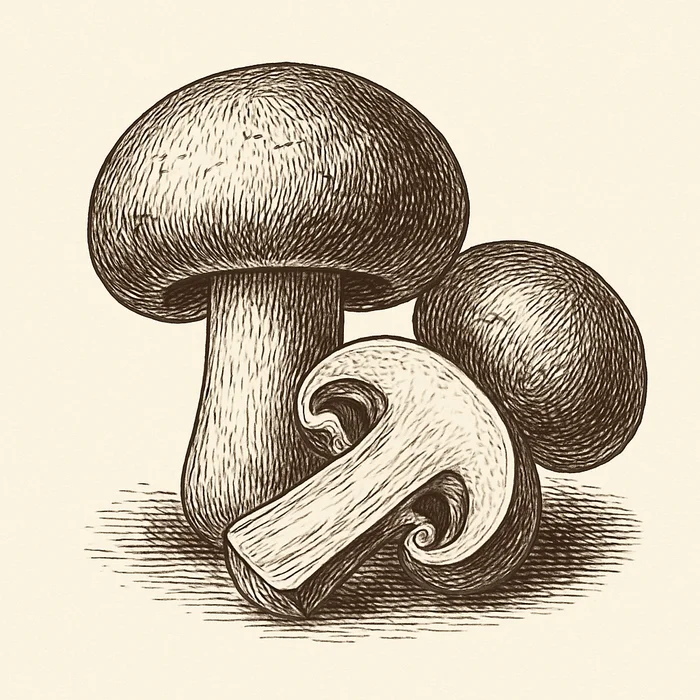
Cremini
Cremini mushrooms (Agaricus bisporus, brown variety) are the only plant food that synthesises vitamin D -- and they share this property with all mushrooms exposed to UV light. Beyond vitamin D, they are the richest dietary source of ergothioneine, a unique antioxidant that researchers have proposed as a longevity vitamin.
Why It Matters for Longevity
Cremini mushrooms are used in multiple Longevity Diet dishes (75--150g raw or boiled per dish). They sit at the intersection of three longevity-relevant mechanisms: vitamin D synthesis, ergothioneine-mediated antioxidant protection, and beta-glucan immune modulation.
Vitamin D synthesis. Mushrooms convert ergosterol to vitamin D2 (ergocalciferol) upon UV light exposure, just as human skin converts 7-dehydrocholesterol to D3. Urbain et al. (2015, J Agric Food Chem) demonstrated a clear dose-response relationship between sunlight exposure and vitamin D2 production in Agaricus bisporus mushrooms -- placing mushrooms gill-side up in sunlight for 30--120 minutes can raise D2 content to levels capable of meaningfully improving serum 25(OH)D status.
Ergothioneine as a longevity vitamin. Beelman et al. (2020, J Nutr Sci) proposed ergothioneine as a longevity vitamin based on its unique properties: it is synthesised only by fungi (humans cannot make it), accumulated preferentially in tissues under oxidative stress (mitochondria, liver, kidney, blood), and transported into cells via a dedicated transporter (OCTN1). Blood ergothioneine levels decline with age, and low levels are associated with multiple age-related diseases. Apparoo et al. (2022, Exp Gerontol) reviewed the mechanistic and epidemiological evidence for ergothioneine as an anti-ageing compound, finding compelling associations with reduced cognitive decline, cardiovascular risk, and all-cause mortality. The cognitive-protection signal has now been quantified in a prospective clinical cohort: Wu et al. (2022, Antioxidants) followed 470 elderly patients attending memory clinics in Singapore for up to five years, finding that lower plasma ergothioneine at baseline predicted significantly faster decline across memory, executive function, attention, visuomotor speed, and language -- with mediation analyses implicating white matter hyperintensity burden and brain atrophy as the mediating pathways. The authors concluded that plasma ergothioneine warrants evaluation as a prognostic biomarker for accelerated cognitive and functional decline in pre-dementia states.
Beta-glucans and immune function. Cremini mushrooms contain beta-1,3/1,6-D-glucans that activate macrophages and natural killer cells via Dectin-1 receptor binding, providing immune-enhancing effects relevant to cancer surveillance and infection resistance in aging. Lee and Kim (2014, Int J Med Mushrooms) reviewed the molecular mechanism in detail: Dectin-1 is expressed on monocytes, macrophages, neutrophils, and NK cells; upon beta-glucan binding, intracellular signalling cascades activate NF-κB transcription, driving cytokine production (IL-4, IL-6, TNF-α) and direct NK-cell cytotoxicity. The water-insoluble beta-glucan fraction characteristic of Agaricus bisporus has stronger immunostimulating activity than the water-soluble fraction, favouring whole-food consumption over isolated extracts.
The population-level implications of regular mushroom consumption are increasingly clear. A prospective cohort study drawing on NHANES III data (n = 15,546; mean follow-up 19.5 years; 5,826 deaths) found that mushroom consumers had an adjusted hazard ratio of 0.84 (95% CI: 0.73--0.98) for all-cause mortality compared to non-consumers (Ba et al., 2021, Nutr J). The effect strengthened substantially when one serving of mushrooms was substituted for a serving of processed or red meat: HR 0.65 (95% CI: 0.50--0.84) -- a 35% lower mortality risk -- with a significant dose-response trend (P-trend = 0.03). A separate systematic review and meta-analysis of 17 observational studies found that the highest mushroom consumers had a 34% lower risk of total cancer compared to the lowest consumers (pooled RR 0.66; 95% CI: 0.55--0.78), with breast cancer showing the strongest signal (Ba et al., 2021, Adv Nutr).
Riboflavin and mitochondrial electron transport. Cremini mushrooms are one of the richest plant-kingdom sources of riboflavin (vitamin B2) at approximately 0.4 mg per 100g -- roughly 30% of the daily reference value. Riboflavin is the biosynthetic precursor of flavin mononucleotide (FMN) and flavin adenine dinucleotide (FAD), the redox cofactors embedded in mitochondrial respiratory Complex I (NADH:ubiquinone oxidoreductase). FMN sits at the electron entry point of Complex I, transferring electrons from NADH to the ubiquinone pool; FAD is similarly essential for Complex II (succinate dehydrogenase). Adequate riboflavin supply is therefore structurally required for efficient oxidative phosphorylation. Riboflavin insufficiency -- common in older adults who reduce meat and dairy intake without compensating through other sources -- impairs Complex I activity, reduces ATP yield per glucose molecule, and increases mitochondrial superoxide leakage. Cremini mushrooms represent a particularly valuable riboflavin source for plant-heavy longevity diets precisely because most other non-animal riboflavin sources are far less concentrated.
How to Use It
Sauté in extra-virgin olive oil with garlic and thyme for maximum ergothioneine delivery and flavour. Do not over-clean -- ergothioneine is distributed throughout the mushroom cap and stem. Expose to sunlight (gill-side up) for 30--120 minutes before cooking to dramatically boost vitamin D2 content. Cooking does not destroy ergothioneine -- it is heat-stable.
What to Pair It With
| Ingredient | Why | Tradition |
|---|---|---|
| Extra-virgin olive oil | Fat enhances absorption of fat-soluble vitamin D2; sautéing is optimal preparation | Italian |
| Garlic | Classic flavour combination; complementary cardiovascular compounds | Mediterranean |
| Thyme | Traditional culinary pairing; complementary polyphenols | Mediterranean |
| Legumes | Mushroom umami reduces perceived need for animal protein; combines with legumes for complete meal | Italian |
| Lemon | Brightens flavour; vitamin C may enhance mineral bioavailability | Mediterranean |
Flavor Profile
Savory, earthy, and umami-rich with a mildly meaty quality. Aroma is distinctly woodsy and fungal. Texture is firm raw and tender when cooked, with a satisfying chew. The brown cremini has more flavour depth than white button mushrooms. High heat (sautéing) produces the Maillard reaction and concentrates flavour dramatically.
The Science
- Urbain et al., 2015, J Agric Food Chem: Dose-response study -- sunlight exposure (gill-side up) produces substantial vitamin D2 in Agaricus bisporus mushrooms; vitamin D2 is retained during cooking and raises serum 25(OH)D comparably to supplements.
- Beelman et al., 2020, J Nutr Sci: Review proposing ergothioneine as a longevity vitamin -- uniquely synthesised by fungi, accumulated in tissues under oxidative stress, declining with age; associated with reduced age-related disease burden.
- Apparoo et al., 2022, Exp Gerontol: Review of ergothioneine as an anti-ageing compound -- compelling evidence for associations with reduced cognitive decline, cardiovascular risk, and all-cause mortality; mushrooms are the primary dietary source.
- Wu et al., 2022, Antioxidants: Prospective cohort (n=470; up to 5 years) -- lower plasma ergothioneine predicts faster decline across memory, executive function, attention, and visuomotor speed; mediating pathway involves white matter hyperintensity burden and brain atrophy.
- Lee and Kim, 2014, Int J Med Mushrooms: Mechanistic review of Dectin-1 beta-glucan signalling -- innate immune activation via NF-κB, cytokine release (IL-4, IL-6, TNF-α), and NK-cell cytotoxicity; water-insoluble beta-glucans from Agaricus bisporus show stronger immunostimulation than soluble fractions.
- Ba et al., 2021, Nutr J: NHANES III prospective cohort (n=15,546; 19.5-year follow-up) -- mushroom consumers: HR 0.84 (95% CI: 0.73--0.98) for all-cause mortality vs non-consumers; substituting mushrooms for processed/red meat: HR 0.65 (95% CI: 0.50--0.84), dose-response P-trend = 0.03.
- Ba et al., 2021, Adv Nutr: Meta-analysis of 17 observational studies -- highest mushroom consumption associated with 34% lower total cancer risk (pooled RR 0.66; 95% CI: 0.55--0.78); strongest signal for breast cancer.
References
- Urbain P, Singler F, Ihorst G, Biesalski HK, Bertz H. Bioavailability of vitamin D2 from UV-B-irradiated button mushrooms in healthy adults deficient in serum 25-hydroxyvitamin D: a randomized controlled trial. J Agric Food Chem. 2015;63(26):6615-6625. PMID: 26314311. doi:10.1021/acs.jafc.5b01895
- Beelman RB, Kalaras MD, Phillips AT, Richie JP. Is ergothioneine a 'longevity vitamin' limited in the American diet? J Nutr Sci. 2020;9:e52. PMID: 33244403. doi:10.1017/jns.2020.44
- Apparoo Y, Phan CW, Kuppusamy UR, Tan YS. Ergothioneine and its prospects as an anti-ageing compound. Exp Gerontol. 2022;170:111982. PMID: 36244584. doi:10.1016/j.exger.2022.111982
- Wu LY, Kan CN, Cheah IK, et al. Low Plasma Ergothioneine Predicts Cognitive and Functional Decline in an Elderly Cohort Attending Memory Clinics. Antioxidants (Basel). 2022;11(9):1717. PMID: 36139790. doi:10.3390/antiox11091717
- Lee DH, Kim HW. Innate immunity induced by fungal β-glucans via dectin-1 signaling pathway. Int J Med Mushrooms. 2014;16(1):1-16. PMID: 24940900. doi:10.1615/IntJMedMushr.v16.i1.10
- Ba DM, Gao X, Muscat J, et al. Association of mushroom consumption with all-cause and cause-specific mortality among American adults: prospective cohort study findings from NHANES III. Nutr J. 2021;20(1):38. PMID: 33888143. doi:10.1186/s12937-021-00691-8
- Ba DM, Ssentongo P, Beelman RB, Muscat J, Gao X, Richie JP. Higher Mushroom Consumption Is Associated with Lower Risk of Cancer: A Systematic Review and Meta-Analysis of Observational Studies. Adv Nutr. 2021;12(5):1691-1704. PMID: 33724299. doi:10.1093/advances/nmab015
Key Nutrients
| Nutrient | Per 100g | Notes |
|---|---|---|
| Ergothioneine | ~1.3--4.9 mg | Unique mitochondria-targeted antioxidant; synthesised only by fungi; transported by OCTN1; stable to cooking; declines in blood with age |
| Vitamin D2 (UV-exposed) | Variable | Formed from ergosterol under UV; gill-side up in 30--120 min sunlight dramatically increases content; retained during cooking |
| Beta-glucans (1,3/1,6-beta-D-glucan) | ~0.5--1.5 g | Immunomodulatory; activate macrophages and NK cells via Dectin-1; partially fermented in colon |
| Riboflavin (vitamin B2) | ~0.4 mg (~30% DV) | Precursor to FMN and FAD -- essential redox cofactors for mitochondrial Complex I and II; riboflavin insufficiency impairs oxidative phosphorylation and increases superoxide leakage |
| Selenium | ~9--26 mcg | Organic selenomethionine form; cofactor for glutathione peroxidase; contributes to antioxidant enzyme network |