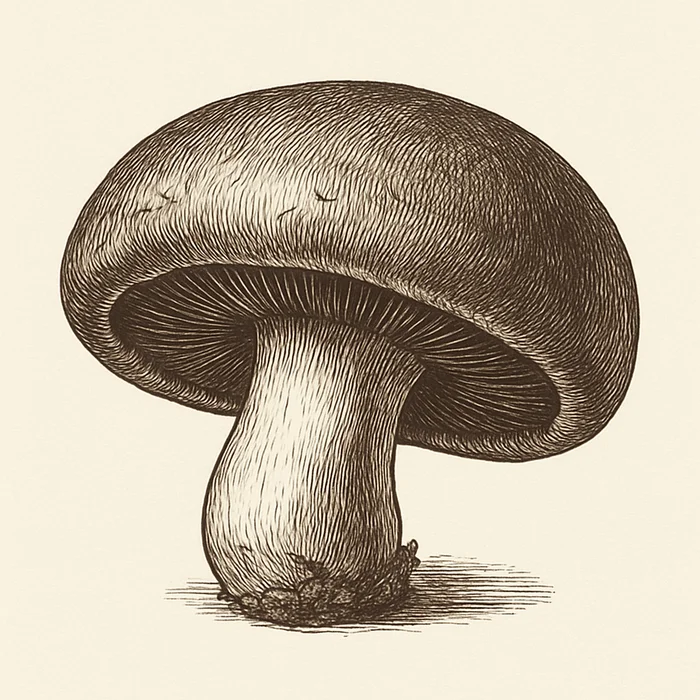
Portobello
Portobello is included in the Longevity Diet as part of the mushroom group (75–150 g raw or boiled per dish). UV-exposed portobello can generate 400–870 IU of bioavailable vitamin D2 per 100 g. It is also one of the richest dietary sources of ergothioneine — a thiol antioxidant that humans cannot synthesize, absorb through a dedicated transporter, and whose blood levels decline measurably after age 60 — and contains beta-glucans associated with immune modulation and gut microbiota support.
Why It Matters for Longevity
Ergothioneine: The Mushroom Longevity Compound
Ergothioneine (ERGO) is a sulfur-containing amino acid synthesized only by fungi and a handful of other microorganisms — mammals have no biosynthetic pathway for it. Humans acquire ERGO exclusively through diet, and mushrooms are by far the richest source, containing 4–5 mg per 100 g in portobello and other Agaricus bisporus varieties. After ingestion, ERGO is taken up via a dedicated transporter protein encoded by the gene SLC22A4 (also called OCTN1), which is expressed in the gut epithelium, kidneys, erythrocytes, and — critically for aging — in mitochondria and the liver. The existence of a high-affinity dedicated transporter is a strong evolutionary signal: the body treats ERGO as a nutrient worth concentrating and retaining rather than excreting.
At the cellular level, ERGO does several things that are directly relevant to aging biology. It scavenges reactive oxygen species (ROS) and reactive nitrogen species with particular efficiency in the mitochondrial matrix, where oxidative stress is concentrated. It chelates divalent metal ions such as Cu²⁺ and Fe²⁺ that otherwise catalyze Fenton-type chemistry leading to lipid peroxidation and DNA strand breaks. It also upregulates Nrf2, the master transcription factor that induces endogenous antioxidant enzymes (superoxide dismutase, catalase, glutathione peroxidase). These properties have prompted some researchers to describe ERGO as a "stress vitamin" — a dietary compound that buffers cells against oxidative insults that accumulate with age.
One emerging line of research connects ERGO specifically to cellular senescence — the accumulation of growth-arrested, inflammatory cells that is increasingly recognized as a driver of tissue aging. Apparoo et al. (2024) screened 14 mushroom species for ergothioneine content and tested extracts against hydrogen peroxide–induced senescence in HT22 neuronal cells. Pretreatment with ergothioneine-rich extracts improved cell viability, reversed markers of cellular senescence, and reduced ROS — findings consistent with ERGO acting upstream of the senescent phenotype rather than merely mopping up downstream damage (Apparoo et al., 2024, Brain Research). Because senescent cell burden in the brain accumulates progressively after midlife, dietary sources of ERGO may represent a practical lever for slowing that accumulation.
The clinical signal is beginning to follow. In a large Swedish prospective cohort (n = 3,236), higher plasma ERGO levels were associated with significantly reduced cardiovascular mortality and overall mortality. Blood concentrations of ERGO decline measurably after the age of 60, and lower levels track with more rapid cognitive decline in aging populations — consistent with a nutrient that is being consumed by ongoing stress responses faster than it can be replenished from a diet that often contains little mushroom. Beelman et al. (2020) formally proposed that ERGO meets criteria for a "longevity vitamin" in the sense coined by Bruce Ames — a micronutrient insufficient intake of which accelerates aging damage even without producing acute deficiency symptoms (Beelman et al., 2020, J Nutr Sci). Tian, Thorne, and Moore (2023) reviewed the mechanistic and epidemiological evidence and concluded that ERGO may warrant reclassification as a "conditionally essential micronutrient" required for healthy ageing, noting the consistent decline in plasma levels after age 60 and the associated increase in disease risk (Tian et al., 2023, Br J Nutr).
A practical implication: because ERGO is concentrated in the gills and cap flesh of the mushroom and is not destroyed by heat, cooking portobello does not meaningfully degrade ERGO content. Sautéing or roasting at normal temperatures preserves the compound; prolonged boiling in water can leach it into the cooking liquid, which can be retained in soups or sauces.
Vitamin D2 from UV Exposure
Portobello, like all Agaricus bisporus, contains ergosterol in its cell walls — a sterol that converts to ergocalciferol (vitamin D2) when exposed to UV-B radiation, following the same photochemical pathway by which human skin converts 7-dehydrocholesterol to vitamin D3. Commercially grown mushrooms typically develop in darkness and contain minimal vitamin D2 (often <10 IU/100 g), but gill-side-up sun exposure for 30–60 minutes at midday generates 400–870 IU per 100 g, with peak production occurring in the UV-B window of 280–315 nm.
The bioavailability of this mushroom-derived D2 is well established in controlled trials. Urbain et al. (2011) administered UV-B-irradiated button mushrooms to vitamin D-deficient adults in a randomised controlled trial and demonstrated significant increases in serum 25(OH)D, with bioavailability equivalent to supplemental vitamin D2 at matched doses (Urbain et al., 2011, Eur J Clin Nutr). An important nuance emerged from a 2023 systematic review of 18 studies (6 in humans, 12 in animals): while UV-irradiated mushrooms reliably raised serum 25(OH)D2, human trials did not consistently show improvements in bone density or other clinical endpoints over the 1–6 month study periods examined — though animal evidence for downstream effects on bone metabolism and inflammation is substantially stronger (Rondanelli et al., 2023, Antioxidants). A further nuance: vitamin D2 and D3 share the same hepatic hydroxylation enzyme (CYP2R1), and high D2 intake can trigger a compensatory decline in 25(OH)D3. This competition means mushroom D2 is most useful for people with low baseline D3 status. Vitamin D supports immune function, calcium homeostasis, and modulates a cluster of aging-related inflammatory gene programs via the vitamin D receptor (VDR), which is expressed in nearly every tissue type.
Beta-Glucan and Immune–Gut Axis
The cell walls of portobello contain 3–4 g of beta-glucan polysaccharides per 100 g — branched 1,3/1,6-linked glucose polymers that are largely indigestible by human enzymes. These structural features are essential for their biological activity: intact beta-glucans reach the gut microenvironment and act on two levels simultaneously.
Immunologically, beta-glucans bind Dectin-1 and Toll-like receptor 2 (TLR2) on macrophages, dendritic cells, and natural killer cells, triggering NF-κB-dependent cytokine production, enhanced phagocytosis, and NK-cell activation. A 2024 study by Case et al. demonstrated that this goes beyond acute activation: beta-glucans from Agaricus bisporus powders drive "trained immunity" — epigenetic and metabolic reprogramming of innate immune cells that produces a persistently enhanced response to future immune challenges. In mouse models, oral delivery of mushroom powder shifted bone marrow hematopoietic stem cells toward myeloid commitment; in human monocyte-derived macrophages, mushroom powder exposure similarly enhanced cytokine production across multiple stimuli (Case et al., 2024, Front Nutr). Trained immunity is distinguished from classical adaptive immunity in that it does not require antigen specificity — it recalibrates baseline surveillance — making it particularly relevant in older adults whose innate immune function (as distinct from acquired immunity) deteriorates with age. Wasser's foundational review documented antitumour activity of mushroom beta-glucans in laboratory and clinical contexts, attributed to this pattern-recognition receptor activation (Wasser, 2002, Appl Microbiol Biotechnol).
In the gut, undigested beta-glucans function as prebiotics. They ferment selectively in the colon, promoting growth of Lactobacillus and Bifidobacterium species and driving production of short-chain fatty acids (SCFAs) — acetate, propionate, and butyrate. Butyrate is the primary energy substrate for colonocytes and suppresses colonic inflammation via histone deacetylase inhibition; propionate is transported to the liver and modulates lipid metabolism. Cerletti, Esposito, and Iacoviello (2021) reviewed the evidence that mushroom beta-glucans modulate both the immune system and gut microbiota composition with downstream cardiovascular and metabolic effects, and noted that edible mushrooms act on health through a combination of their beta-glucan fraction, phenolic compounds, and micronutrients including ergothioneine (Cerletti et al., 2021, Nutrients).
Cohort Evidence: Mushroom Consumption and Mortality
Mechanistic pathways become more compelling when matched by population data. Two independent lines of cohort evidence are now reasonably consistent.
On all-cause mortality: Ba et al. (2021) analysed data from NHANES III, a prospective cohort of 15,546 American adults followed from 1988 to 2015. Mushroom consumers had a 16% lower risk of all-cause mortality compared to non-consumers (HR 0.84, 95% CI: 0.73–0.97), after adjustment for age, sex, race, smoking, alcohol, energy intake, and other dietary covariates. A substitution analysis showed that replacing one daily serving of processed or red meat with mushrooms was associated with further mortality reduction (Ba et al., 2021, Nutr J). These findings were replicated at larger scale in a Korean prospective cohort of 152,828 adults (mean age 53.7 years, 11.6 years follow-up, 7,085 deaths). Even low consumption — fewer than one serving per week — was associated with significantly reduced all-cause mortality in both men (HR 0.86, 95% CI: 0.79–0.93) and women (HR 0.86, 95% CI: 0.78–0.95), with cardiovascular mortality reductions of approximately 23% in men (Jung et al., 2023, Food Funct).
On cancer incidence: a systematic review and meta-analysis of 17 observational studies (6 cohort, 11 case-control; 19,732 cancer cases) found that higher mushroom consumption was associated with a 34% lower risk of total cancer (pooled RR 0.66, 95% CI: 0.55–0.78). The association was most robust for breast cancer. The authors noted that the antioxidant, immunomodulatory, and antiproliferative properties of mushroom bioactives — ergothioneine, polysaccharides, and conjugated linoleic acid — are consistent candidate mechanisms (Ba et al., 2021, Adv Nutr).
These are observational findings with the usual caveats: mushroom intake may proxy for other healthy dietary habits, and residual confounding cannot be excluded. But the effect sizes are non-trivial, consistent across multiple populations and study designs, and plausibly linked to the mechanisms above.
How to Use It
Use 75–150 g per dish according to the Longevity Diet guidelines. For vitamin D, place portobello gills-side up in midday sun for 30–60 minutes before cooking — this dramatically increases D2 content. To preserve ergothioneine, prefer grilling, roasting, or sautéing over prolonged boiling; if boiling, retain the cooking liquid. Works well as a meat substitute in pasta and grain dishes.
What to Pair It With
| Ingredient | Why | Tradition |
|---|---|---|
| Extra-virgin olive oil | Fat needed for fat-soluble vitamin D2 absorption | Mediterranean |
| Garlic | Garlic prebiotic fructooligosaccharides complement portobello beta-glucans | Mediterranean |
| Spinach | Umami depth + mineral content; nutrient-dense combination | Mediterranean |
| Thyme | Aromatic complement to earthy mushroom flavor | Mediterranean |
Flavor Profile
Umami-rich, meaty, earthy, and savory. Aroma intensifies when grilled or roasted — forest floor with caramelized depth. Texture is dense and meaty, absorbs marinades well, tender when cooked.
The Science
- Urbain et al., 2011, Eur J Clin Nutr: RCT confirming UV-B-irradiated button mushrooms raise serum 25(OH)D in deficient adults; bioavailability equivalent to supplemental D2.
- Wasser, 2002, Appl Microbiol Biotechnol: Medicinal mushrooms contain immunomodulating and anti-tumour beta-glucan polysaccharides that activate innate immune cells via pattern-recognition receptors.
- Beelman et al., 2020, J Nutr Sci: Proposes ergothioneine as a candidate "longevity vitamin" — produced only by fungi, transported via OCTN1, and potentially insufficient in American diets due to low mushroom intake.
- Tian et al., 2023, Br J Nutr: Reviews mechanistic and epidemiological evidence that ergothioneine is an underrecognised dietary micronutrient for healthy ageing; plasma levels decline after age 60 and correlate with cognitive and cardiovascular outcomes.
- Apparoo et al., 2024, Brain Research: Ergothioneine-rich mushroom extracts reverse oxidative stress–induced neuronal senescence in vitro, identifying senescent cell elimination as a candidate anti-aging mechanism for dietary ERGO.
- Rondanelli et al., 2023, Antioxidants: Systematic review of 18 studies; UV-irradiated mushrooms reliably raise 25(OH)D2 in humans, with strong animal evidence for downstream effects on bone and inflammation; human clinical endpoints require longer intervention periods.
- Case et al., 2024, Front Nutr: Beta-glucans from Agaricus bisporus drive trained immunity via Dectin-1–mediated epigenetic reprogramming of macrophages in both mouse models and human monocytes.
- Ba et al., 2021, Nutr J: NHANES III prospective cohort (n = 15,546); mushroom consumers had 16% lower all-cause mortality risk vs. non-consumers over ~27 years of follow-up.
- Ba et al., 2021, Adv Nutr: Systematic review and meta-analysis of 17 studies; highest mushroom intake associated with 34% lower cancer risk (pooled RR 0.66, 95% CI: 0.55–0.78).
- Jung et al., 2023, Food Funct: Korean prospective cohort (n = 152,828, 11.6 years follow-up); low-to-moderate mushroom consumption associated with ~14% lower all-cause mortality and ~23% lower cardiovascular mortality in men and women.
- Cerletti et al., 2021, Nutrients: Review of mushroom beta-glucan effects on immune modulation, gut microbiota composition, and cardiovascular and metabolic markers.
References
- Urbain P, Singler F, Ihorst G, Biesalski HK, Bertz H. Bioavailability of vitamin D₂ from UV-B-irradiated button mushrooms in healthy adults deficient in serum 25-hydroxyvitamin D: a randomized controlled trial. Eur J Clin Nutr. 2011;65(8):965-971. PMID: 21540874. doi:10.1038/ejcn.2011.53
- Wasser SP. Medicinal mushrooms as a source of antitumor and immunomodulating polysaccharides. Appl Microbiol Biotechnol. 2002;60(3):258-274. PMID: 12436306. doi:10.1007/s00253-002-1076-7
- Beelman RB, Kalaras MD, Phillips AT, Richie JP Jr. Is ergothioneine a 'longevity vitamin' limited in the American diet? J Nutr Sci. 2020;9:e52. PMID: 33244403. doi:10.1017/jns.2020.44
- Tian X, Thorne JL, Moore JB. Ergothioneine: an underrecognised dietary micronutrient required for healthy ageing? Br J Nutr. 2023;129(1):104-114. PMID: 38018890. doi:10.1017/S0007114522003592
- Apparoo Y, Phan CW, Kuppusamy UR, Chan EWC. Potential role of ergothioneine rich mushroom as anti-aging candidate through elimination of neuronal senescent cells. Brain Res. 2024;1823:148693. PMID: 38036238. doi:10.1016/j.brainres.2023.148693
- Rondanelli M, Moroni A, Zese M, Gasparri C, Riva A, Petrangolini G, Perna S, Mazzola G. Vitamin D from UV-Irradiated Mushrooms as a Way for Vitamin D Supplementation: A Systematic Review on Classic and Nonclassic Effects in Human and Animal Models. Antioxidants (Basel). 2023;12(3):736. PMID: 36978984. doi:10.3390/antiox12030736
- Case S, O'Brien T, Ledwith AE, Chen S, Horneck Johnston CJH, Hackett EE, O'Sullivan M, Charles-Messance H, Dempsey E, Yadav S, Wilson J, Corr SC, Nagar S, Sheedy FJ. β-glucans from Agaricus bisporus mushroom products drive Trained Immunity. Front Nutr. 2024;11:1346706. PMID: 38425482. doi:10.3389/fnut.2024.1346706
- Ba DM, Gao X, Muscat J, Al-Shaar L, Chinchilli V, Zhang X, Ssentongo P, Beelman RB, Richie JP Jr. Association of mushroom consumption with all-cause and cause-specific mortality among American adults: prospective cohort study findings from NHANES III. Nutr J. 2021;20(1):38. PMID: 33888143. doi:10.1186/s12937-021-00691-8
- Ba DM, Ssentongo P, Beelman RB, Muscat J, Gao X, Richie JP. Higher Mushroom Consumption Is Associated with Lower Risk of Cancer: A Systematic Review and Meta-Analysis of Observational Studies. Adv Nutr. 2021;12(5):1691-1704. PMID: 33724299. doi:10.1093/advances/nmab015
- Jung H, Shin J, Lim K, Shin S. Edible mushroom intake and risk of all-cause and cause-specific mortality: results from the Korean Genome and Epidemiology Study (KoGES) Cohort. Food Funct. 2023;14(19):8808-8818. PMID: 37682230. doi:10.1039/d3fo00996c
- Cerletti C, Esposito S, Iacoviello L. Edible Mushrooms and Beta-Glucans: Impact on Human Health. Nutrients. 2021;13(7):2195. PMID: 34202377. doi:10.3390/nu13072195
Key Nutrients
| Nutrient | Per 100g | Notes |
|---|---|---|
| Vitamin D2 (ergocalciferol) | ~10–870 IU (UV-exposed) | UV exposure essential; store gills-up in sunlight before use; cooking largely preserves D2 |
| Ergothioneine | ~4–5 mg | Unique thiol antioxidant; absorbed via OCTN1 (SLC22A4) transporter; concentrates in mitochondria and erythrocytes; plasma levels decline after age 60 |
| Beta-glucans | ~3–4 g | Stimulate innate immune cells via Dectin-1 and TLR2; drive trained immunity; act as prebiotics driving SCFA production in the colon |
| Potassium | 437 mg (cooked) | Significant source supporting blood pressure regulation |