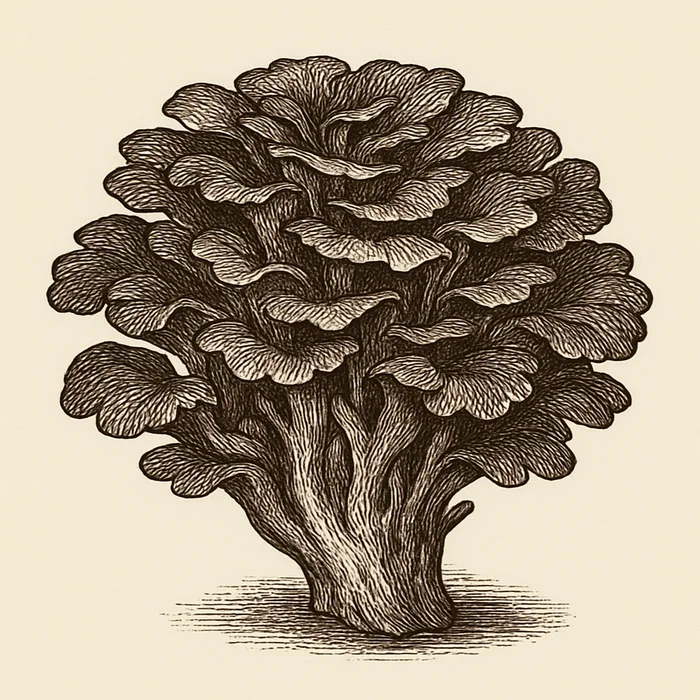
Maitake
Used in multiple Longevity Diet dishes. Maitake mushrooms are the top food source of vitamin D among mushrooms (786 IU per cup raw, 196.5% DV), the highest of any non-animal food when UV-exposed.
Why It Matters for Longevity
Maitake (Grifola frondosa) is both a culinary and medicinal mushroom used extensively in the Longevity Diet. Its longevity case rests on three pillars: extraordinary vitamin D content when UV-exposed, immunomodulatory beta-glucan polysaccharides (the maitake D-fraction), and a growing body of clinical evidence for its effects on immune function.
Mushrooms synthesize vitamin D2 (ergocalciferol) upon UV light exposure, analogous to human skin producing vitamin D3. Maitake's ergosterol-rich structure makes it the most potent dietary vitamin D source among mushrooms; placing maitake gills-up in sunlight for 30–60 minutes generates significant D2 that is bioavailable and raises serum 25(OH)D2.
Maitake mushroom extract was tested in a phase II clinical study in patients with myelodysplastic syndromes (MDS), a hematological condition associated with immune dysfunction; the extract was well-tolerated and showed potential immunological activity, supporting the development of maitake-based immunotherapy in oncological and immune-aging contexts (Wesa et al., 2015, Cancer Immunol Immunother).
Maitake beta-glucan enhances the anti-tumor efficacy of trastuzumab (an HER2-targeted antibody therapy) through anti-tumor immune activation — demonstrating that maitake beta-glucan modulates adaptive immune responses in cancer treatment contexts (Masuda et al., 2024, Biol Pharm Bull).
Vitamin D2 Bioavailability: What the RCT Evidence Shows
The claim that UV-exposed maitake raises serum vitamin D is not just biochemical inference — it has been tested in humans. Urbain et al. (2011, European Journal of Clinical Nutrition, PMID 21540874) conducted a 5-week randomized controlled trial with 26 vitamin D-deficient adults. UV-B irradiation raised the D2 content of mushrooms from less than 1 μg per 100g to 491 μg per 100g. Participants receiving 28,000 IU weekly via UV-irradiated mushroom soup gained approximately 3.9 nmol/L serum 25(OH)D per week — statistically equivalent to the group receiving a D2 supplement (4.7 nmol/L/week, 95% CI: 3.8–5.7). After just 2 weeks, mushroom-group 25(OH)D was significantly higher than placebo (p = 0.001). This is the strongest human evidence that the gills-up sun-exposure protocol works as advertised.
One important nuance from the literature: ergocalciferol (D2) from mushrooms raises 25(OH)D2 but can simultaneously reduce 25(OH)D3. The net effect on total vitamin D status depends on baseline levels. For people who are genuinely deficient, UV-exposed mushrooms are a legitimate non-animal D source; for those with adequate D3, the incremental benefit is smaller.
D-Fraction Beta-Glucan and NK Cell Activation
Maitake's D-fraction is a beta-1,6-glucan with beta-1,3-branching, extracted and concentrated from the fruiting body. The proposed mechanism is pattern recognition: D-fraction binds to Dectin-1 receptors on macrophages and NK cells, triggering downstream cytokine release (IL-12, TNF-α, IFN-γ) that activates cytotoxic immune cells.
Deng et al. (2009, Journal of Cancer Research and Clinical Oncology, PMID 19253021) tested this in humans — a phase I/II dose-escalation trial in 34 postmenopausal breast cancer patients, disease-free after initial treatment, receiving oral maitake extract at 0.1 to 5 mg/kg twice daily for 3 weeks. The association between maitake and immune function was statistically significant (p < 0.0005). Critically, the dose-response was non-monotonic: intermediate doses enhanced some immune parameters while suppressing others. This is not a signal to take as much as possible — it is a signal that whole-food consumption (standard culinary portions) is probably more appropriate than high-dose concentrated extracts.
The D-fraction mechanism involves macrophage-derived IL-12 upregulation, which in turn activates NK cells. TNF-α and IFN-γ release from spleen cells and NK cells increased in corresponding animal studies. Beta-glucan-activated NK cells then exert cytotoxic activity against aberrant cells — a plausible anti-aging immune mechanism given that declining NK cell activity is a consistent feature of immunosenescence.
Blood Glucose and Insulin Sensitivity
A secondary but well-investigated property of maitake polysaccharides is their effect on glucose metabolism. Chun Xiao et al. (2015, Food & Function, PMID 26311233) isolated two polysaccharide fractions (F2 and F3) from maitake and tested them in streptozotocin-induced diabetic rats. Both fractions significantly decreased fasting serum glucose (FSG), fasting serum insulin (FSI), and HOMA-IR (insulin resistance index) compared to untreated diabetic controls (p < 0.05). The mechanism operates through two parallel pathways: F3 upregulates PI3K/Akt signaling downstream of the insulin receptor, while F2 inhibits PTP1B — a phosphatase that normally dephosphorylates and thus inactivates the insulin receptor. Inhibiting PTP1B extends insulin receptor activation and improves insulin sensitivity.
This is animal data, not human RCT data — extrapolation to humans requires caution. But the mechanistic clarity is valuable: it identifies specific molecular targets and explains why maitake's glucose effects are consistent across multiple study designs. The edible culinary portions used in the Longevity Diet deliver grams of beta-glucan per serving, which is meaningful intake.
How to Use It
Always sauté in olive oil or dress with olive oil — fat significantly enhances absorption of fat-soluble vitamin D2. For maximum vitamin D, place mushrooms gills-up in direct sunlight for 30–60 minutes before cooking. Pairs with garlic, pasta, barley, and thyme in Longevity Diet dishes.
What to Pair It With
| Ingredient | Why | Tradition |
|---|---|---|
| Olive oil | Fat enhances absorption of fat-soluble vitamin D2 from maitake | The Longevity Diet |
| Garlic | Classic culinary pairing; allicin and maitake beta-glucans provide complementary immunomodulatory effects | Italian |
| Lemon | Brightens flavor of rich umami mushroom | Mediterranean |
| Pasta | Traditional maitake pasta preparation in the Longevity Diet | The Longevity Diet |
| Barley | Maitake and barley provide complementary beta-glucan sources for gut health | Traditional |
Flavor Profile
Earthy, savory, umami-rich, slightly peppery. Aroma is forest floor, earthy, woodsy. Texture is frilly and delicate raw, tender when cooked, slightly chewy.
The Science
- Wesa et al., 2015, Cancer Immunol Immunother: Phase II clinical study of maitake mushroom extract in myelodysplastic syndromes — extract was well-tolerated and showed potential immunological activity, supporting maitake beta-glucan as a clinically relevant immunomodulatory agent.
- Masuda et al., 2024, Biol Pharm Bull: Maitake beta-glucan enhances the anti-tumor efficacy of trastuzumab through anti-tumor immune activation, demonstrating maitake beta-glucan's role in modulating adaptive immune responses.
- Urbain et al., 2011, Eur J Clin Nutr: RCT in 26 vitamin D-deficient adults — UV-B-irradiated mushroom soup (28,000 IU D2/week) raised serum 25(OH)D by ~3.9 nmol/L/week, statistically comparable to D2 supplement; mushroom group significantly higher than placebo at 2 weeks (p = 0.001).
- Deng et al., 2009, J Cancer Res Clin Oncol: Phase I/II trial in 34 breast cancer patients — oral maitake extract associated with significant immune modulation (p < 0.0005); non-monotonic dose-response with NK cell and cytokine activation.
- Chun Xiao et al., 2015, Food Funct: Maitake polysaccharide fractions F2/F3 reduced fasting serum glucose, serum insulin, and HOMA-IR in diabetic rats via PI3K/Akt upregulation and PTP1B inhibition.
References
- Wesa KM, Cunningham-Rundles S, Klimek VM, et al. Maitake mushroom extract in myelodysplastic syndromes (MDS): a phase II study. Cancer Immunol Immunother. 2015;64(2):237-247. PMID: 25351719. doi:10.1007/s00262-014-1628-6
- Masuda Y, Ito K, Nanba H, et al. Maitake Beta-Glucan Enhances the Therapeutic Effect of Trastuzumab via Anti-tumor Immunity Induction. Biol Pharm Bull. 2024. PMID: 38616114. doi:10.1248/bpb.b24-00006
- Urbain P, Singler F, Ihorst G, Biesalski HK, Bertz H. Bioavailability of vitamin D₂ from UV-B-irradiated button mushrooms in healthy adults deficient in serum 25-hydroxyvitamin D: a randomized controlled trial. Eur J Clin Nutr. 2011;65(8):965-971. PMID: 21540874. doi:10.1038/ejcn.2011.53
- Deng G, Lin H, Seidman A, et al. A phase I/II trial of a polysaccharide extract from Grifola frondosa (Maitake mushroom) in breast cancer patients: immunological effects. J Cancer Res Clin Oncol. 2009;135(9):1215-1221. PMID: 19253021. doi:10.1007/s00432-009-0562-z
- Chun Xiao, Wu Q, Xie Y, Zhang J, Tan J. Hypoglycemic effects of Grifola frondosa (Maitake) polysaccharides F2 and F3 through improvement of insulin resistance in diabetic rats. Food Funct. 2015;6(10):3567-3575. PMID: 26311233. doi:10.1039/c5fo00499c
Key Nutrients
| Nutrient | Per 100g | Notes |
|---|---|---|
| Vitamin D2 (ergocalciferol) | ~786 IU (UV-exposed, raw) | UV-exposed maitake is the richest plant-kingdom vitamin D source; cooking reduces content by ~50% — use raw or lightly sautéed; gills-up sun exposure for 30–60 min maximizes D2 |
| Beta-glucans (D-fraction) | ~15–30 g (dry weight basis) | Partially digested; activate pattern recognition receptors on immune cells; not destroyed by cooking |
| Ergothioneine | ~1.3 mg | Unique thiol antioxidant synthesized only by fungi; stable to cooking; accumulates in high-stress tissues |
| Potassium | ~210 mg (raw) | Well-bioavailable; supports blood pressure regulation |
| Copper | ~0.3 mg (raw) | Mushrooms are good copper sources; essential for immune cell function and antioxidant enzymes |