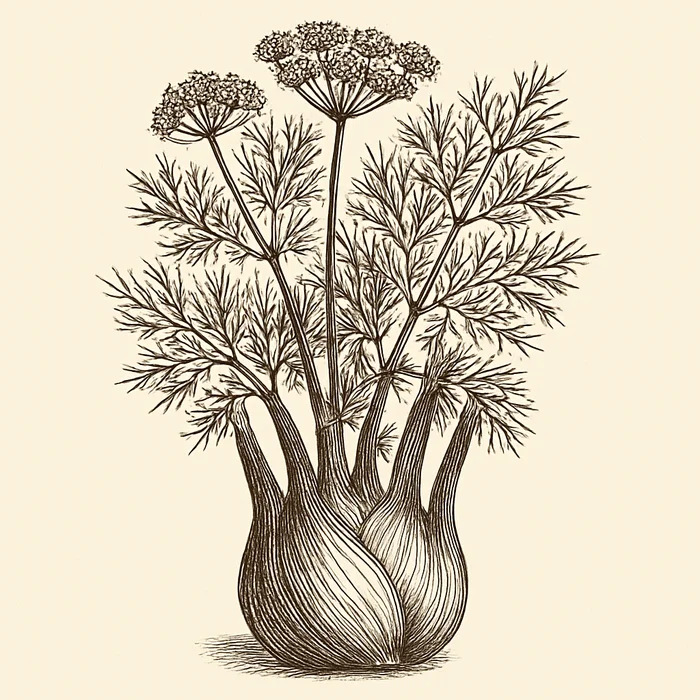
Fennel
Vegetable used in the Longevity Diet fennel salad and as a side dish ingredient. Provides dietary fiber, vitamin C, potassium, and bioactive phytochemicals including anethole and fenchone as part of a plant-forward longevity eating pattern.
Why It Matters for Longevity
Fennel (Foeniculum vulgare) is an aromatic Mediterranean vegetable whose health profile extends well beyond basic nutrition. Its principal volatile compounds — particularly trans-anethole (80–90% of the essential oil) and fenchone — have documented anti-inflammatory, antioxidant, and gut-modulatory properties that may contribute to reduced chronic disease risk within a Mediterranean dietary context. Four distinct mechanistic pathways make fennel worth understanding in detail.
Anethole's NF-κB Mechanism
The most rigorously characterized molecular action of fennel belongs to trans-anethole. A landmark study by Chainy et al. established that anethole functions as a potent inhibitor of the TNF-induced NF-κB signaling cascade — blocking both early and late cellular responses downstream of tumor necrosis factor. Specifically, anethole suppressed NF-κB activation, AP-1 transcription factor activity, c-jun N-terminal kinase (JNK) activity, and MAPK-kinase (MAPKK) phosphorylation. It also inhibited TNF-induced apoptosis through caspase suppression and reduced reactive oxygen species (ROS) generation (Chainy et al., 2000, Oncogene). The significance of this pathway is that NF-κB is the master regulator of chronic low-grade inflammation — the same inflammatory state underpinning atherosclerosis, insulin resistance, and several cancers. Blocking its activation by TNF places anethole in a mechanistic category shared by far more studied compounds like curcumin and resveratrol.
Complementing this, essential oils of Foeniculum vulgare demonstrated significant in vitro anti-arthritic activity by inhibiting protein denaturation and membrane stabilization — mechanisms relevant to chronic inflammatory joint disease (Marrelli et al., 2020, Chem Biodivers). And fenchone, the second major volatile, ameliorated experimental TNBS-induced colitis in rats via antioxidant and immunomodulatory pathways, reducing pro-inflammatory cytokines and oxidative stress markers (Araruna et al., 2024, Pharmaceuticals).
Digestive Health: Motility, IBS, and Barrier Function
Fennel has been used as a carminative and digestive tonic across Mediterranean, Ayurvedic, and Chinese medicine for centuries. The ethnobotanical record now has a clinical counterpart. A randomized controlled trial in 121 patients with mild-to-moderate IBS found that the combination of curcumin and fennel essential oil produced a 50% relative reduction in IBS Symptom Severity Score (IBS-SSS) after 30 days, compared with 26% in controls (P < 0.001); symptom-free rates were 25.9% vs. 6.8% in favor of the treatment group (P = 0.005). Quality of life improved across all measured domains (Portincasa et al., 2016, J Gastrointestin Liver Dis). Anethole's smooth-muscle relaxant activity — it binds to calcium channels in intestinal smooth muscle — is the likely mechanistic driver, reducing spasmodic contraction and gas retention.
Fennel's effects on intestinal epithelial integrity have also been quantified in vitro and in vivo. A 2022 study showed that fennel seed extract significantly preserved transepithelial electrical resistance (TEER) in IFN-γ-challenged intestinal epithelial cells and suppressed phosphorylated STAT1 signaling — a key pathway in gut inflammation — in both cell culture and a DSS-induced murine colitis model. The authors conclude that fennel extract "improves barrier function of the gastrointestinal tract" and represents a candidate for further clinical trials in inflammatory bowel disease (Das et al., 2022, PLoS One).
Vitamin C and Antioxidant Polyphenols
Raw fennel bulb provides approximately 12 mg of vitamin C per 100 g — a modest but meaningful contribution toward the ~75–90 mg daily requirement. Vitamin C is water-soluble and heat-sensitive; fennel consumed raw or very lightly dressed retains the full dose, while prolonged roasting at high heat degrades it substantially. Vitamin C acts as a direct aqueous-phase antioxidant (scavenging superoxide and hydroxyl radicals) and as a cofactor for prolyl hydroxylase, the enzyme responsible for collagen cross-linking — relevant to vascular wall integrity and skin structure with age.
Fennel also contains a measurable flavonoid and phenolic pool. Analysis of 23 fennel accessions identified quercetin, apigenin, and rutin as the dominant flavonoids, alongside phenolic acids including chlorogenic acid and caffeic acid. Total flavonoid content in the highest-performing samples reached 14.8 mg quercetin equivalent per gram (dry weight), with total phenolic content up to 262 mg/g DW. These extracts demonstrated concentration-dependent inhibition of advanced glycation end-product (AGE) formation — a relevant anti-aging endpoint — as well as DPPH radical scavenging activity (Salami et al., 2016, Food Chemistry). AGE accumulation in collagen, myelin, and vascular smooth muscle is a hallmark of biological aging and accelerated by dietary sugar; compounds that limit AGE formation are therefore directly relevant to long-term tissue health.
Fiber and Gut Microbiota
Fennel bulb delivers approximately 3.1 g of dietary fiber per 100 g raw weight — a mix of soluble and insoluble fractions. The soluble component includes pectin-type polysaccharides and fructooligosaccharide-like structures that resist small-intestine digestion and reach the colon largely intact. There, these substrates support fermentation by Bifidobacterium and Lactobacillus species, promoting short-chain fatty acid (SCFA) production — chiefly butyrate, propionate, and acetate. Butyrate is the primary energy substrate for colonocytes, helps maintain tight-junction integrity, and suppresses NF-κB activity in the gut epithelium, creating an intersection with fennel's volatile-compound effects. This combined action of the fiber matrix and the anethole fraction may explain why whole-fennel interventions tend to show stronger digestive benefits than isolated extracts in observational comparisons.
Deep Dive: Anethole as Fennel's Primary Bioactive
Trans-anethole (1-methoxy-4-propenylbenzene) is a phenylpropanoid ether comprising 80–90% of fennel essential oil by mass, though the bulb itself contains only trace quantities relative to the seed or frond. After ingestion, anethole is absorbed via passive diffusion across intestinal epithelium and enters the portal circulation, where it undergoes hepatic O-demethylation and β-oxidation to yield anethole epoxide, p-methoxyphenylacetone, and p-anisic acid. These metabolites are substantially cleared before systemic circulation, which means the highest anethole concentrations are encountered in the gut lumen and intestinal wall — anatomically consistent with the strongest observed effects (smooth muscle relaxation, barrier protection, anti-inflammatory signaling).
At the pathway level, anethole's effects span at least four signal transduction systems:
- NF-κB / IκBα axis: Anethole blocks the phosphorylation and proteasomal degradation of IκBα, preventing NF-κB p65/p50 nuclear translocation and downstream transcription of TNF, IL-1β, IL-6, and COX-2.
- AP-1 / JNK axis: Anethole suppresses JNK phosphorylation and c-jun-driven AP-1 transcription, dampening cellular stress responses that feed inflammatory gene expression.
- MAPKK / ERK cascade: Inhibition at the MAPKK level reduces downstream ERK1/2 signaling, affecting proliferative and survival gene programs.
- TLR4 / MyD88 pathway: More recent work in ischemia-reperfusion models shows anethole reduces TLR4 and MyD88 protein expression and blunts p38 MAPK phosphorylation, suggesting activity upstream of NF-κB via the innate immune receptor axis.
Structurally, anethole resembles the catecholamine neurotransmitters dopamine and the synthetic estrogen diethylstilbestrol at a distance — a similarity that may partially account for its smooth-muscle effects, though direct receptor binding studies in humans remain limited. For practical purposes, the bioactive fraction is concentrated in fennel seeds (≈1–3% anethole by weight) and fronds rather than the bulb, so using seeds in cooking or consuming fronds rather than discarding them meaningfully increases anethole exposure.
How to Use It
Raw fennel bulb retains the full vitamin C content (12 mg/100 g) and the characteristic crisp texture. Shave the bulb paper-thin on a mandoline — this maximizes surface area for marinade penetration — and dress immediately with extra-virgin olive oil and fresh lemon juice. The fat from olive oil improves uptake of fat-soluble phytonutrients; the lemon's acidity brightens the anise flavor and preserves color. This is the Longevity Diet preparation, and the simplest way to eat fennel regularly.
Roasting fundamentally changes the compound: high dry heat (200–220 °C) caramelizes the sugars, mellows the licorice note to something sweeter and more neutral, and drives off the volatile anethole fraction. The resulting flavor is more approachable for people who find raw fennel too assertive, but it comes at the cost of vitamin C (largely destroyed above 70 °C), reduced anethole content, and softer texture. Cut wedges through the core so they hold together, toss with olive oil and orange zest, and roast cut-side down until the edges char slightly — 25–30 minutes. Orange and fennel is a classic Sicilian pairing; the bitter citrus flavonoids and fennel polyphenols make a complementary antioxidant profile.
Fronds vs. bulb: The fronds (feathery green tops) concentrate more anethole and apigenin than the bulb tissue, making them closer in phytochemical profile to fennel seed. Use fronds as you would dill — scattered over fish before serving, stirred into yogurt sauces, or added raw to salads at the last moment. Cooking destroys their volatile load.
Pairing with fish is not arbitrary tradition. Fennel's anethole and the omega-3 fatty acids in oily fish (sardines, anchovies, sea bass) are metabolically complementary: EPA and DHA produce anti-inflammatory resolvins and protectins, while anethole inhibits the NF-κB pathway that amplifies prostaglandin synthesis. Classic Sicilian preparations use fennel seeds, fronds, and sardines together — a dish whose anti-inflammatory profile maps well to its health reputation. For a simple version, sear sardines or anchovies in olive oil, remove from the pan, sauté thin-sliced fennel bulb in the same oil until softened, return the fish and scatter fronds over the top.
What to Pair It With
| Ingredient | Why | Tradition |
|---|---|---|
| Extra-virgin olive oil | Fat-soluble antioxidants in fennel are better absorbed; classic fennel salad base | The Longevity Diet |
| Lemon | Classic Mediterranean pairing; vitamin C enhances iron absorption | Mediterranean |
| Fish (sardines, anchovies) | Traditional Italian pairing; complementary phytonutrients and omega-3 | Sicilian/Italian |
| Orange | Traditional Sicilian fennel-orange salad; complementary polyphenol profiles | Sicilian |
Flavor Profile
Mildly sweet, anise-like, subtly licorice. Aroma is fresh, anise, herbaceous. Texture is crisp raw, tender when cooked. The fronds have a more intense anise flavor than the bulb. Cooking mellows the licorice note considerably.
The Science
- Chainy et al., 2000, Oncogene: Anethole potently inhibits TNF-induced NF-κB activation and blocks downstream AP-1, JNK, and MAPKK signaling, as well as TNF-induced apoptosis — establishing the molecular basis for its anti-inflammatory activity.
- Portincasa et al., 2016, J Gastrointestin Liver Dis: RCT in 121 IBS patients; curcumin + fennel essential oil produced a 50% relative reduction in IBS-SSS vs. 26% in controls (P < 0.001), with 25.9% symptom-free rate vs. 6.8% (P = 0.005).
- Salami et al., 2016, Food Chemistry: Analysis of 23 fennel accessions identified quercetin, apigenin, and rutin as dominant flavonoids; extracts inhibited AGE formation and showed DPPH radical scavenging with total phenolics up to 262 mg/g DW.
- Das et al., 2022, PLoS One: Fennel seed extract preserved TEER in IFN-γ-challenged intestinal epithelial cells, suppressed phospho-STAT1, and reduced DSS-induced colitis severity in mice — supporting gut barrier and anti-inflammatory applications.
- Marrelli et al., 2020, Chem Biodivers: Essential oils of Foeniculum vulgare subsp. piperitum demonstrated significant in vitro anti-arthritic activity via protein denaturation inhibition and membrane stabilization mechanisms.
- Araruna et al., 2024, Pharmaceuticals: Fenchone ameliorated TNBS-induced colitis in rats via antioxidant and immunomodulatory pathways, reducing pro-inflammatory cytokines and oxidative stress markers.
References
- Chainy GB, Manna SK, Chaturvedi MM, Aggarwal BB. Anethole blocks both early and late cellular responses transduced by tumor necrosis factor: effect on NF-kappaB, AP-1, JNK, MAPKK and apoptosis. Oncogene. 2000;19(25):2943-2950. PMID: 10871845. doi:10.1038/sj.onc.1203614
- Portincasa P, Bonfrate L, Scribano ML, et al. Curcumin and Fennel Essential Oil Improve Symptoms and Quality of Life in Patients with Irritable Bowel Syndrome. J Gastrointestin Liver Dis. 2016;25(2):151-157. PMID: 27308645. doi:10.15403/jgld.2014.1121.252.ccf
- Salami M, Rahimmalek M, Ehtemam MH. Inhibitory effect of different fennel (Foeniculum vulgare) samples and their phenolic compounds on formation of advanced glycation products and comparison of antimicrobial and antioxidant activities. Food Chem. 2016;213:196-205. PMID: 27451172. doi:10.1016/j.foodchem.2016.06.070
- Das B, Rabalais J, Kozan P, et al. The effect of a fennel seed extract on the STAT signaling and intestinal barrier function. PLoS One. 2022;17(7):e0271045. PMID: 35802574. doi:10.1371/journal.pone.0271045
- Marrelli M, Amodeo V, Statti G, Conforti F. Essential Oils of Foeniculum vulgare subsp. piperitum and Their in Vitro Anti-Arthritic Activity. Chem Biodivers. 2020;17(11):e2000388. PMID: 33063941. doi:10.1002/cbdv.202000388
- Araruna MEC, Serafim C, Araújo AAM, et al. (-)-Fenchone Ameliorates TNBS-Induced Colitis in Rats via Antioxidant, Immunomodulatory and Intestinal Barrier Effects. Pharmaceuticals (Basel). 2024;18(1):18. PMID: 39861081. doi:10.3390/ph18010018
Key Nutrients
| Nutrient | Per 100g | Notes |
|---|---|---|
| Vitamin C | 12 mg | Water-soluble; best consumed raw or lightly cooked |
| Potassium | 414 mg | Well absorbed from plant sources; supports blood pressure regulation |
| Dietary fiber | 3.1 g | Mix of soluble and insoluble fiber; supports gut microbiome via SCFA production |
| Anethole / Fenchone | Trace (bulb); higher in fronds and seeds | Principal volatile compounds; anti-inflammatory (NF-κB inhibition) and smooth-muscle relaxant activity |
| Quercetin / Apigenin / Rutin | Trace–moderate | Flavonoids; antioxidant, AGE-inhibition, and anti-inflammatory activity |