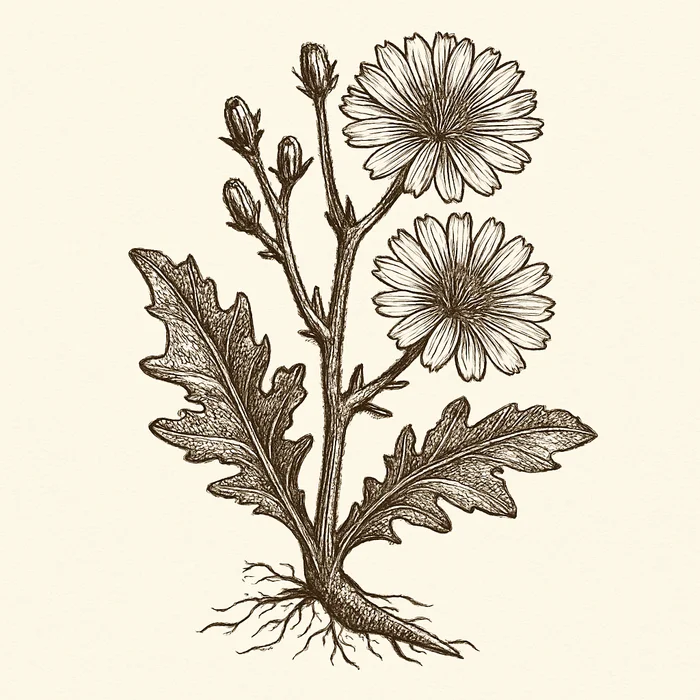
Chicory
A featured vegetable in the Longevity Diet -- used as a side dish and main ingredient including in white bean salad with chicory. Recommended serving is 200g boiled, seasoned with oil and lemon, or 180g in bean dishes.
Why It Matters for Longevity
Chicory is a bitter leafy green that delivers two overlapping longevity mechanisms: a rich prebiotic matrix of inulin-type fructans that selectively feed beneficial gut bacteria, and a concentration of chlorogenic acid and chicoric acid that provide antioxidant and anti-hyperglycaemic activity.
Chicory-derived inulin and oligofructose selectively stimulate bifidobacteria in the human colon, improving microbial composition and bowel function -- effects linked to immune modulation and reduced chronic disease risk in aging (Niness & Roberfroid, 1999, J Nutr).
As a comprehensive food, chicory provides significant quantities of vitamin K, folate, chicoric acid (a potent antioxidant), inulin-type fructans, and a wide range of phenolic compounds. Its nutritional and nutraceutical composition supports gut health, bone metabolism, and antioxidant defense simultaneously (Nwafor et al., 2017, ScientificWorldJournal).
As part of a Mediterranean dietary pattern, higher fruit and vegetable intake -- including bitter greens like chicory -- is consistently associated with significantly lower all-cause mortality risk, with each 200g/day increment associated with approximately 8% lower mortality (Aune et al., 2017, Int J Epidemiol).
Prebiotic Potency: What the Meta-Analysis Shows
The bifidogenic effect of chicory-derived inulin-type fructans is now quantified at scale. A systematic review and meta-analysis of 50 studies with 2,525 participants across all ages (0--83 years) found that chicory inulin-type fructans at doses of 3--20 g/day produced a standardized mean difference of 0.83 (95% CI: 0.58--1.08; p < 0.01) in Bifidobacterium abundance -- a statistically robust and clinically meaningful increase (Nagy et al., 2022, Crit Rev Food Sci Nutr). The effect was consistent across healthy subjects and most populations with health impairments, with the exception of people with active gastrointestinal disorders. Beneficial effects on bowel function parameters were confirmed in healthy subjects.
A randomized crossover trial in 50 healthy low-fiber-consuming adults adds granular dose data. Participants receiving 7 g/day of chicory inulin-type fructans (ITF) for four weeks showed a rise in relative Bifidobacterium abundance from 5.3% ± 5.9% to 18.7% ± 15.0% -- more than a threefold increase (Reimer et al., 2020, Am J Clin Nutr). A lower dose of 3 g/day produced detectable but smaller changes. This dose-dependence is practically useful: even modest amounts of chicory leaf in a mixed diet contribute meaningfully to the prebiotic threshold.
Why does Bifidobacterium matter for longevity? Bifidobacteria are among the most well-characterised beneficial gut genera, declining with age and associated with reduced systemic inflammation and improved immune function. Their selective stimulation by chicory fructans drives short-chain fatty acid production (primarily acetate and lactate) in the colon, which acidifies luminal pH, inhibits pathogenic bacteria, and strengthens the gut epithelial barrier.
Glucose and Liver Effects
Chicory inulin exerts measurable effects on glucose metabolism through two distinct pathways: mechanical displacement of digestible carbohydrates and direct fermentation-mediated effects on insulin sensitivity.
When chicory oligofructose or inulin replaced 20--30% of sugar in test foods (yogurt and fruit jelly), postprandial blood glucose incremental area under the curve (iAUC) fell by 15--16% compared to full-sugar controls in healthy adults, with parallel reductions in postprandial insulin (Lightowler et al., 2017, Eur J Nutr). This effect is dose-proportional: the more sugar replaced by inulin-type fructans, the greater the glycaemic attenuation (p < 0.001). The mechanism is straightforward -- inulin passes undigested to the colon, contributing no glucose to the portal circulation.
A two-month randomized placebo-controlled trial in 46 women with type 2 diabetes found that 10 g/day of chicory inulin significantly reduced fasting serum glucose and HbA1c, while also decreasing AST and ALP liver enzyme concentrations, suggesting both glycaemic and hepatic benefits (Abbasalizad Farhangi et al., 2016, Prim Care Diabetes). Systolic and diastolic blood pressure also decreased. This trial population -- older, diabetic women -- is representative of the demographic where metabolic improvements matter most for longevity outcomes.
How to Use It
Boil or blanch briefly to reduce bitterness, then dress with extra-virgin olive oil and fresh lemon -- the book's standard preparation. Serve as a side or combine with white beans, cannellini, or borlotti as in the Longevity Diet recipe. The olive oil is nutritionally important: it is required for absorption of chicory's fat-soluble vitamin K.
What to Pair It With
| Ingredient | Why | Tradition |
|---|---|---|
| White beans | Prebiotic inulin + bean fiber -- potent combined prebiotic effect for gut diversity | The Longevity Diet |
| Extra-virgin olive oil | Required for fat-soluble vitamin K absorption; classic preparation method | The Longevity Diet |
| Lemon | Acid brightens bitterness; vitamin C complements chicory's antioxidant profile | The Longevity Diet |
| Garlic | Complementary antimicrobial compounds; classic Italian flavour base | Italian |
| Anchovy | Umami depth balances bitterness in Puglian-style chicory dishes | Italian |
Flavor Profile
Bitter, slightly nutty, and mildly earthy. Raw chicory is crisp with a sharp, clean bitterness. Cooked, the bitterness mellows considerably and the texture becomes tender and slightly chewy. The characteristic bitter taste reflects lactucopicrin and chicoric acid content -- markers of bioactive polyphenol concentration.
The Science
- Niness & Roberfroid, 1999, J Nutr: Chicory-derived inulin and oligofructose selectively stimulate bifidobacteria in the human gut -- the defining paper establishing chicory inulin as a prebiotic.
- Nwafor et al., 2017, ScientificWorldJournal: Review of chicory nutritive benefits -- confirms vitamin K, folate, inulin-type fructans, and phenolic compounds including chicoric acid relevant to gut health and antioxidant defense.
- Aune et al., 2017, Int J Epidemiol: Systematic review and meta-analysis -- each 200g/day increase in vegetable intake associated with ~8% lower all-cause mortality risk across prospective cohort studies.
- Nagy et al., 2022, Crit Rev Food Sci Nutr: Meta-analysis of 50 studies (2,525 participants) -- chicory inulin-type fructans 3--20 g/day significantly increased Bifidobacterium abundance (SMD 0.83, 95% CI 0.58--1.08) across diverse populations.
- Reimer et al., 2020, Am J Clin Nutr: Randomized crossover trial (50 adults) -- 7 g/day chicory ITF raised Bifidobacterium relative abundance from 5.3% to 18.7% over four weeks in low-fiber consumers.
- Lightowler et al., 2017, Eur J Nutr: Two RCTs (40--42 healthy adults each) -- replacing 20--30% sugar with chicory inulin/oligofructose reduced postprandial glucose iAUC by 15--16% with parallel insulin reductions.
- Abbasalizad Farhangi et al., 2016, Prim Care Diabetes: Randomized trial in 46 T2D women -- 10 g/day chicory inulin for 2 months significantly reduced fasting glucose, HbA1c, and liver enzymes (AST, ALP).
References
- Niness KR, Roberfroid M. Inulin and oligofructose: what are they? J Nutr. 1999;129(7 Suppl):1402S-1406S. PMID: 10395607. doi:10.1093/jn/129.7.1402S
- Nwafor IC, Shale K, Achilonu MC. Chemical composition and nutritive benefits of chicory (Cichorium intybus) as an ideal companion plant to monogastric livestock. ScientificWorldJournal. 2017;2017:7343928. PMID: 29387778. doi:10.1155/2017/7343928
- Aune D, Giovannucci E, Boffetta P, et al. Fruit and vegetable intake and the risk of cardiovascular disease, total cancer and all-cause mortality -- a systematic review and dose-response meta-analysis of prospective studies. Int J Epidemiol. 2017;46(3):1029-1056. PMID: 28338764. doi:10.1093/ije/dyw319
- Nagy DU, Sándor-Bajusz KA, Bódy B, Decsi T, Van Harsselaar J, Theis S, Lohner S. Effect of chicory-derived inulin-type fructans on abundance of Bifidobacterium and on bowel function: a systematic review with meta-analyses. Crit Rev Food Sci Nutr. 2023;63(33):12018-12043. PMID: 35833477. doi:10.1080/10408398.2022.2098246
- Reimer RA, Soto-Vaca A, Nicolucci AC, et al. Effect of chicory inulin-type fructan-containing snack bars on the human gut microbiota in low dietary fiber consumers in a randomized crossover trial. Am J Clin Nutr. 2020;111(6):1286-1296. PMID: 32320024. doi:10.1093/ajcn/nqaa074
- Lightowler H, Thondre S, Holz A, Theis S. Replacement of glycaemic carbohydrates by inulin-type fructans from chicory (oligofructose, inulin) reduces the postprandial blood glucose and insulin response to foods: report of two double-blind, randomized, controlled trials. Eur J Nutr. 2018;57(3):1259-1268. PMID: 28255654. doi:10.1007/s00394-017-1409-z
- Abbasalizad Farhangi M, Zare Javid A, Dehghan P. The effect of enriched chicory inulin on liver enzymes, calcium homeostasis and hematological parameters in patients with type 2 diabetes mellitus: A randomized placebo-controlled trial. Prim Care Diabetes. 2016;10(4):265-271. PMID: 26872721. doi:10.1016/j.pcd.2015.10.009
Key Nutrients
| Nutrient | Per 100g | Notes |
|---|---|---|
| Inulin (prebiotic fructans) | ~4--8 g (root); ~1--2 g (leaf) | Selectively feeds Bifidobacterium and Lactobacillus; passes undigested to colon; 7 g/day raises Bifidobacterium >3-fold in 4 weeks |
| Chicoric acid | ~200--400 mg (leaf) | Metabolised to caffeic acid; antioxidant and anti-hyperglycaemic activity |
| Vitamin K | ~297 mcg | Fat-soluble; absorption enhanced by olive oil dressing -- exactly as recommended in the Longevity Diet |