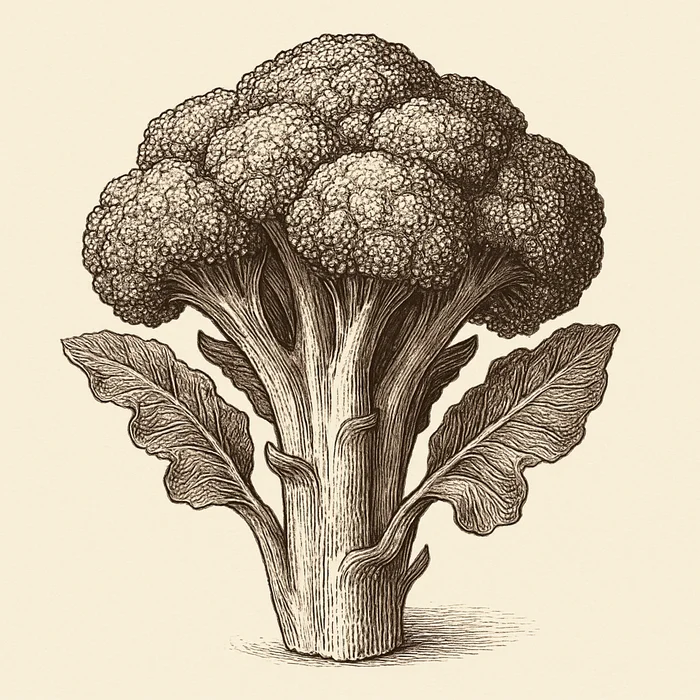
Broccoli
Broccoli is explicitly listed as a recommended vegetable in the Longevity Diet; rich in sulforaphane, vitamin C, vitamin K, and fiber with anti-cancer and anti-inflammatory properties
Why It Matters for Longevity
Broccoli is explicitly listed as a recommended vegetable in the Longevity Diet. It is rich in sulforaphane, vitamin C, vitamin K, and fiber, with anti-cancer and anti-inflammatory activity. Sulforaphane activates the Nrf2 pathway, upregulating detoxification and antioxidant enzymes; vitamin C and K support immune and bone health; fiber feeds the microbiome.
Broccoli provides folate (52 mcg per ½ cup cooked, 13% DV), vitamin C (51 mg per ½ cup cooked, 85% DV), vitamin A (60 mcg RAE per ½ cup boiled, 24% DV), calcium (21 mg per ½ cup raw), and iron (1 mg per ½ cup boiled); 150–200 g steamed or lightly cooked is the typical longevity-diet serving.
The clinical literature is consistent. A review of broccoli sprout clinical trials (Fahey et al., 2021, Front Nutr) summarizes how sulforaphane from glucoraphanin activates Nrf2-mediated cytoprotective gene expression in humans. Population-level data from a pooled cohort analysis (Aune et al., 2017, Int J Epidemiol) links higher fruit-and-vegetable intake -- including cruciferous vegetables -- to lower all-cause and cardiovascular mortality in a dose-response pattern.
Sulforaphane, Nrf2, and Cancer Risk
Sulforaphane is an isothiocyanate derived from the glucosinolate glucoraphanin. When broccoli tissue is damaged — by chewing, chopping, or food processing — the enzyme myrosinase converts glucoraphanin to sulforaphane. Heat denatures myrosinase, so cooking method is a meaningful variable in the delivered dose.
Sulforaphane's principal mechanism is disruption of the Keap1/Nrf2 complex in cells. Under baseline conditions, Keap1 keeps Nrf2 sequestered in the cytoplasm and targets it for proteasomal degradation. Sulforaphane modifies reactive cysteines on Keap1, releasing Nrf2 to translocate to the nucleus, where it drives transcription of more than 100 cytoprotective genes — including heme oxygenase-1 (HO-1), NQO1, glutathione S-transferases, and thioredoxin reductase. These enzymes collectively raise cellular antioxidant capacity and accelerate detoxification of carcinogens.
At the epidemiological level, a systematic review and meta-analysis of observational studies — 23 case-control studies (12,929 cases, 18,363 controls) and 12 cohort studies (699,482 participants) — found that higher broccoli consumption was associated with a 36% lower cancer risk in case-control studies (OR 0.64; 95% CI 0.58–0.70) and an 11% lower risk in cohort studies (RR 0.89; 95% CI 0.82–0.96) (Baladia et al., 2024, Nutrients). The consistency across different study designs and cancer types strengthens the inference that this is not a residual confounding effect.
For colorectal cancer specifically, a meta-analysis of 24 case-control and 11 prospective studies found an overall relative risk of 0.82 (95% CI 0.75–0.90) — an 18% reduction — with broccoli explicitly analyzed as a protective food among cruciferous vegetables (Wu et al., 2013, Ann Oncol).
Cooking Method and Sulforaphane Delivery
The gap between the sulforaphane content of raw broccoli and what is actually absorbed after cooking is large. Boiling at 100°C for more than 2–3 minutes fully inactivates myrosinase, reducing sulforaphane formation by 80–90% relative to raw broccoli; the colonic bacteria can perform partial hydrolysis of remaining glucoraphanin, but efficiency is low (10–12% recovery versus 32–80% from raw or minimally cooked broccoli with intact enzyme).
A randomized crossover trial in 12 healthy adults quantified the effect precisely: consuming 200 g of cooked broccoli alone produced urinary sulforaphane metabolite excretion of 9.8 ± 5.1 μmol per gram creatinine. Adding just 1 g of powdered brown mustard (a source of exogenous myrosinase) to the same cooked broccoli increased excretion to 44.7 ± 33.9 μmol — more than a 4-fold increase (Okunade et al., 2018, Mol Nutr Food Res). This is the first in vivo human evidence that exogenous myrosinase from a common condiment can compensate for cooking-induced enzyme inactivation.
The practical protocols that preserve sulforaphane: chop raw broccoli and allow 40 minutes before cooking (myrosinase acts on glucoraphanin during the rest period, producing sulforaphane before heat is applied); steam at low temperature for 3–4 minutes rather than boiling; or add a small amount of raw mustard, daikon, or watercress — all of which supply active myrosinase — to cooked broccoli at the table.
Sulforaphane and Cardiovascular Protection
Beyond cancer, sulforaphane exerts cardiovascular protection through the same Nrf2 axis. Nrf2 activation in vascular cells upregulates antioxidant and detoxification enzymes in endothelial and smooth muscle cells, reducing oxidative modification of LDL, suppressing NF-κB-driven vascular inflammation, and improving endothelial function. A dedicated review of the cardiovascular evidence found that sulforaphane's Nrf2 induction reduces the oxidative stress driving cardiac dysfunction, atherosclerosis, hypertension, and ischemia-reperfusion injury — operating through MAP kinase, PI3K/Akt, and PKC pathways that converge on Nrf2 nuclear translocation (Bai et al., 2015, Oxid Med Cell Longev).
How to Use It
Pairs well with garlic, olive oil, lemon. Chop before cooking and allow a 40-minute rest to maximize glucoraphanin conversion. Steam or stir-fry; avoid boiling. Add raw mustard to cooked broccoli to restore myrosinase activity. Use as a vegetable in your daily meals according to the Longevity Diet guidelines.
What to Pair It With
| Ingredient | Why | Tradition |
|---|---|---|
| garlic | See synergies | culinary tradition |
| olive oil | See synergies | culinary tradition |
| lemon | See synergies | culinary tradition |
| anchovies | See synergies | culinary tradition |
| chickpeas | See synergies | culinary tradition |
Synergies
- Olive Oil (synergy): Olive oil enhances absorption of fat-soluble vitamins K and A in broccoli; polyphenols complement anti-inflammatory effects of sulforaphane - Garlic (synergy): Garlic's diallyl disulfide and broccoli's sulforaphane both activate Nrf2 and inhibit NF-κB; combination shows additive anti-cancer effects in vitro - Sardines (complement): Sardine calcium and vitamin D pair well with broccoli's vitamin K2 for bone health in a complete longevity meal - Mustard (functional): A teaspoon of mustard powder added to cooked broccoli delivers exogenous myrosinase, raising sulforaphane bioavailability more than 4-fold compared to cooked broccoli alone
Flavor Profile
Taste: mildly bitter, earthy, slightly sweet when roasted, vegetal. Aroma: sulfurous when overcooked, fresh and grassy when raw, nutty when roasted. Texture: firm, crunchy when raw, tender-crisp when steamed, soft when boiled. Category: cruciferous vegetable.
The Science
- Fahey et al., 2021, Front Nutr: Review of broccoli-sprout clinical trials — sulforaphane from glucoraphanin activates Nrf2-mediated cytoprotective gene expression in humans.
- Aune et al., 2017, Int J Epidemiol: Pooled cohort analysis — higher fruit and vegetable intake linked to lower all-cause, cardiovascular, and cancer mortality in dose-response pattern.
- Baladia et al., 2024, Nutrients: Meta-analysis of 23 case-control studies and 12 cohort studies (699,482 participants) — broccoli consumption associated with 36% lower cancer risk (case-control OR 0.64) and 11% lower cancer risk (cohort RR 0.89).
- Wu et al., 2013, Ann Oncol: Meta-analysis of 35 studies — cruciferous vegetable intake (including broccoli) associated with 18% lower colorectal cancer risk (RR 0.82; 95% CI 0.75–0.90).
- Okunade et al., 2018, Mol Nutr Food Res: RCT in 12 adults — adding 1g mustard powder to cooked broccoli raised urinary sulforaphane metabolite excretion from 9.8 to 44.7 μmol/g creatinine, a >4-fold increase.
- Bai et al., 2015, Oxid Med Cell Longev: Review — sulforaphane activates Nrf2 via Keap1/Nrf2/ARE pathway in vascular cells, reducing oxidative stress driving atherosclerosis, hypertension, and cardiac dysfunction.
References
- Fahey JW, Kensler TW. The Challenges of Designing and Implementing Clinical Trials With Broccoli Sprouts… and Turning Evidence Into Public Health Action. Front Nutr. 2021;8:648788. PMID: 33996874. doi:10.3389/fnut.2021.648788
- Aune D, Giovannucci E, Boffetta P, et al. Fruit and vegetable intake and the risk of cardiovascular disease, total cancer and all-cause mortality — a systematic review and dose-response meta-analysis of prospective studies. Int J Epidemiol. 2017;46(3):1029-1056. PMID: 28338764. doi:10.1093/ije/dyw319
- Baladia E, Moñino M, Pleguezuelos E, Russolillo G, Garnacho-Castaño MV. Broccoli Consumption and Risk of Cancer: An Updated Systematic Review and Meta-Analysis of Observational Studies. Nutrients. 2024;16(12):1929. PMID: 38892516.
- Wu QJ, Yang Y, Vogtmann E, et al. Cruciferous vegetables intake and the risk of colorectal cancer: a meta-analysis of observational studies. Ann Oncol. 2013;24(4):1079-1087. PMID: 23211939. doi:10.1093/annonc/mds601
- Okunade O, Niranjan K, Ghawi SK, Kuhnle G, Methven L. Supplementation of the Diet by Exogenous Myrosinase via Mustard Seeds to Increase the Bioavailability of Sulforaphane in Healthy Human Subjects after the Consumption of Cooked Broccoli. Mol Nutr Food Res. 2018;62(18):e1700980. PMID: 29806738. doi:10.1002/mnfr.201700980
- Bai Y, Wang X, Zhao S, Ma C, Cui J, Zheng Y. Sulforaphane Protects against Cardiovascular Disease via Nrf2 Activation. Oxid Med Cell Longev. 2015;2015:407580. PMID: 26583056. doi:10.1155/2015/407580
Key Nutrients
| Nutrient | Per 100g | Notes |
|---|---|---|
| Sulforaphane (from glucoraphanin) | ~40–60 mg glucoraphanin (raw) | Activated by myrosinase; chopping and resting before cooking maximizes conversion; light steaming preferred over boiling; exogenous myrosinase from mustard restores >4-fold sulforaphane delivery after cooking |
| Vitamin C | 89 mg (raw); 65 mg (lightly steamed) | Water-soluble; significant loss with boiling; steaming or stir-frying preserves more |
| Folate | 63 mcg (raw) | Critical for DNA synthesis and methylation; heat-sensitive, prefer gentle cooking |
| Vitamin K1 | 102 mcg (raw) | Fat-soluble; substantially enhanced by co-ingestion with olive oil |
| Indole-3-carbinol | ~100 mg (raw) | Supports estrogen metabolism and tumor suppressor pathways; bioavailability improved in acidic environment (stomach acid) |