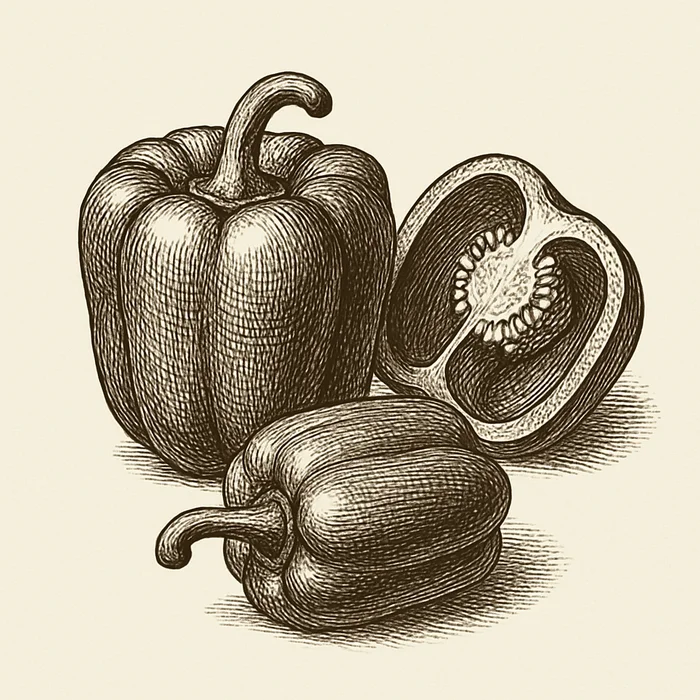
Bell Peppers
Bell peppers are one of the most nutrient-dense vegetables available, with red varieties delivering more vitamin C per gram than any commonly consumed fruit or vegetable, alongside a distinctive carotenoid profile — capsanthin, capsorubin, and beta-carotene — that sets them apart from most other produce.
Why It Matters for Longevity
Vitamin C and Mortality Risk
The case for bell peppers begins with plasma ascorbate. The EPIC-Norfolk prospective study followed 19,496 men and women for four years and found a clear inverse relationship between plasma vitamin C concentration and all-cause mortality: each 20 µmol/L increment in plasma ascorbate was associated with approximately a 13% reduction in mortality risk, independent of age, systolic blood pressure, cholesterol, smoking, and diabetes (Khaw et al., 2001, Lancet). A single raw red bell pepper (about 160 g) contains roughly 200 mg of vitamin C — enough to substantially shift plasma ascorbate levels. This positions bell peppers as one of the most practical dietary vehicles for maintaining the plasma concentrations associated with reduced mortality in large cohort data.
The mechanism involves vitamin C acting as the dominant water-soluble antioxidant in plasma, regenerating vitamin E at membrane surfaces, and supporting collagen hydroxylation via prolyl and lysyl hydroxylase activity. These enzymes require ascorbate as a cofactor; without it, collagen structure degrades — relevant not just for skin but for arterial integrity and wound healing across the lifespan.
Carotenoids: Capsanthin, Capsorubin, and Beta-Carotene
Red bell peppers are the primary dietary source of capsanthin and capsorubin — keto-carotenoids that are structurally distinct from the carotenoids found in tomatoes or carrots. An in vitro digestion study modeling gastrointestinal absorption found that capsanthin had bioaccessibility of 36–40%, among the highest of any carotenoid tested, outperforming beta-carotene (4.0%), beta-cryptoxanthin (6.1%), and all other carotenoids measured — suggesting that the unique ester-bound form in which capsanthin occurs in bell peppers makes it more efficiently transferred from the food matrix to the micellar phase during digestion (Pugliese et al., 2014, Eur J Nutr).
Once absorbed, capsanthin distributes primarily in LDL (44%) and HDL (43%) fractions, with a half-life of approximately 20 hours, compared to 222 hours for lycopene — meaning regular daily consumption is required to maintain circulating levels (Oshima et al., 1997, J Nutr). The anti-inflammatory potential of capsanthin operates through free radical quenching and inhibition of lipid peroxidation. Unlike provitamin A carotenoids, capsanthin has no vitamin A activity, so there is no toxicity ceiling from dietary consumption.
Flavonoids: Quercetin and Luteolin
Bell peppers — particularly yellow varieties — contain meaningful amounts of quercetin and luteolin, two flavones also present in onions, capers, and herbs. A meta-analysis of 15 prospective cohort studies (combined n not specified, covering 386,610 participants) found that high total flavonoid intake was associated with a pooled relative risk of 0.86 for cardiovascular disease mortality (95% CI: 0.75–0.98) and 0.86 for all-cause mortality (95% CI: 0.73–1.00) compared to low flavonoid intake (Kim & Je, 2017, Clin Nutr ESPEN). The flavone subclass — which includes quercetin and luteolin from bell peppers — showed a significant inverse association with CVD mortality across the cohorts analyzed. The mechanism involves flavone inhibition of LDL oxidation, modulation of eNOS activity (increasing nitric oxide bioavailability), and suppression of platelet aggregation.
Vegetable Intake and All-Cause Mortality
Bell peppers fit within the broader evidence base for vegetable intake and longevity. A dose-response meta-analysis covering 95 prospective studies found that vegetable intake reduces cardiovascular disease, cancer, and all-cause mortality in a dose-dependent fashion, with the strongest marginal gains occurring between zero and two servings daily (Aune et al., 2017, Int J Epidemiol). Bell peppers contribute to this dose not only through vitamin C and carotenoids but through fiber, folate, and vitamin B6 — micronutrients supporting homocysteine metabolism and immune cell proliferation.
How to Use It
Pairs well with olive oil, tomatoes, garlic. Use as a vegetable in your daily meals according to the Longevity Diet guidelines. For maximum vitamin C, eat raw or lightly roasted; prolonged boiling degrades ascorbate. For carotenoids, roast or sauté with a small amount of fat — bioaccessibility increases as the cell matrix softens and fat facilitates micellar incorporation.
What to Pair It With
| Ingredient | Why | Tradition |
|---|---|---|
| olive oil | Fat enhances capsanthin and beta-carotene absorption into micellar phase | culinary tradition |
| tomatoes | Overlapping carotenoid coverage; lycopene from tomatoes + capsanthin from peppers | culinary tradition |
| garlic | Anti-inflammatory synergy; Mediterranean base flavor combination | culinary tradition |
| chickpeas | Vitamin C boosts non-heme iron absorption from legumes by 2–6× | culinary tradition |
| farro | Same mechanism; C from peppers rescues the limited iron bioavailability of whole grains | culinary tradition |
Synergies
- Olive Oil (synergy): Fat from olive oil dramatically enhances absorption of fat-soluble carotenoids (beta-carotene, capsanthin) from bell peppers — bioaccessibility of capsanthin is near-zero without co-ingested lipid.
- Iron-Rich Legumes (synergy): High vitamin C content reduces ferric iron (Fe³⁺) to ferrous iron (Fe²⁺) at the intestinal brush border, boosting non-heme iron absorption from legumes such as lentils, fava beans, and peas.
- Tomatoes (complement): Both are lycopene/carotenoid-rich Mediterranean vegetables that combine well for anti-inflammatory, anti-cancer phytonutrient coverage.
Flavor Profile
Taste: sweet, mildly bitter (green), fruity (red/yellow), crisp. Aroma: fresh, grassy, sweet-vegetal when roasted. Texture: crunchy raw, tender when roasted, silky when peeled. Category: vegetable.
The Science
- Khaw et al., 2001, Lancet: Plasma vitamin C inversely associated with all-cause mortality in EPIC-Norfolk (n=19,496); each 20 µmol/L increment reduced mortality risk by ~13%.
- Aune et al., 2017, Int J Epidemiol: Meta-analysis of 95 prospective studies: higher vegetable intake dose-dependently reduces cardiovascular disease, cancer, and all-cause mortality.
- Pugliese et al., 2014, Eur J Nutr: In vitro digestion study: capsanthin bioaccessibility from red chili peppers 36–40%, highest among all carotenoids tested; beta-carotene only 4.0%.
- Oshima et al., 1997, J Nutr: Human pharmacokinetics of dietary capsanthin from paprika juice; plasma half-life 20.1 hours; distributed primarily in LDL (44%) and HDL (43%) fractions.
- Kim & Je, 2017, Clin Nutr ESPEN: Meta-analysis of 15 prospective cohorts; high flavonoid intake associated with pooled RR 0.86 for CVD mortality and 0.86 for all-cause mortality.
References
- Khaw KT, Bingham S, Welch A, et al. Relation between plasma ascorbic acid and mortality in men and women in EPIC-Norfolk prospective study. Lancet. 2001;357(9257):657-63. PMID: 11247548. doi:10.1016/S0140-6736(00)04128-3
- Aune D, Giovannucci E, Boffetta P, et al. Fruit and vegetable intake and the risk of cardiovascular disease, total cancer and all-cause mortality — a systematic review and dose-response meta-analysis of prospective studies. Int J Epidemiol. 2017;46(3):1029-1056. PMID: 28338764. doi:10.1093/ije/dyw319
- Pugliese A, O'Callaghan Y, Tundis R, et al. In vitro investigation of the bioaccessibility of carotenoids from raw, frozen and boiled red chili peppers (Capsicum annuum). Eur J Nutr. 2014;53(5):1131-41. PMID: 23820691. doi:10.1007/s00394-013-0611-3
- Oshima S, Sakamoto H, Ishiguro Y, Terao J. Accumulation and clearance of capsanthin in blood plasma after the ingestion of paprika juice in men. J Nutr. 1997;127(8):1475-9. PMID: 9237940. doi:10.1093/jn/127.8.1475
- Kim Y, Je Y. Flavonoid intake and mortality from cardiovascular disease and all causes: a meta-analysis of prospective cohort studies. Clin Nutr ESPEN. 2017;20:68-77. PMID: 29072172. doi:10.1016/j.clnesp.2017.03.004
Key Nutrients
| Nutrient | Per 100g | Notes |
|---|---|---|
| Vitamin C | 128 mg (red, raw) | Water-soluble; best preserved raw or lightly cooked; co-ingestion with iron-rich foods enhances non-heme iron absorption |
| Beta-carotene (pro-vitamin A) | 1624 mcg (red, raw) | Fat-soluble; absorption significantly increased with co-ingested fat such as olive oil |
| Capsanthin (carotenoid) | ~4 mg (red, raw) | Unique keto-xanthophyll; bioaccessibility 36–40% — among highest of any carotenoid; distributes in LDL/HDL; half-life ~20 hours |
| Quercetin / Luteolin | ~5 mg combined (yellow, raw) | Flavones associated with reduced CVD mortality in meta-analyses; inhibit LDL oxidation and platelet aggregation |
| Vitamin B6 | 0.29 mg (red, raw) | Supports neurotransmitter synthesis and immune function; bioavailable from fresh peppers |