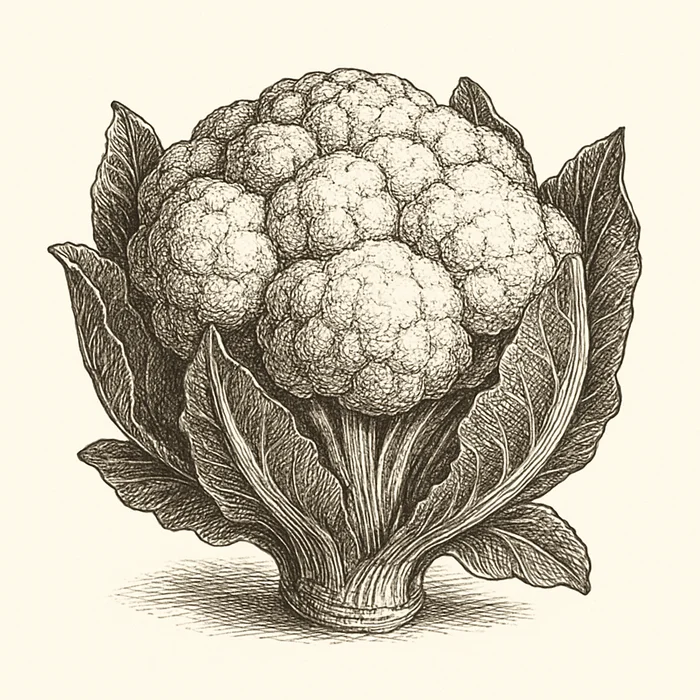
Cauliflower
Cauliflower is a cruciferous vegetable providing meaningful quantities of vitamin C (48 mg per 100g raw), folate, choline, and a group of compounds -- glucosinolates -- that set cruciferous vegetables apart from all other plant families. Vitamin C is the primary water-soluble antioxidant in plasma, required for collagen biosynthesis, immune cell function, and regeneration of vitamin E.
Why It Matters for Longevity
Glucosinolates in cauliflower (principally glucobrassicin and glucoraphanin) are converted by the enzyme myrosinase into bioactive isothiocyanates and indole-3-carbinol when the vegetable is chopped or chewed. A comprehensive review (Barrera et al., 2012, Proc Nutr Soc) documented that these isothiocyanates inhibit phase I activating enzymes and induce phase II detoxifying enzymes -- effectively both suppressing carcinogen activation and accelerating carcinogen elimination. This dual mechanism underlies the consistent epidemiological associations between cruciferous vegetable intake and cancer risk reduction.
A meta-analysis (Liu & Lv, 2013, Breast) of prospective cohort studies found cruciferous vegetable intake inversely associated with breast cancer risk, with each additional serving per week associated with a 3% reduction in risk. The practical implication: light cooking preserves isothiocyanate bioavailability better than boiling (which leaches glucosinolates into cooking water), while thorough chewing of raw cauliflower activates the full myrosinase pathway.
Glucosinolates, Isothiocyanates, and the NRF2 Pathway
Cauliflower's glucosinolate content is lower than broccoli's -- roughly 25--60 mg/100g fresh weight versus 60--150 mg in broccoli florets -- but the biochemical machinery is the same. Glucoraphanin, upon hydrolysis by myrosinase, yields sulforaphane, which activates the NRF2 (nuclear factor erythroid 2-related factor 2) transcription factor. NRF2 upregulates a battery of cytoprotective and antioxidant response genes including heme oxygenase-1, NAD(P)H:quinone oxidoreductase 1, and glutathione S-transferases. Glucobrassicin yields indole-3-carbinol (I3C), which in the acidic stomach environment dimerizes to 3,3'-diindolylmethane (DIM).
I3C and DIM act through complementary mechanisms: I3C shifts estrogen metabolism toward the less estrogenic 2-hydroxyestrone pathway (reducing the 16α-hydroxyestrone:2-hydroxyestrone ratio), while DIM modulates cell cycle checkpoints and promotes apoptosis in transformed cells. A 2023 review of clinical and preclinical data across multiple cancer types confirmed that I3C and DIM regulate "cyclins, ER-dependent-independent pathways, and hallmarks of cancer" and have demonstrated pharmacodynamic activity in cervical dysplasia, prostate, and breast cancer trials -- though bioavailability limitations remain a practical constraint (Reyes-Hernández et al., 2023, Cancer Cell Int).
Cruciferous Vegetables and Cancer Cohort Evidence
The epidemiological literature on cruciferous vegetables and cancer is the largest and most consistent in plant food research. A meta-analysis of 35 observational studies (24 case-control and 11 prospective) found cruciferous vegetable intake inversely associated with colorectal cancer risk, with a pooled relative risk of 0.82 (95% CI 0.75--0.90) for highest versus lowest intake categories (Wu et al., 2013, Ann Oncol). The association was consistent across colon and distal colon subsites.
A more recent systematic review and dose-response meta-analysis of 226 case-control and cohort studies identified protective associations across nine cancer types, with an overall odds ratio of 0.77 for cruciferous vegetable consumers versus non-consumers. The analysis further delineated optimal intake levels: approximately 5.4 servings per week was associated with the greatest protection for colorectal and lung cancer; prostate cancer benefit plateaued at around 3 servings per week (Zheng et al., 2025, Nutr Rev). Importantly, this analysis observed stronger associations in Asian populations for lung and upper digestive cancers, and in American populations for colorectal and gynecological cancers, suggesting gene-environment interactions may modify the protective effect.
Cauliflower's glucosinolate profile differs from broccoli in the relative abundance of glucobrassicin (which yields I3C) versus glucoraphanin (which yields sulforaphane). Both forms are biologically active, but broccoli delivers higher sulforaphane-forming potential per gram. Cauliflower compensates with lower calories per serving and a milder flavor, making it easier to reach the 3--5 servings per week where cohort data concentrate the benefit.
Choline: the Underappreciated Nutrient
Cauliflower is one of the more concentrated plant sources of choline, providing approximately 45 mg per 100g -- meaningful given that most plant foods contribute far less. The adequate intake for choline is 425 mg/day for women and 550 mg/day for men, and surveys consistently find most adults fall short, particularly those eating minimal meat or eggs.
Choline is essential for membrane phospholipid synthesis (phosphatidylcholine is the principal structural phospholipid in cell membranes), for methyl-group donation through the methionine cycle, and for synthesis of acetylcholine, the neurotransmitter central to learning and memory. The brain-health relevance is not merely mechanistic: a prospective cohort study of 2,497 Finnish men followed for a median of 21.9 years found that those in the highest quartile of phosphatidylcholine intake had a 28% lower risk of incident dementia (95% CI: 1%--48%, P-trend = 0.02) compared to those in the lowest quartile. The same cohort showed better performance on tests of verbal fluency and memory with higher choline intake (Ylilauri et al., 2019, Am J Clin Nutr). Including cauliflower regularly is one of the more efficient plant-based strategies for improving dietary choline intake without relying on eggs or organ meat.
How to Use It
Pairs well with turmeric, garlic, extra-virgin olive oil. Roasting at high heat (200--220°C) develops Maillard browning and concentrates sweetness. Steaming preserves glucosinolates better than boiling; thorough chewing of raw florets activates myrosinase fully. Avoid prolonged boiling: 10 minutes of boiling can reduce glucosinolate content by 30--60% as these water-soluble compounds leach into cooking water. A sprinkle of ground mustard seed (which contains myrosinase) added after cooking can partially restore the conversion pathway when cooking cannot be avoided.
What to Pair It With
| Ingredient | Why | Tradition |
|---|---|---|
| turmeric | Curcumin + isothiocyanates synergistically inhibit NF-kB signaling | General culinary |
| garlic | Allicin and isothiocyanates both activate Nrf2 through independent pathways | General culinary |
| extra-virgin olive oil | Increases fat-soluble carotenoid absorption; polyphenols act synergistically with glucosinolate metabolites | General culinary |
| lemon | Acid enhances flavor; vitamin C protects against glucosinolate oxidation | General culinary |
| tahini | Fat source for roasted cauliflower; complements nutty roasted flavors | Middle Eastern |
Synergies
- Turmeric (synergy): Curcumin from turmeric and isothiocyanates from cauliflower synergistically inhibit NF-kB signaling, providing additive anti-inflammatory effects.
- Extra-Virgin-Olive-Oil (complement): Olive oil increases fat-soluble carotenoid absorption from cauliflower and contributes polyphenols that act synergistically with glucosinolate metabolites.
- Garlic (synergy): Garlic's allicin and cauliflower's isothiocyanates both activate Nrf2 through independent pathways, providing additive induction of antioxidant defense genes.
Flavor Profile
Taste: mild, slightly nutty when roasted, subtly sweet. Aroma: mild sulfurous (raw), nutty and caramelized (roasted). Texture: firm and crunchy (raw), tender (steamed), crispy (roasted). Category: cruciferous vegetable.
The Science
- Barrera et al., 2012, Proc Nutr Soc: Review of isothiocyanates from cruciferous vegetables — dual mechanism of inhibiting phase I carcinogen-activating enzymes and inducing phase II detoxifying enzymes; epigenetic and antioxidant effects relevant to cancer prevention.
- Liu & Lv, 2013, Breast: Meta-analysis of prospective cohort studies — cruciferous vegetable intake inversely associated with breast cancer risk; ~3% risk reduction per weekly serving.
- Wu et al., 2013, Ann Oncol: Meta-analysis of 35 studies; cruciferous vegetable intake RR 0.82 (95% CI 0.75--0.90) for colorectal cancer; consistent across case-control and prospective designs.
- Reyes-Hernández et al., 2023, Cancer Cell Int: Review of I3C and DIM mechanisms — cyclins regulation, ER-dependent/independent pathways, NF-kB; clinical evidence in cervical, prostate, and breast cancer.
- Zheng et al., 2025, Nutr Rev: Dose-response meta-analysis, 226 studies, 9 cancer types; OR 0.77 for cruciferous consumers; optimal intake ~5.4 servings/week for colorectal and lung cancer.
- Ylilauri et al., 2019, Am J Clin Nutr: KIHD prospective cohort (n=2,497, 21.9-year follow-up); highest phosphatidylcholine quartile associated with 28% lower dementia risk; better verbal memory scores.
- Vitamin C: 48 mg per 100g raw cauliflower; highly bioavailable when raw or lightly steamed; degrades rapidly with prolonged boiling.
- Glucosinolate → isothiocyanate conversion requires myrosinase activation; activated by chopping, chewing, or fermentation; inactivated by prolonged cooking.
References
- Barrera LN, Cassidy A, Johnson IT, Bao Y, Belshaw NJ. Epigenetic and antioxidant effects of dietary isothiocyanates and selenium: potential implications for cancer chemoprevention. Proc Nutr Soc. 2012;71(2):237-245. PMID: 22391025. doi:10.1017/S002966511200016X
- Liu X, Lv K. Cruciferous vegetables intake is inversely associated with risk of breast cancer: a meta-analysis. Breast. 2013;22(3):309-313. PMID: 22877795. doi:10.1016/j.breast.2012.07.013
- Wu QJ, Yang Y, Vogtmann E, et al. Cruciferous vegetables intake and the risk of colorectal cancer: a meta-analysis of observational studies. Ann Oncol. 2013;24(4):1079-1087. PMID: 23211939. doi:10.1093/annonc/mds601
- Reyes-Hernández OD, Mejía-García A, Figueroa-González G, et al. 3,3'-Diindolylmethane and indole-3-carbinol: potential therapeutic molecules for cancer chemoprevention and treatment via regulating cellular signaling pathways. Cancer Cell Int. 2023;23(1):180. PMID: 37633886. doi:10.1186/s12935-023-03023-8
- Zheng S, Yan J, Wang J, et al. Unveiling the Effects of Cruciferous Vegetable Intake on Different Cancers: A Systematic Review and Dose-Response Meta-analysis. Nutr Rev. 2025;83(1):e24-e40. PMID: 39348271. doi:10.1093/nutrit/nuae135
- Ylilauri MPT, Voutilainen S, Lönnroos E, et al. Associations of dietary choline intake with risk of incident dementia and with cognitive performance: the Kuopio Ischaemic Heart Disease Risk Factor Study. Am J Clin Nutr. 2019;110(6):1416-1423. PMID: 31360988. doi:10.1093/ajcn/nqz148
Key Nutrients
| Nutrient | Per 100g | Notes |
|---|---|---|
| Vitamin C | 48.2 mg (raw) | Highly bioavailable when raw or lightly cooked; degrades rapidly with boiling (up to 50% loss). Maximize by steaming or roasting. |
| Glucosinolates | ~25-60 mg (fresh) | Converted to bioactive isothiocyanates by myrosinase; cooking inactivates myrosinase but gut bacteria provide partial conversion. Lower glucoraphanin than broccoli but meaningful glucobrassicin (I3C precursor). |
| Choline | 45 mg | Plant-based choline; supports membrane phospholipid synthesis, methyl metabolism, and acetylcholine production; 45 mg contributes ~8-10% of adequate intake per 100g serving. |
| Folate | 57 mcg | Natural food folate; ~50% bioavailability; supports DNA synthesis and repair processes central to healthy aging. |