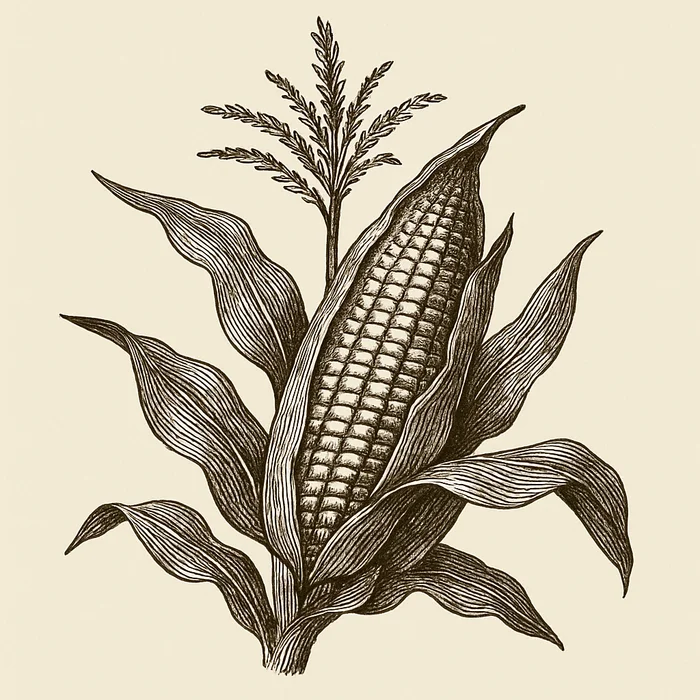
Corn
Corn is used in barley salad in the Longevity Diet. Corn tortilla provides calcium (46 mg per 6-inch tortilla, 5% DV). Polenta is listed as an acceptable pasta substitute (40 g serving). Beyond its role as a carbohydrate staple, yellow corn is among the richest dietary sources of lutein and zeaxanthin -- the carotenoids that accumulate in the retinal macula and protect against age-related macular degeneration.
Why It Matters for Longevity
Yellow corn delivers two carotenoids that most people know little about: lutein and zeaxanthin (~644 mcg per 100g). These fat-soluble pigments selectively accumulate in the macula of the eye, where they function as biological blue-light filters and antioxidants. Abdel-Aal et al. (2013, Nutrients) systematically characterised the dietary sources of lutein and zeaxanthin and confirmed corn as one of the richest cereal sources, with high variability by variety (yellow > white > blue corn). Li et al. (2023, Nutr Rev) reviewed the human evidence and found that dietary zeaxanthin and lutein intake is associated with lower risk of age-related macular degeneration and improved functional visual performance -- effects that become increasingly relevant as longevity extends the years of visual function demanded.
Whole grain corn (polenta, tortillas, hominy) also contributes to the whole-grain dietary pattern associated with reduced cancer and cardiovascular risk. Hu et al. (2023, Am J Clin Nutr) found in a large prospective cohort that higher whole grain consumption was associated with significantly lower cancer risk, with dose-response relationships across multiple cancer types.
A practical note on corn tortillas: traditional nixtamalization (treating corn with calcium hydroxide/lime) not only increases calcium content dramatically but also releases niacin bound in phytic acid -- the absence of this process in populations relying on untreated corn historically caused pellagra. Nixtamalized tortilla corn is nutritionally superior to unprocessed maize for calcium and niacin bioavailability.
Polenta made from corn contains retrograded starch after cooling, which behaves as resistant starch -- a prebiotic that selectively feeds beneficial colon bacteria and produces short-chain fatty acids (especially butyrate), supporting gut health and reducing postprandial glucose response.
Heat Processing Increases Ferulic Acid Bioavailability
Corn contains ferulic acid bound to arabinoxylan in the cell wall — one of the few major food sources of this hydroxycinnamic acid phenol. In raw corn, most of the ferulic acid is esterified and inaccessible; the plant's cell wall locks it away. Heat changes this dramatically. Dewanto et al. (2002, J Agric Food Chem) found that thermal processing at 115 °C for 25 minutes increased corn's total antioxidant activity by 44%, ferulic acid content by 550%, and total phenolics by 54%, while vitamin C fell by only 25%. The paradox — that processing improves the antioxidant profile — arises because heat breaks the ester bond between ferulic acid and the cell-wall polysaccharide, releasing the free form. Free ferulic acid is absorbed in the small intestine, whereas bound ferulic acid requires colonic microbial esterases for release. Cooking, roasting, and popping corn therefore meaningfully increases the dose of ferulic acid bioavailable per serving. Ferulic acid acts as a radical scavenger, inhibits LDL oxidation, and exerts anti-inflammatory effects through NF-κB pathway suppression.
Blue and Purple Corn: Anthocyanins and Cardiovascular Protection
Yellow corn dominates the nutrition conversation, but blue and purple corn varieties contain substantial anthocyanins — the flavonoid pigments largely absent from yellow varieties. The primary anthocyanin in purple corn is cyanidin-3-glucoside (C3G), which has demonstrated anti-inflammatory activity in human cell models. At the population level, Kimble et al. (2019, Crit Rev Food Sci Nutr) conducted a systematic review and meta-analysis of prospective cohort studies and found that the highest dietary anthocyanin intake was associated with a 9% lower risk of coronary heart disease (RR = 0.91, 95% CI 0.83–0.99) and an 8% lower risk of CVD mortality (RR = 0.92, 95% CI 0.87–0.97). The mechanism involves multiple pathways: anthocyanins activate endothelial nitric oxide synthase (eNOS), improving vascular tone; they inhibit platelet aggregation; and they suppress COX-1 and COX-2 enzymatic activity to reduce prostanoid-driven inflammation.
More specifically on the inflammation side, Fallah et al. (2020, Food Chem Toxicol) meta-analyzed 32 randomized controlled trials and found that anthocyanin supplementation significantly reduced CRP by 0.33 mg/l (p = 0.003), IL-6 by 0.41 pg/ml (p = 0.004), and TNF-α by 0.64 pg/ml (p = 0.023), while adiponectin — an anti-inflammatory adipokine associated with lower cardiovascular risk — increased by 0.75 µg/ml (p = 0.004). Blue and purple corn used in tortillas, tamales, chicha, and other traditional preparations delivers these anthocyanins in a culturally familiar form; yellow corn does not.
Resistant Starch and Glycemic Modulation
The resistant starch formed when cooked polenta or tortillas cool adds a meaningful metabolic layer. Retrograded starch (RS3) and the native granule-bound resistant starch in corn (RS2) both escape digestion in the small intestine and reach the colon, where they are fermented by Bacteroides and Bifidobacterium species to produce SCFAs. Xiong et al. (2021, Br J Nutr) meta-analyzed 19 RCTs and found that resistant starch significantly reduced fasting plasma glucose by 0.09 mmol/l overall and 0.16 mmol/l at doses above 28 g/day (p < 0.001), and improved HOMA-IR by −0.33 (p = 0.001). The practical implication is straightforward: allowing polenta to cool, or eating day-old corn tortillas rather than freshly pressed ones, substantially increases the resistant starch content and reduces the glycemic load per serving.
How to Use It
Use corn in barley and vegetable salads (the Longevity Diet preparation). For polenta: cook as directed, then cool -- chilled polenta contains more resistant starch than freshly cooked. For tortillas: use nixtamalized corn tortillas for the calcium and niacin benefit. Always dress carotenoid-rich corn dishes with olive oil -- lutein and zeaxanthin are fat-soluble and require dietary fat for absorption.
What to Pair It With
| Ingredient | Why | Tradition |
|---|---|---|
| Extra-virgin olive oil | Fat required for absorption of fat-soluble lutein and zeaxanthin | Mediterranean |
| Legumes (black beans) | Classic Three Sisters pairing; complementary amino acids (corn low in lysine, beans rich in it) | Mexican / Native American |
| Barley | Combined whole grains in the Longevity Diet salad preparation | The Longevity Diet |
| Tomatoes | Carotenoid synergy; classic Mediterranean and Mexican combinations | Global |
| Lemon | Vitamin C enhances overall antioxidant profile | Mediterranean |
Flavor Profile
Sweet and mildly starchy when fresh. Polenta is earthy, nutty, and grounding. Grilled corn develops caramel sweetness and smoky char. Tortillas have a distinctive lime note from nixtamalization and a satisfying chew. Dried corn meal and polenta are remarkably versatile -- savory or sweet, dense or light.
The Science
- Abdel-Aal et al., 2013, Nutrients: Corn characterised as one of the richest cereal sources of lutein and zeaxanthin; yellow varieties contain substantially more than white; carotenoids fat-soluble and require dietary fat for absorption.
- Li et al., 2023, Nutr Rev: Dietary zeaxanthin and lutein associated with lower risk of age-related macular degeneration and improved functional visual performance in dose-response meta-analysis of prospective studies.
- Hu et al., 2023, Am J Clin Nutr: Higher whole grain consumption associated with significantly lower cancer risk in large prospective cohort; dose-response relationships across multiple cancer types.
- Dewanto et al., 2002, J Agric Food Chem: Thermal processing of sweet corn at 115 °C for 25 min increased antioxidant activity by 44%, ferulic acid by 550%, and total phenolics by 54% — demonstrating that heat liberates bound ferulic acid from the arabinoxylan cell wall, substantially increasing its bioavailability.
- Kimble et al., 2019, Crit Rev Food Sci Nutr: Meta-analysis of prospective cohorts — highest dietary anthocyanin intake associated with 9% lower coronary heart disease risk (RR 0.91, 95% CI 0.83–0.99) and 8% lower CVD mortality (RR 0.92, 95% CI 0.87–0.97), via eNOS activation, platelet inhibition, and COX suppression.
- Fallah et al., 2020, Food Chem Toxicol: Meta-analysis of 32 RCTs — anthocyanin supplementation significantly reduced CRP by 0.33 mg/l, IL-6 by 0.41 pg/ml, TNF-α by 0.64 pg/ml, and raised adiponectin by 0.75 µg/ml.
- Xiong et al., 2021, Br J Nutr: Meta-analysis of 19 RCTs — resistant starch reduced fasting plasma glucose by 0.09 mmol/l overall and 0.16 mmol/l at >28 g/day doses; HOMA-IR improved by −0.33 (p = 0.001).
References
- Abdel-Aal el-SM, Akhtar H, Zaheer K, Ali R. Dietary sources of lutein and zeaxanthin carotenoids and their role in eye health. Nutrients. 2013;5(4):1169-1185. PMID: 23571649. doi:10.3390/nu5041169
- Li X, Holt RR, Keen CL, Morse LS, Zivkovic AM, Yokoyama W. Potential roles of dietary zeaxanthin and lutein in macular health and function. Nutr Rev. 2023;81(6):670-689. PMID: 36094616. doi:10.1093/nutrit/nuac076
- Hu H, Zhao Y, Guo Y, et al. Consumption of whole grains and refined grains and associated risk of cardiovascular disease events and all-cause mortality: a systematic review and dose-response meta-analysis of prospective cohort studies. Am J Clin Nutr. 2023;117(6):1228-1240. PMID: 36789934. doi:10.1016/j.ajcnut.2023.02.018
- Dewanto V, Wu X, Liu RH. Processed sweet corn has higher antioxidant activity. J Agric Food Chem. 2002;50(17):4959-4964. PMID: 12166989. doi:10.1021/jf0255937
- Kimble R, Keane KM, Lodge JK, Howatson G. Dietary intake of anthocyanins and risk of cardiovascular disease: A systematic review and meta-analysis of prospective cohort studies. Crit Rev Food Sci Nutr. 2019;59(18):3032-3043. PMID: 30277799. doi:10.1080/10408398.2018.1509835
- Fallah AA, Sarmast E, Fatehi P, Jafari T. Impact of dietary anthocyanins on systemic and vascular inflammation: Systematic review and meta-analysis on randomised clinical trials. Food Chem Toxicol. 2020;135:110922. PMID: 31669599. doi:10.1016/j.fct.2019.110922
- Xiong K, Wang J, Kang T, Xu F, Ma A. Effects of resistant starch on glycaemic control: a systematic review and meta-analysis. Br J Nutr. 2021;125(10):1154-1163. PMID: 32959735. doi:10.1017/S0007114520003840
Key Nutrients
| Nutrient | Per 100g | Notes |
|---|---|---|
| Lutein and zeaxanthin | ~644 mcg (yellow corn) | Fat-soluble carotenoids; absorption enhanced by olive oil; accumulate in retinal macula, protecting against AMD |
| Resistant starch | ~0.6 g (cooked); higher in cooled polenta | Passes to colon intact; fermented by Bifidobacterium to butyrate; prebiotic benefit increases with cooling |
| Calcium (nixtamalized tortilla) | ~46 mg per 6-inch tortilla | Traditional lime treatment dramatically increases calcium content vs. untreated corn |
| Niacin (nixtamalized) | Highly bioavailable | Nixtamalization releases niacin bound to phytate; prevents pellagra in corn-dependent populations |