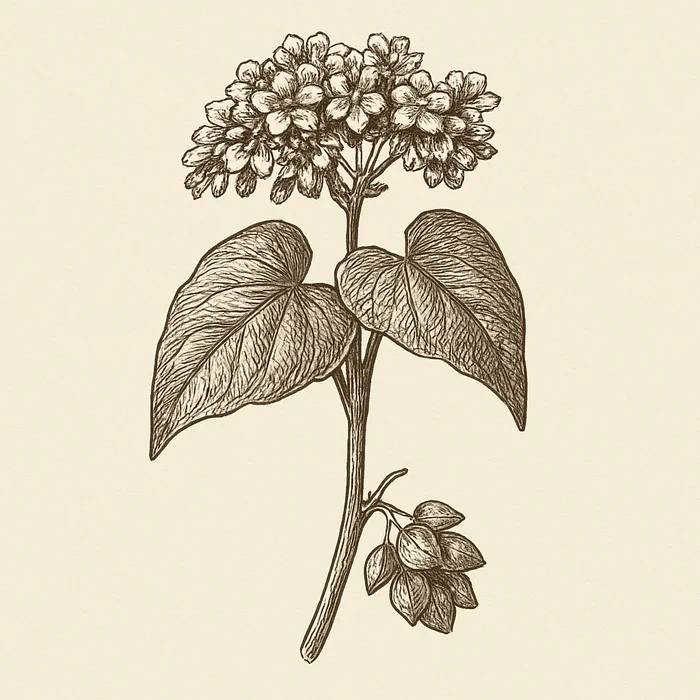
Buckwheat
Despite the name, buckwheat is not wheat -- it is a pseudocereal related to rhubarb, with a complete amino acid profile (rare for plants), and the richest dietary source of rutin, a flavonoid with anti-inflammatory and vasculoprotective properties.
Why It Matters for Longevity
Buckwheat's nutritional case is built on two rare properties. First, it provides all nine essential amino acids in adequate proportions -- making it one of only a handful of plant proteins that qualifies as "complete." This makes it particularly valuable in plant-dominant diets where lysine (the limiting amino acid in most cereals) is easily deficient.
Second, buckwheat is the richest dietary source of rutin (quercetin-3-rutinoside), a glycosylated flavonoid that reduces capillary fragility, inhibits platelet aggregation, and modulates inflammatory pathways. Gut bacteria convert rutin to quercetin, producing sustained quercetin plasma levels that exceed what quercetin supplements achieve.
Eating buckwheat cookies is associated with reductions in serum levels of myeloperoxidase -- a pro-inflammatory enzyme and predictor of cardiovascular events -- suggesting a direct anti-inflammatory effect of buckwheat consumption (Wieslander et al., 2011, Tohoku J Exp Med).
Buckwheat has a low-to-moderate glycemic index (estimated 40-60 depending on preparation), with its fiber and protein content slowing glucose absorption compared to refined cereal grains. An assessment of groats including buckwheat confirmed a significantly lower glycemic response than wheat-based products (Rozanska et al., 2020, Rocz Panstw Zakl Hig).
Cardiometabolic Evidence
A systematic review and meta-analysis of 13 randomized controlled human studies found that buckwheat intervention significantly reduced blood glucose by −0.85 mmol/L (95% CI: −1.31 to −0.39), total cholesterol by −0.50 mmol/L (95% CI: −0.80 to −0.20), and triglycerides by −0.25 mmol/L (95% CI: −0.49 to −0.02), compared to control conditions (Li et al., 2018, Nutrients). These effects were observed across studies in subjects with mild dyslipidemia and impaired glucose tolerance. The authors noted that animal data corroborated the findings, with 19 of 21 animal studies showing total cholesterol reductions of 12–54%.
A subsequent and larger meta-analysis of 16 human studies (464 participants) confirmed that buckwheat supplementation produced reductions in total cholesterol (−0.14 mmol/L) and glucose (−0.18 mmol/L, 95% CI: −0.36 to 0.003), with effects concentrated in those with mild dyslipidemia and type 2 diabetes (Llanaj et al., 2022, J Pers Med). The magnitude is modest — buckwheat is not a therapeutic agent — but the consistency across studies supports a real metabolic signal from regular consumption.
D-Chiro-Inositol and Insulin Sensitization
Tartary buckwheat (Fagopyrum tataricum) is notable for its D-chiro-inositol (DCI) content. DCI is a secondary messenger in insulin signaling: following insulin binding, DCI-containing inositolphosphoglycan mediators are released from cell membranes and activate intracellular enzymes involved in glucose disposal. In insulin-resistant states, this DCI-mediated signaling pathway is deficient, contributing to impaired glucose uptake.
A pilot RCT in patients with type 2 diabetes and suboptimal glycemic control (baseline HbA1c 7.0–10.0%) tested combined myo-inositol (550 mg twice daily) and D-chiro-inositol (13.8 mg twice daily) supplementation over 3 months. Fasting glucose decreased from 192.6 ± 60.2 to 160.9 ± 36.4 mg/dL (P = 0.02) and HbA1c from 8.6 ± 0.9 to 7.7 ± 0.9% (P = 0.02), with no adverse effects reported (Pintaudi et al., 2016, Int J Endocrinol). This study used isolated DCI rather than buckwheat, but it validates the mechanistic role of the compound that tartary buckwheat delivers as a food source.
Rutin, Quercetin, and Vascular Function
Rutin is not merely an antioxidant — its bioactivity involves distinct vascular mechanisms. After intestinal absorption, rutin is cleaved by gut bacteria to release quercetin aglycone, which acts on endothelial cells to increase nitric oxide (NO) production. This endothelium-derived NO causes smooth muscle relaxation, lowering peripheral vascular resistance and blood pressure. Rutin also inhibits platelet aggregation by blocking platelet P2Y12 receptor activation and reducing thromboxane A2 synthesis, with demonstrated anti-thrombotic activity in animal and in vitro models.
The clinical implication is that consistent buckwheat consumption maintains a low-level background supply of quercetin through gut-mediated conversion of rutin — a more sustained delivery mechanism than direct quercetin supplementation, which is cleared quickly. Tartary buckwheat (used in some East Asian staples) contains higher rutin concentrations (up to 1,700 mg/100 g dry weight) than common buckwheat (Fagopyrum esculentum, 8–30 mg/100 g cooked), so the form consumed matters substantially for rutin dose.
How to Use It
Cook as kasha (toasted buckwheat groats) as a grain side dish. Use buckwheat flour for crepes or pancakes (100% buckwheat crepes are traditional in Brittany). Soba noodles are traditionally 30-50% buckwheat (check labels -- some are mostly wheat). Buckwheat honey is exceptionally rich in polyphenols. For maximum rutin content, tartary buckwheat flour or noodles deliver substantially more than common buckwheat.
What to Pair It With
| Ingredient | Why | Tradition |
|---|---|---|
| Mushrooms | Umami complement; classic kasha and mushroom (buckwheat pilaf) | Eastern European |
| Onion | Flavour base for kasha; caramelised onion with roasted buckwheat | Eastern European |
| Goat's milk yogurt | Complete protein + probiotic combination | General |
| Smoked salmon | Complete amino acid + omega-3 combination | General |
| Honey (buckwheat) | Highest polyphenol content of any honey variety | Global |
Flavor Profile
Nutty, earthy, and robust with a slightly bitter finish. Toasted kasha (the most common preparation) develops a deep, roasted grain flavour. Raw buckwheat is milder and more delicate. Buckwheat flour has a distinctive grey-brown colour and a pronounced nuttiness that pairs well with cream, eggs, and smoked foods.
The Science
- Wieslander et al., 2011, Tohoku J Exp Med: Eating buckwheat cookies associated with reduced serum myeloperoxidase -- a pro-inflammatory enzyme linked to cardiovascular risk.
- Rozanska et al., 2020, Rocz Panstw Zakl Hig: Buckwheat groats confirmed to have a significantly lower glycemic index than wheat-based cereal products.
- Li et al., 2018, Nutrients: Meta-analysis of 13 RCTs — buckwheat intervention reduced blood glucose by −0.85 mmol/L, total cholesterol by −0.50 mmol/L, and triglycerides by −0.25 mmol/L.
- Llanaj et al., 2022, J Pers Med: Systematic review and meta-analysis of 16 human studies (464 participants) — buckwheat supplementation reduced total cholesterol and glucose, with effects concentrated in those with dyslipidemia or T2DM.
- Pintaudi et al., 2016, Int J Endocrinol: Pilot RCT — myo-inositol + D-chiro-inositol supplementation for 3 months significantly reduced fasting glucose (192.6 → 160.9 mg/dL) and HbA1c (8.6 → 7.7%) in type 2 diabetes patients.
- Aune et al., 2016, BMJ: Whole grain consumption associated with dose-response reductions in all-cause and cardiovascular mortality.
References
- Wieslander G, Fabjan N, Vogrinčič M, et al. Eating buckwheat cookies is associated with the reduction in serum levels of myeloperoxidase and cholesterol. Tohoku J Exp Med. 2011;225(2):123-130. PMID: 21931228. doi:10.1620/tjem.225.123
- Rozanska D, Regulska-Ilow B. Assessment of the glycemic index of groats available on the Polish food market. Rocz Panstw Zakl Hig. 2020;71(1):31-40. PMID: 32227786. doi:10.32394/rpzh.2020.0103
- Li L, Lietz G, Seal C. Buckwheat and CVD Risk Markers: A Systematic Review and Meta-Analysis. Nutrients. 2018;10(5):619. PMID: 29762481. doi:10.3390/nu10050619
- Llanaj E, Ahanchi NS, Dizdari H, Taneri PE, et al. Buckwheat and Cardiometabolic Health: A Systematic Review and Meta-Analysis. J Pers Med. 2022;12(12):1940. PMID: 36556161. doi:10.3390/jpm12121940
- Pintaudi B, Di Vieste G, Bonomo M. The Effectiveness of Myo-Inositol and D-Chiro Inositol Treatment in Type 2 Diabetes. Int J Endocrinol. 2016;2016:9132052. PMID: 27807448. doi:10.1155/2016/9132052
- Aune D, Keum N, Giovannucci E, et al. Whole grain consumption and risk of cardiovascular disease, cancer, and all cause and cause specific mortality. BMJ. 2016;353:i2716. PMID: 27301975. doi:10.1136/bmj.i2716
Key Nutrients
| Nutrient | Per 100g (cooked) | Notes |
|---|---|---|
| Protein | 3.4 g | Complete amino acid profile; high lysine vs cereals |
| Rutin (quercetin-3-rutinoside) | ~8-30 mg (common); up to 1,700 mg/100g dry weight (tartary) | Richest dietary source; converted to quercetin by gut bacteria |
| D-chiro-inositol | Present in tartary buckwheat bran | Secondary insulin-signaling messenger; mediates glucose disposal |
| Manganese | 0.5 mg | 22% DV; cofactor for antioxidant enzyme SOD |
| Magnesium | 51 mg | 12% DV; important for insulin signaling and cardiovascular function |