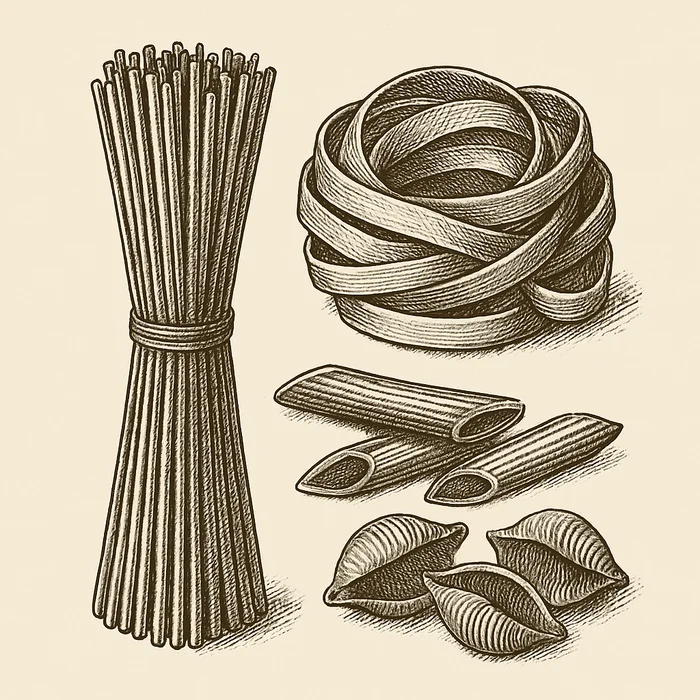
Durum Wheat Pasta
Pasta cooked al dente has a glycaemic index of approximately 45 -- lower than brown rice, lower than whole wheat bread, and roughly half that of white rice. The secret is not what is in the pasta but how its dense protein-starch matrix physically slows digestion.
Why It Matters for Longevity
Pasta has an undeserved reputation as a junk carbohydrate. The reality is more nuanced. Durum wheat flour creates a uniquely compact protein-starch matrix during extrusion. When cooked al dente, that matrix remains largely intact, and pancreatic amylases must work slowly through the gluten network to reach starch granules inside. The result is a genuinely low-glycaemic food.
Vanhatalo et al. (2022, J Nutr) studied how pasta structure influences mastication, bolus properties, and postprandial glucose response. They found that the compact gluten-starch matrix of conventional pasta significantly attenuates postprandial glucose and insulin responses compared to structurally disrupted preparations -- confirming that the al dente structural integrity is the key mediator of pasta's low glycaemic behaviour.
The cooking method is everything. Al dente pasta (GI ~45) versus overcooked pasta (GI ~70+) is a completely different metabolic experience. Cooling and reheating pasta further increases resistant starch content, making leftover pasta even better for blood sugar control. Adding olive oil or chickpeas further slows glucose absorption.
Whole grain pasta fits within the whole-grain dietary pattern consistently associated with reduced cardiovascular and cancer mortality. Aune et al. (2016, Lancet) conducted a meta-analysis of 45 prospective cohort studies and found that whole grain consumption was associated with significantly lower risk of coronary heart disease, cardiovascular disease, total cancer, and all-cause mortality -- with evidence for a dose-response relationship that supports including pasta from whole durum wheat among beneficial complex carbohydrates.
The traditional Southern Italian combination of pasta with chickpeas (pasta e ceci) deserves special attention. Durum wheat is low in lysine; chickpeas are rich in it. Together they provide complete protein with all essential amino acids -- no animal products needed.
Pasta, Adiposity, and Body Weight
The claim that pasta causes weight gain has been directly tested. A meta-analysis of 32 RCTs encompassing 2,448 participants (Chiavaroli et al., 2018, BMJ Open) found that pasta consumed within low-glycemic index dietary patterns reduced body weight by 0.63 kg and BMI by 0.26 kg/m² compared with control diets. The researchers concluded that "pasta in the context of low-GI dietary patterns does not adversely affect adiposity" — directly contradicting the reflex assumption that any pasta contribution is categorically fattening. The key qualifier is context: pasta eaten al dente within a Mediterranean-pattern diet behaves as a low-GI food; pasta eaten overcooked, in large portions, with high-calorie sauces, does not.
The glycemic index story has broader mortality implications. A 4.7-year follow-up of 3,583 non-diabetic participants in the PREDIMED cohort (Castro-Quezada et al., 2014, PLoS One) found that the highest dietary GI quartile was associated with more than double the all-cause mortality risk of the lowest quartile (HR 2.15; 95% CI 1.15–4.04). This is the population context in which pasta's low GI (~45 al dente, versus ~70+ for overcooked or ~72 for white bread) becomes clinically meaningful: it is one of the few starchy staple foods that can anchor a low-GI Mediterranean dietary pattern without requiring the cook to abandon the Mediterranean tradition.
Lutein from Durum: The Overlooked Carotenoid
Durum wheat's characteristic yellow colour comes from lutein, the dominant carotenoid in semolina at ~86–94% of total carotenoid content. Average lutein concentrations in durum wheat grain are 5–7 mg/kg dry weight; cooking converts a fraction to cis-isomers that may be more bioavailable from the lipid-rich gut environment. The practical instruction from the food chemistry data is consistent with the low-GI advice: cook al dente. Oduro-Obeng et al. (2021, Food Chemistry) found that carotenoid retention was highest at shorter cooking durations; over-cooking increased cis-carotenoid formation but also increased cooking loss and degraded texture.
Lutein's longevity significance goes beyond eye health. Wu et al. (2015, JAMA Ophthalmol) followed 102,046 adults (Nurses' Health Study and Health Professionals Follow-up Study) over two decades, identifying 1,118 advanced AMD cases. Participants in the highest predicted plasma lutein/zeaxanthin quintile had a 41% lower risk of advanced AMD (pooled RR 0.59; 95% CI 0.48–0.73) compared with the lowest quintile. As a fat-soluble carotenoid, lutein from pasta is best absorbed when the pasta is served with olive oil — the standard Southern Italian preparation. Whole wheat pasta provides approximately double the lutein of refined semolina pasta, adding another reason to favour the whole grain version when texture and dish context permit.
How to Use It
Cook in well-salted boiling water until al dente -- follow package times minus one minute, then taste. Drain and toss with extra-virgin olive oil or sauce immediately. For maximum resistant starch, cook, cool, and reheat. Pair with legumes (chickpeas, lentils, white beans) for complete protein. Whole wheat pasta has more fibre but slightly different texture.
What to Pair It With
| Ingredient | Why | Tradition |
|---|---|---|
| Chickpeas | Complete protein; low-GI legume adds fibre; classic pairing | Southern Italian (pasta e ceci) |
| Extra-virgin olive oil | Healthy fat slows carb absorption; Mediterranean staple | Italian |
| Tomatoes | Lycopene antioxidant; classic pairing | Italian |
| Broccoli | Sulforaphane from cruciferous vegetables | Southern Italian (orecchiette) |
| Garlic | Anti-inflammatory organosulfur compounds | Mediterranean |
Flavor Profile
Clean, wheaty, and mild with a slight nuttiness from durum wheat. The texture is the star -- al dente pasta has a satisfying firmness with a slight snap at the centre. The surface picks up sauces well, and the neutral flavour makes it a canvas for bold Mediterranean ingredients.
The Science
- Vanhatalo et al., 2022, J Nutr: Pasta structure significantly attenuates postprandial glucose and insulin responses -- the intact protein-starch matrix slows starch digestion; al dente cooking is critical to preserving this structural advantage.
- Aune et al., 2016, Lancet: Meta-analysis of 45 cohort studies -- whole grain consumption associated with significantly lower risk of coronary heart disease, cardiovascular disease, total cancer, and all-cause mortality; dose-response relationship.
- Chiavaroli et al., 2018, BMJ Open: Meta-analysis of 32 RCTs (2,448 participants) — pasta in low-GI dietary patterns reduced body weight by 0.63 kg and BMI by 0.26 kg/m²; moderate-certainty evidence that pasta does not adversely affect adiposity.
- Castro-Quezada et al., 2014, PLoS One: PREDIMED sub-cohort (3,583 non-diabetic adults, 4.7 years) — highest dietary GI quartile associated with 2.15× all-cause mortality risk vs. lowest quartile (HR 2.15; 95% CI 1.15–4.04); pasta's low GI (~45 al dente) positions it as a mortality-protective staple within a Mediterranean pattern.
- Oduro-Obeng et al., 2021, Food Chemistry: Lutein is the dominant carotenoid in durum wheat pasta (~86–94% of total carotenoids); shorter al dente cooking maximises carotenoid retention and texture quality.
- Wu et al., 2015, JAMA Ophthalmol: 20-year prospective follow-up (102,046 adults; NHS + HPFS) — highest predicted plasma lutein/zeaxanthin quintile associated with 41% lower advanced AMD risk (pooled RR 0.59; 95% CI 0.48–0.73); absorption enhanced by dietary fat (e.g., olive oil).
References
- Vanhatalo S, Freese R, Björk C, et al. Pasta Structure Affects Mastication, Bolus Properties, and Postprandial Glycemic Response in Healthy Adults. J Nutr. 2022;152(2):435-443. PMID: 34669959. doi:10.1093/jn/nxab349
- Aune D, Keum N, Giovannucci E, et al. Whole grain consumption and risk of cardiovascular disease, cancer, and all cause and cause specific mortality: systematic review and dose-response meta-analysis of prospective studies. Lancet. 2016;388(10063):3080-3097. PMID: 27301975. doi:10.1016/S0140-6736(16)31595-3
- Chiavaroli L, Kendall CWC, Braunstein CR, et al. Effect of pasta in the context of low-glycaemic index dietary patterns on body weight and markers of adiposity: a systematic review and meta-analysis of randomised controlled trials in adults. BMJ Open. 2018;8(3):e019438. PMID: 29615407. doi:10.1136/bmjopen-2017-019438
- Castro-Quezada I, Sánchez-Villegas A, Estruch R, et al. A high dietary glycemic index increases total mortality in a Mediterranean population at high cardiovascular risk. PLoS One. 2014;9(9):e107968. PMID: 25250626. doi:10.1371/journal.pone.0107968
- Oduro-Obeng H, Fu BX, Beta T. Influence of cooking duration on carotenoids, physical properties and in vitro antioxidant capacity of pasta prepared from three Canadian durum wheat cultivars. Food Chemistry. 2021;363:130376. PMID: 34237558. doi:10.1016/j.foodchem.2021.130376
- Wu J, Cho E, Willett WC, Sastry SM, Schaumberg DA. Intakes of lutein, zeaxanthin, and other carotenoids and age-related macular degeneration during 2 decades of prospective follow-up. JAMA Ophthalmol. 2015;133(12):1415-1424. PMID: 26447482. doi:10.1001/jamaophthalmol.2015.3590
Key Nutrients
| Nutrient | Per 100g (cooked) | Notes |
|---|---|---|
| Resistant starch | 2--4 g (al dente) | Acts as prebiotic; increases significantly with cooling and reheating |
| Protein | ~5 g (cooked) | Higher-quality than common wheat; gluten matrix slows starch digestion |
| Selenium | ~18 mcg (cooked) | Cofactor for glutathione peroxidase antioxidant system |
| Lutein | ~0.5 mg (cooked) | Fat-soluble carotenoid; absorption enhanced by olive oil |
| B vitamins | B1, B3, folate | Enriched versions have higher folate; energy metabolism cofactors |