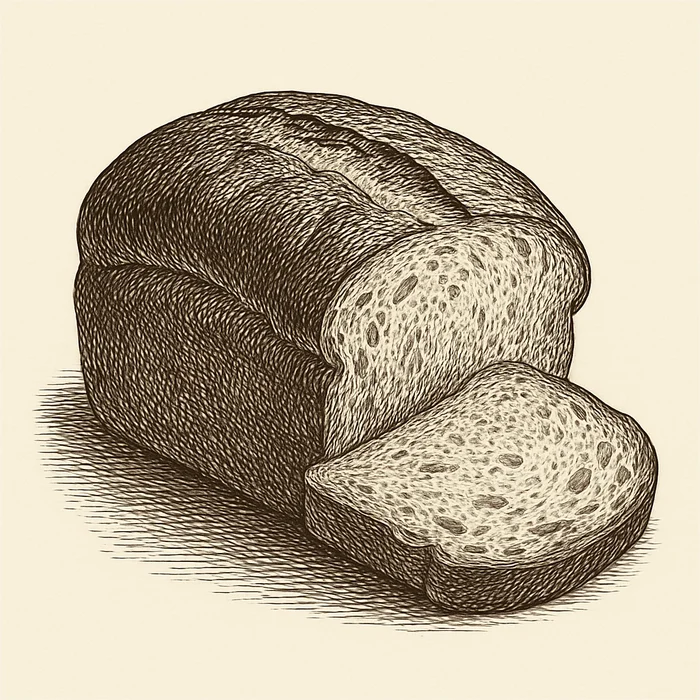
Bread
Whole-grain bread is strongly preferred in the Longevity Diet over refined white bread. The glycemic index difference is meaningful: white bread (~95 GI) produces rapid blood glucose spikes, while whole-grain (~55 GI) and sourdough (~54 GI) produce gentler responses.
Why It Matters for Longevity
The Longevity Diet distinction between whole-grain and refined bread is not just about fiber. Whole grains retain the bran and germ, preserving B vitamins, magnesium, phytochemicals, and fermentable fibers. These components independently reduce cardiovascular, metabolic, and cancer risk.
Fiber from whole grains -- but not refined grains -- is inversely associated with all-cause and cardiovascular mortality. In a study of 34,492 women followed for 9 years, whole-grain fiber intake was significantly associated with lower total and CVD mortality (Jacobs et al., 2000, J Am Coll Nutr).
A dose-response meta-analysis of 45 prospective cohort studies found that each 90g/day increment in whole-grain consumption was associated with 17% lower all-cause mortality, 19% lower cardiovascular disease mortality, and 15% lower cancer incidence (Aune et al., 2016, BMJ). The evidence was strong for whole grains in general and specifically for whole-grain bread.
Sourdough fermentation reduces phytate content through lactic acid bacteria-mediated phytase activation, improves mineral bioavailability (magnesium, iron, and zinc), lowers glycemic index, and changes the fermentable fiber profile — partially explaining why traditionally fermented breads appear more metabolically benign than their GI alone would suggest. A systematic review of 18 randomized clinical trials found that sourdough demonstrated lower blood glucose impact at 60 minutes (mean difference −0.29 mmol/L, 95% CI [−0.46, −0.12]) and at 120 minutes (MD −0.21, 95% CI [−0.32, −0.09]) compared to industrially fermented bread or glucose reference, with the benefit most pronounced when sourdough was prepared with whole wheat flour (Rolim et al., 2024, Crit Rev Food Sci Nutr).
Whole Grain Bread and Type 2 Diabetes Risk
Whole grain bread's protective effect against type 2 diabetes is among the most consistently replicated findings in nutritional epidemiology. A meta-analysis of 16 cohort studies (Aune et al., 2013, Eur J Epidemiol) found that consuming three servings of whole grains per day was associated with a summary relative risk of 0.68 (95% CI 0.58–0.81) for type 2 diabetes — a 32% reduction. Refined grain consumption at the same dose showed a relative risk of 0.95 (95% CI 0.88–1.04), indistinguishable from no effect. The dose-response relationship was nonlinear, with most of the benefit accruing in the transition from no whole grains to one to two servings per day.
The largest prospective analysis to date (Hu et al., 2020, BMJ) tracked 194,784 participants across three U.S. cohorts over 4.6 million person-years, identifying 18,629 diabetes cases. Participants in the highest whole grain intake category had a 29% lower rate of type 2 diabetes (95% CI 26–33%) versus the lowest category. Among specific foods, dark bread carried a hazard ratio of 0.79, corresponding to a 21% risk reduction. Protective benefits plateaued at approximately two servings per day for whole grains overall, with only half a serving per day of dark bread capturing most of the benefit — underscoring that modest, consistent intake outperforms intermittent high doses.
The mechanisms linking whole grain bread to lower diabetes incidence are multiple. Insoluble bran fiber slows gastric emptying and starch hydrolysis, reducing the peak postprandial glucose and insulin demand. Soluble arabinoxylan and beta-glucan form viscous gels that further delay glucose absorption. Magnesium (concentrated in the bran, 76 mg per 100 g whole grain bread, ~20% DV) acts as a cofactor for insulin receptor signaling — a pathway degraded in refined grains that are stripped of the bran layer.
Arabinoxylan: The Fiber Fraction That Matters at Night
Arabinoxylan oligosaccharides (AXOS), the dominant soluble fiber fraction of wheat bran, produce effects beyond simple viscosity. A randomized crossover trial in 15 subjects with metabolic syndrome (Hartvigsen et al., 2014, Eur J Clin Nutr) tested meals containing concentrated arabinoxylan alongside whole grain rye kernels. The arabinoxylan-rye combination significantly reduced acute postprandial glucose (p = 0.005) and insulin (p < 0.001) responses. Beyond the immediate meal, both arabinoxylan-containing conditions measurably increased butyrate and acetate concentrations in circulation 6 hours after eating, demonstrating that colonic fermentation of AXOS into short-chain fatty acids (SCFAs) is rapid enough to influence same-day metabolic markers.
A second crossover trial with healthy young adults (Johansson-Boll et al., 2015, Eur J Nutr) tested evening consumption of test breads enriched with arabinoxylan oligosaccharides. The following morning, participants who had eaten the high-AXOS bread showed dose-dependent reductions in glucose response to a standardized breakfast, improved insulin sensitivity index, elevated breath hydrogen (a marker of colonic fermentation), and higher circulating SCFA. This "second meal effect" — where evening dietary fiber intake improves next-morning glucose handling — operates through SCFA-mediated upregulation of incretin hormones (GLP-1 and PYY) that sensitize the gut-brain axis before breakfast is consumed.
Butyrate, the SCFA most closely associated with whole grain arabinoxylan fermentation, serves as the primary energy substrate for colonocytes and exerts anti-inflammatory effects by inhibiting NF-κB activation in intestinal epithelial cells. This pathway connects whole grain bread consumption to reduced mucosal inflammation — a mechanism relevant not only to colorectal cancer risk but to systemic low-grade inflammation markers (CRP, IL-6) that track closely with cardiovascular disease progression.
Sourdough Fermentation: Mechanisms Beyond Acidity
Sourdough's metabolic advantages arise from a cascade of chemical changes during long fermentation. Lactic acid bacteria lower dough pH to approximately 4.5–5.0, creating optimal conditions for the grain's endogenous phytase enzymes; phytate degradation of 62–90% has been documented in sourdough compared to 25–75% with commercial yeast alone. Phytate is an antinutrient that chelates divalent minerals (iron, zinc, magnesium), so its reduction directly increases the fraction of these minerals available for absorption.
Beyond phytate, prolonged fermentation converts some rapidly digestible starch into resistant starch through partial retrogradation. The organic acids produced — primarily lactic acid and acetic acid — also retard starch gelatinization during baking, leaving more starch in a slow-digesting form. Acetic acid specifically slows gastric emptying, extending the time window over which glucose is absorbed. Together, these mechanisms explain why sourdough whole wheat bread tends to outperform standard whole wheat bread on postprandial glucose tests despite similar total carbohydrate content.
An in-vivo study by Hefni et al. developed five prototype breads combining sourdough fermentation with intact cereal and legume kernels and measured their glycemic index directly in human volunteers. The in-vivo GI values came in at 65 and 67, but glycemic load values were low owing to high fiber and water content — illustrating that medium GI does not preclude a beneficial glycemic load when total carbohydrate per serving is moderate (Hefni et al., 2021, Int J Food Sci Nutr). Resistant starch content in these breads tripled during the breadmaking process, a finding consistent with the starch retrogradation that occurs as dough cools between fermentation and baking.
Whole Grain vs. Refined: What Processing Removes
Commercial refining of wheat removes the bran and germ layers, retaining only the endosperm. This strips away roughly 75% of the dietary fiber, 80% of the magnesium, 79% of the B vitamins, and essentially all the fermentable fiber fractions (arabinoxylan, beta-glucan). Enrichment programs restore some B vitamins and iron to white flour, but fiber and magnesium are not replaced. The resulting product has a rapidly digestible starch that reaches peak blood glucose ~30% faster than equivalent carbohydrate from whole grain bread, driving greater insulin secretion per gram of carbohydrate consumed.
How to Use It
Choose bread with whole grain as the first ingredient. Sourdough made from whole wheat or rye is the best option. Use as a vehicle for nutrient-dense toppings (avocado, olive oil, sardines, nut butters, no-sugar-added jam) rather than a base for refined spreads. Avoid breads with added sugars in the ingredient list.
What to Pair It With
| Ingredient | Why | Tradition |
|---|---|---|
| Extra-virgin olive oil | Replaces butter; MUFA and polyphenols from olive oil | Mediterranean |
| Avocado | Healthy fat + potassium; fiber synergy | Modern |
| Sardines | Complete protein + omega-3; classic Longevity Diet pattern | Mediterranean |
| No-sugar-added jam | Polyphenols with fiber; pectin slows starch absorption | The Longevity Diet |
| Nut butter | Healthy fat + protein combination | Global |
Flavor Profile
Whole-grain bread is nuttier, denser, and more complex than white bread. Sourdough varieties have a characteristic tang from lactic and acetic acid. Rye breads are darker and more robust. The flavour deepens when toasted, developing Maillard reaction compounds that intensify the grain character.
The Science
- Jacobs et al., 2000, J Am Coll Nutr: Fiber from whole grains -- not refined grains -- inversely associated with all-cause and cardiovascular mortality in 34,492 women over 9 years.
- Aune et al., 2016, BMJ: Meta-analysis of 45 cohort studies -- each 90g/day increment in whole-grain intake associated with 17% lower all-cause mortality and 19% lower CVD mortality.
- Aune et al., 2013, Eur J Epidemiol: Meta-analysis of 16 cohort studies -- 3 servings/day whole grains associated with 32% lower type 2 diabetes risk (RR 0.68); refined grains showed no effect.
- Hu et al., 2020, BMJ: 194,784 participants, 4.6 million person-years -- highest whole grain consumers had 29% lower type 2 diabetes rate; dark bread associated with 21% risk reduction (HR 0.79).
- Hartvigsen et al., 2014, Eur J Clin Nutr: RCT in 15 metabolic syndrome subjects -- arabinoxylan + rye kernels reduced acute glucose (p = 0.005) and insulin (p < 0.001) responses; elevated butyrate and acetate 6h post-meal.
- Johansson-Boll et al., 2015, Eur J Nutr: RCT crossover -- evening consumption of AXOS-enriched bread improved next-morning glucose tolerance and insulin sensitivity via elevated SCFA and breath hydrogen.
- Rolim et al., 2024, Crit Rev Food Sci Nutr: Systematic review of 18 RCTs -- sourdough reduced postprandial blood glucose vs industrial bread at 60 min (MD −0.29 mmol/L) and 120 min (MD −0.21 mmol/L); effect largest with whole wheat sourdough.
- Hefni et al., 2021, Int J Food Sci Nutr: Five sourdough prototype breads with intact cereal and legume kernels -- in-vivo GI values 65–67; resistant starch tripled during breadmaking; glycemic load remained low despite medium GI due to high fiber and water content.
References
- Jacobs DR, Pereira MA, Meyer KA, et al. Fiber from whole grains, but not refined grains, is inversely associated with all-cause mortality in older women: the Iowa Women's Health Study. J Am Coll Nutr. 2000;19(3 Suppl):326S-330S. PMID: 10875605. doi:10.1080/07315724.2000.10718968
- Aune D, Keum N, Giovannucci E, et al. Whole grain consumption and risk of cardiovascular disease, cancer, and all cause and cause specific mortality: systematic review and dose-response meta-analysis of prospective studies. BMJ. 2016;353:i2716. PMID: 27301975. doi:10.1136/bmj.i2716
- Aune D, Norat T, Romundstad P, Vatten LJ. Whole grain and refined grain consumption and the risk of type 2 diabetes: a systematic review and dose-response meta-analysis of cohort studies. Eur J Epidemiol. 2013;28(11):845-858. PMID: 24158434. doi:10.1007/s10654-013-9852-5
- Hu Y, Ding M, Sampson L, et al. Intake of whole grain foods and risk of type 2 diabetes: results from three prospective cohort studies. BMJ. 2020;370:m2206. PMID: 32641435. doi:10.1136/bmj.m2206
- Hartvigsen ML, Lærke HN, Overgaard A, et al. Postprandial effects of test meals including concentrated arabinoxylan and whole grain rye in subjects with the metabolic syndrome: a randomised study. Eur J Clin Nutr. 2014;68(5):567-574. PMID: 24595224. doi:10.1038/ejcn.2014.25
- Johansson-Boll E, Nilsson A, Sontag TJ, et al. Effects of wheat bran extract rich in arabinoxylan oligosaccharides and resistant starch on overnight glucose tolerance and markers of gut fermentation in healthy young adults. Eur J Nutr. 2015;54(8):1393-1402. PMID: 26169871. doi:10.1007/s00394-015-0985-z
- Rolim ME, Fortes MI, Von Frankenberg A, Duarte CK. Consumption of sourdough bread and changes in the glycemic control and satiety: A systematic review. Crit Rev Food Sci Nutr. 2024;64(3):636-650. PMID: 35943419. doi:10.1080/10408398.2022.2108756
- Hefni ME, Thomsson A, Witthöft CM. Bread making with sourdough and intact cereal and legume grains - effect on glycaemic index and glycaemic load. Int J Food Sci Nutr. 2021;72(1):134-142. PMID: 32466685. doi:10.1080/09637486.2020.1769568
Key Nutrients
| Nutrient | Per 100g (whole-grain) | Notes |
|---|---|---|
| Dietary fiber | 6-8 g | Combination of insoluble (bran) and soluble (beta-glucan, arabinoxylan) fractions |
| Magnesium | 76 mg | In bran layer; ~20% DV; lost in refining; important for insulin sensitivity |
| B vitamins (folate, B6) | Moderate | Retained in germ; partially lost in commercial refining |
| Beta-glucan | 0.5-1.5 g (oat > wheat) | Soluble fiber with established cholesterol-lowering effect |
| Arabinoxylan | 2-3 g | Principal soluble fiber in wheat bran; fermented to SCFA by colonic microbiota |