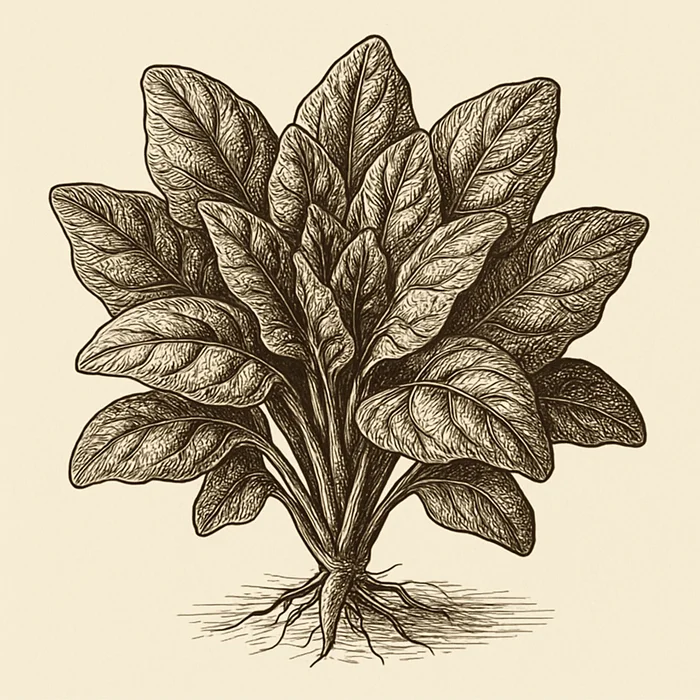
Spinach
A featured vegetable across multiple Longevity Diet meals -- one of the richest plant sources of folate, providing 131 mcg per half-cup boiled (33% DV), alongside meaningful iron, vitamin A, and vitamin K.
Why It Matters for Longevity
Spinach earns its place in longevity diets through a combination of nutrient density and unique bioactive compounds. Per calorie, it is one of the most folate-rich foods available. Folate (vitamin B9) is essential for DNA methylation and repair -- two processes that slow with age and whose failure is linked to both cancer risk and accelerated cellular aging. One cup cooked spinach delivers nearly half the daily folate requirement.
Beyond folate, spinach provides a notable quantity of non-heme iron (3.6 mg per 100g cooked), though bioavailability is significantly limited by high oxalate content. The practical fix is pairing with vitamin C: a squeeze of lemon juice can multiply non-heme iron absorption 2–3 fold. This is why recipes like the Longevity Diet's spinach with lemon and olive oil are nutritionally rational combinations, not just culinary convention.
Spinach also contains thylakoid membranes -- the chloroplast structures that give leaves their green colour. A clinical study (Stenblom et al., 2016, Nutr Metab) found that dietary green-plant thylakoids significantly decreased gastric emptying rate and promoted gut hormone responses associated with increased satiety and reduced appetite. The fat-soluble vitamins A, E, and K are present in meaningful concentrations, but require fat for absorption -- making olive oil an essential companion rather than an optional garnish.
Dietary Nitrates and the NO Pathway
Spinach is one of the richest vegetable sources of inorganic nitrate, typically delivering 250--400 mg per 100g dry weight. Once consumed, salivary bacteria reduce nitrate (NO₃⁻) to nitrite (NO₂⁻), which is then converted to nitric oxide (NO) in the stomach and bloodstream -- a pathway that bypasses the enzymatic eNOS route and becomes particularly relevant when tissue oxygen is low or eNOS activity is impaired with age.
A controlled crossover trial (Jovanovski et al., 2015, Clin Nutr Res) randomised 27 healthy adults to 7 days of high-nitrate spinach soup (845 mg nitrate/day) versus low-nitrate asparagus soup (0.6 mg nitrate/day). After 7 days, the spinach arm showed reductions in central systolic BP (−3.39 mmHg, p=0.004), central diastolic BP (−2.60 mmHg, p=0.028), and brachial systolic BP (−3.48 mmHg, p=0.022). Augmentation index -- a measure of arterial wave reflection that tracks vascular stiffness -- decreased by 6.93% from baseline (p<0.001).
These acute findings are supported by a broader evidence base. A meta-analysis of 47 RCTs with 1,101 participants (Li et al., 2020, J Hypertens) found that repeated inorganic nitrate administration reduced systolic BP by 2.91 mmHg (95% CI: −3.92 to −1.89) and diastolic BP by 1.45 mmHg (95% CI: −2.22 to −0.68). While these are modest absolute numbers, population-level modelling suggests that a sustained 2 mmHg reduction in systolic BP reduces stroke mortality by ~10% and ischaemic heart disease mortality by ~7%.
The practical implication: nitrate content of spinach is highest in raw and lightly cooked leaves; boiling leaches nitrate into cooking water, so steaming or sautéing preserves more of the active compound. Chewing initiates the salivary conversion step, meaning whole leaves are more effective than swallowed capsules.
Lutein, Zeaxanthin, and Visual Health
Spinach provides approximately 11.9 mg of lutein and zeaxanthin per 100g raw -- the highest concentration of any commonly consumed leafy green. These xanthophyll carotenoids accumulate selectively in the macula of the retina, where they function as short-wavelength light filters and quench reactive oxygen species generated during phototransduction.
A meta-analysis of six longitudinal cohort studies (Ma et al., 2012, Br J Nutr) quantified the protective relationship. Higher dietary lutein and zeaxanthin intake was not significantly associated with early AMD (RR 0.96; 95% CI 0.78–1.17), but was significantly protective against late AMD (RR 0.74; 95% CI 0.57–0.97) and specifically neovascular AMD (RR 0.68; 95% CI 0.51–0.92). This 26–32% reduction in late-stage AMD risk translates clinically to protection against the form of the disease most likely to cause legal blindness. Given that AMD prevalence more than doubles each decade after age 60, increasing lutein/zeaxanthin intake through foods like spinach at mid-life is a rational preventive strategy.
Absorption of lutein from spinach requires concurrent fat intake. Studies using olive oil as the fat co-ingested with spinach show substantially higher plasma lutein responses than fat-free preparations -- one more mechanistic reason the Mediterranean practice of sautéing spinach in olive oil is nutritionally sound.
Folate, One-Carbon Metabolism, and Cardiovascular Risk
Folate's relevance to cardiovascular disease runs through the one-carbon metabolism pathway: adequate folate is required to remethylate homocysteine back to methionine. When folate is insufficient, plasma homocysteine rises -- and elevated homocysteine is an independent risk factor for coronary artery disease and stroke. A meta-analysis of 30 RCTs with 82,334 participants (Li et al., 2016, J Am Heart Assoc) found that folic acid supplementation reduced stroke risk by 10% (RR 0.90; 95% CI 0.84–0.96) and overall CVD risk by 4% (RR 0.96; 95% CI 0.92–0.99), with larger benefits in participants without pre-existing CVD or in those with lower baseline folate levels. The implication for spinach: its folate content (194 mcg per 100g cooked, roughly 50% DV) directly addresses the dietary shortfall most likely to produce the elevated homocysteine associated with cardiovascular risk. Notably, folic acid supplementation showed no effect on coronary heart disease (RR 1.04), suggesting stroke prevention is the primary cardiovascular benefit of folate repletion via diet.
How to Use It
Lightly sauté in olive oil with garlic and a squeeze of lemon -- the heat reduces volume dramatically, concentrating nutrients per serving. Use raw in salads where you want to preserve folate and avoid oxalate concerns (cooking increases oxalate bioavailability from the cell wall). Blend into smoothies to add nutrients without altering flavour significantly. The Longevity Diet features spinach with raisins, pine nuts, and olive oil -- a traditional Sicilian and Catalan preparation (spinaci con uvetta) that adds iron alongside natural sugars.
What to Pair It With
| Ingredient | Why | Tradition |
|---|---|---|
| Lemon juice | Vitamin C dramatically improves non-heme iron absorption | Mediterranean |
| Olive oil | Essential fat carrier for vitamins A, E, K, and for lutein/zeaxanthin absorption | Mediterranean |
| Garlic | Complementary antimicrobial and cardiovascular compounds | Global |
| Raisins | Traditional combination; iron-rich alongside spinach | Sicilian / Catalan |
| Chickpeas | Combined iron sources; classic palak chana | Indian |
| Eggs | Fat and heme iron enhance non-heme iron absorption | Global |
Flavor Profile
Mild, slightly bitter, and earthy with a clean green taste. Raw spinach is crisp with a faint metallic note from iron. Cooked spinach becomes tender and silky, with bitterness reduced and a more concentrated, savoury depth. The texture collapses dramatically with heat -- one pound raw becomes roughly one cup cooked. Baby spinach is milder and less fibrous than mature leaves.
The Science
- Stenblom et al., 2016, Nutr Metab (Lond): Dietary green-plant thylakoids decreased gastric emptying and promoted gut hormone changes associated with increased satiety and reduced appetite.
- Jovanovski et al., 2015, Clin Nutr Res: 7-day spinach RCT (n=27) -- 845 mg nitrate/day from spinach reduced central systolic BP by 3.39 mmHg, arterial augmentation index by 6.93%; nitrate → NO pathway.
- Li et al., 2020, J Hypertens: Meta-analysis of 47 RCTs (n=1,101) -- inorganic nitrate reduced SBP by 2.91 mmHg and DBP by 1.45 mmHg via dietary nitrate → NO pathway.
- Ma et al., 2012, Br J Nutr: Meta-analysis of 6 cohort studies -- higher lutein/zeaxanthin intake associated with 26% lower late AMD risk (RR 0.74) and 32% lower neovascular AMD risk (RR 0.68).
- Li et al., 2016, J Am Heart Assoc: Meta-analysis of 30 RCTs (n=82,334) -- folate supplementation reduced stroke risk by 10% (RR 0.90) via homocysteine-lowering / one-carbon metabolism.
- Iron bioavailability from spinach is low (~2%) due to oxalate binding -- co-ingestion with vitamin C (lemon juice) significantly improves absorption.
References
- Stenblom EL, Weström B, Linninge C, et al. Dietary green-plant thylakoids decrease gastric emptying and gut transit, promote changes in the gut microbiota, and alter sterol excretion in obese mice. Nutr Metab (Lond). 2016;13:51. PMID: 27777602.
- Jovanovski E, Bosco L, Khan K, et al. Effect of Spinach, a High Dietary Nitrate Source, on Arterial Stiffness and Related Hemodynamic Measures: A Randomized, Controlled Trial in Healthy Adults. Clin Nutr Res. 2015;4(3):160-167. PMID: 26251834. doi:10.7762/cnr.2015.4.3.160
- Li D, Nishi SK, Jovanovski E, et al. Repeated administration of inorganic nitrate on blood pressure and arterial stiffness: a systematic review and meta-analysis of randomized controlled trials. J Hypertens. 2020;38(9):1651-1663. PMID: 32723980. doi:10.1097/HJH.0000000000002524
- Ma L, Dou HL, Wu YQ, et al. Lutein and zeaxanthin intake and the risk of age-related macular degeneration: a systematic review and meta-analysis. Br J Nutr. 2012;107(3):350-359. PMID: 21899805. doi:10.1017/S0007114511004260
- Li Y, Huang T, Zheng Y, et al. Folic Acid Supplementation and the Risk of Cardiovascular Diseases: A Meta-Analysis of Randomized Controlled Trials. J Am Heart Assoc. 2016;5(8):e003768. PMID: 27528407. doi:10.1161/JAHA.116.003768
Key Nutrients
| Nutrient | Per 100g (cooked) | Notes |
|---|---|---|
| Folate (B9) | 194 mcg | ~50% bioavailability; cooking increases concentration per gram but reduces total content; essential for homocysteine remethylation |
| Iron (non-heme) | 3.6 mg | Only ~2% absorbed due to oxalate; pair with vitamin C to improve absorption |
| Lutein + zeaxanthin | 11.9 mg (raw) | Selective macular accumulation; fat required for absorption; protective against late AMD |
| Dietary nitrate | ~250--400 mg/100g (dry) | Converted to NO via salivary/gastric pathway; contributes to blood pressure lowering |
| Vitamin A (as beta-carotene) | 573 mcg RAE | Conversion from beta-carotene; fat required for absorption |
| Vitamin K1 | 494 mcg (412% DV) | Highest of any common leafy green; important for bone health and blood coagulation |
| Vitamin C | 9.8 mg | Partially lost in cooking; contributes to iron absorption when eaten raw |