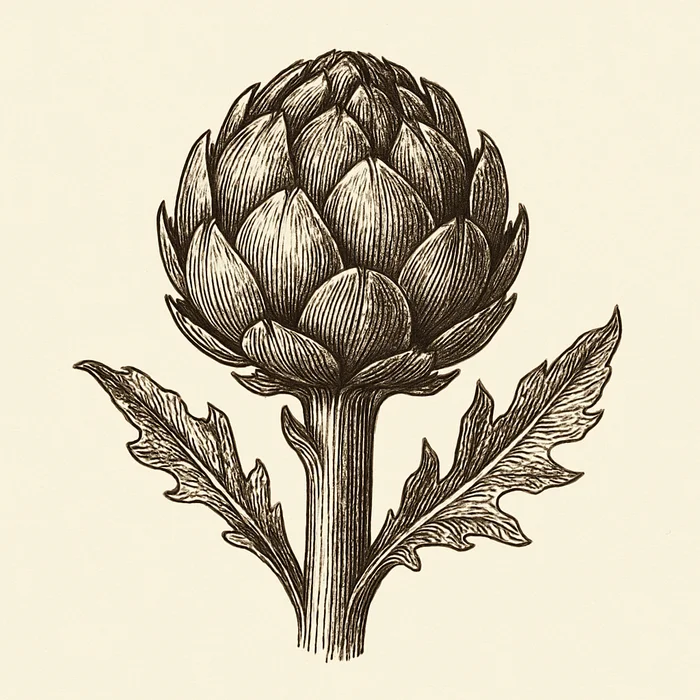
Artichokes
Among the richest plant sources of prebiotic inulin -- and artichoke leaf extract is one of the few food-derived compounds with Cochrane-level evidence for LDL cholesterol reduction.
Why It Matters for Longevity
Artichokes appear in the Longevity Diet in a Mediterranean spelt salad and as a pizza topping, recommended at 50--80g preserved or canned per serving. They earn their place through two independent mechanisms: bile-mediated cholesterol clearance and selective prebiotic support for beneficial gut bacteria.
Cholesterol Reduction via Cynarin and Luteolin
Artichoke leaf extract contains cynarin (1,3-dicaffeoylquinic acid) and luteolin, compounds that inhibit cholesterol synthesis in the liver — luteolin suppresses HMG-CoA reductase activity, the same enzyme targeted by statin drugs — and cynarin stimulates bile acid secretion, increasing cholesterol clearance from circulation. A Cochrane systematic review concluded that artichoke leaf extract significantly reduced total cholesterol in adults with elevated levels, with a favourable safety profile (Wider et al., 2009, Cochrane Database Syst Rev).
A more recent dose-response meta-analysis of 14 randomized controlled trials (15 effect sizes) quantified the effect more precisely: artichoke leaf extract reduced LDL cholesterol by a mean of 17.48 mg/dL (95% CI: –25.44 to –9.53; p < 0.001), total cholesterol by 17.01 mg/dL, and triglycerides by 17.01 mg/dL (Shahinfar et al., 2021, Phytother Res). The effect on HDL cholesterol was not significant. This magnitude of LDL reduction — roughly 10--12% from an elevated baseline — is clinically meaningful, though doses used in trials (typically 1.8--2.7 g extract/day) are higher than the amount in a typical 80 g food serving of artichoke hearts. The review also found a dose-response relationship, with reductions more pronounced at higher supplementation doses.
Luteolin exerts additional anti-inflammatory effects via NF-κB inhibition and mTOR pathway suppression, both relevant to the chronic low-grade inflammation that characterises biological aging.
Prebiotic Inulin and Gut Microbiome Support
Artichoke is among the richest plant sources of inulin-type fructooligosaccharides, containing 3--10 g per 100 g fresh (the range reflects variety, season, and post-harvest storage, as inulin partially converts to fructose over time). Inulin is a prebiotic fibre that passes through the small intestine undigested and is selectively fermented by colonic Bifidobacterium and Lactobacillus species.
A double-blind, randomized crossover trial in 32 healthy adults directly tested very-long-chain inulin extracted from globe artichoke (Cynara scolymus) at 10 g/day against a maltodextrin placebo for three weeks each. Faecal Bifidobacterium and Lactobacillus counts were significantly higher after artichoke inulin consumption; Bacteroides-Prevotella levels decreased, consistent with a selective shift toward beneficial taxa (Costabile et al., 2010, Br J Nutr). Mild bloating was reported by some participants, reflecting the fermentation activity that drives the bifidogenic effect.
Bifidobacterium fermentation of inulin produces short-chain fatty acids — principally acetate and lactate, which are further converted to butyrate by cross-feeding bacteria. Butyrate is the primary energy substrate for colonocytes, maintains gut barrier integrity, and suppresses NF-κB signalling in intestinal epithelial cells. Microbiome profiles rich in Bifidobacterium and butyrate-producing bacteria are consistently associated with lower inflammatory markers and longer healthspan in centenarian studies.
An in vitro study further confirmed that artichoke extract significantly promoted Bifidobacterium growth (25-fold increase at 48 hours) while increasing short-chain fatty acid production in colon microbiome simulation (Van den Abbeele et al., 2020, Nutrients).
Liver Protection
Cynarin and chlorogenic acid (another artichoke polyphenol) have hepatoprotective properties in human and animal studies: they reduce lipid accumulation in hepatocytes, support bile flow, and exert antioxidant effects against oxidative stress in liver tissue. Chlorogenic acid is also a substrate for colonic fermentation producing dihydrocaffeic and dihydroferulic acids, extending its bioactivity beyond the small intestine. Artichoke leaf extract has been used in European phytomedicine for functional dyspepsia and hyperlipidemia for decades, with a safety profile supported by the Cochrane review.
How to Use It
Preserved or canned artichoke hearts are nutritionally similar to fresh and far more convenient. Drain and rinse before use. Dress with olive oil, lemon, and herbs for an antipasto. Add to grain salads (spelt, farro) or thin-crust pizza. Artichoke hearts roasted with garlic and olive oil are also excellent as a side or bruschetta topping. Pairing artichokes with whole grains (spelt, farro, barley) compounds the prebiotic effect, as the resistant starch in whole grains further selectively feeds beneficial gut bacteria.
What to Pair It With
| Ingredient | Why | Tradition |
|---|---|---|
| Spelt | Longevity Diet salad combination; complex carbs + prebiotic inulin synergy | Longevity Diet |
| Olive oil | Fat enhances luteolin absorption; traditional Mediterranean pairing | Mediterranean |
| Lemon juice | Prevents browning; vitamin C complements iron; brightens flavour | Mediterranean |
| Capers | Complementary polyphenol sources | Mediterranean |
| Sardines | Longevity Diet combination on pizza | Longevity Diet |
Flavor Profile
Earthy, mildly bitter, nutty, and slightly sweet. The bitterness comes from cynarin and chlorogenic acid. Cooked hearts have a meaty, tender texture. Preserved in water or oil, the flavour mellows considerably.
The Science
- Wider et al., 2009, Cochrane Database Syst Rev: Cochrane review -- artichoke leaf extract significantly reduced total cholesterol in adults with elevated cholesterol; favourable safety profile.
- Shahinfar et al., 2021, Phytother Res: Dose-response meta-analysis of 14 RCTs -- artichoke leaf extract reduced LDL-C by 17.48 mg/dL (95% CI –25.44 to –9.53, p < 0.001), total cholesterol by 17.01 mg/dL, and triglycerides by 17.01 mg/dL; no significant effect on HDL.
- Costabile et al., 2010, Br J Nutr: Double-blind RCT crossover (n=32) -- 10 g/day artichoke very-long-chain inulin for 3 weeks significantly increased faecal Bifidobacterium and Lactobacillus versus maltodextrin placebo; Bacteroides-Prevotella decreased.
- Van den Abbeele et al., 2020, Nutrients: In vitro study -- artichoke extract increased Bifidobacterium 25-fold at 48 hours and increased short-chain fatty acid production in colon microbiome simulation.
References
- Wider B, Pittler MH, Ernst E. Artichoke leaf extract for treating hypercholesterolaemia. Cochrane Database Syst Rev. 2009;(4):CD003335. PMID: 19821306. doi:10.1002/14651858.CD003335.pub2
- Shahinfar H, Bazshahi E, Amini MR, et al. Effects of artichoke leaf extract supplementation or artichoke juice consumption on lipid profile: A systematic review and dose-response meta-analysis of randomized controlled trials. Phytother Res. 2021;35(12):6607-6621. PMID: 34569671. doi:10.1002/ptr.7219
- Costabile A, Kolida S, Klinder A, et al. A double-blind, placebo-controlled, cross-over study to establish the bifidogenic effect of a very-long-chain inulin extracted from globe artichoke (Cynara scolymus) in healthy human subjects. Br J Nutr. 2010;104(7):1007-1017. PMID: 20591206. doi:10.1017/S0007114510001571
- Van den Abbeele P, Verstrepen L, Ghyselinck J, et al. A comparison of the in vitro effects of 4 prebiotic substrates on the composition and activity of faecal microbiota from children and adults. Nutrients. 2020;12(6):1552. PMID: 32466615. doi:10.3390/nu12061552
Key Nutrients
| Nutrient | Per 100g | Notes |
|---|---|---|
| Inulin (prebiotic fibre) | 3--10 g (fresh) | Fermented by colonic bacteria; selectively feeds Bifidobacterium and Lactobacillus; produces short-chain fatty acids |
| Cynarin | ~60 mg (fresh) | Stimulates bile production; hepatoprotective; responsible for bitter taste; inhibits cholesterol re-uptake |
| Luteolin | ~3.5 mg (fresh) | Flavonoid; anti-inflammatory via NF-κB inhibition; inhibits mTOR pathway; inhibits HMG-CoA reductase |
| Chlorogenic acid | ~70 mg (fresh) | Antioxidant; hepatoprotective; fermented in colon to bioactive phenolic metabolites |
| Folate | 89 mcg (fresh) | Water-soluble; lost with prolonged boiling; steam or use preserved |
| Vitamin C | 11.7 mg (fresh) | Reduced by cooking; preserved artichokes retain inulin and polyphenols |