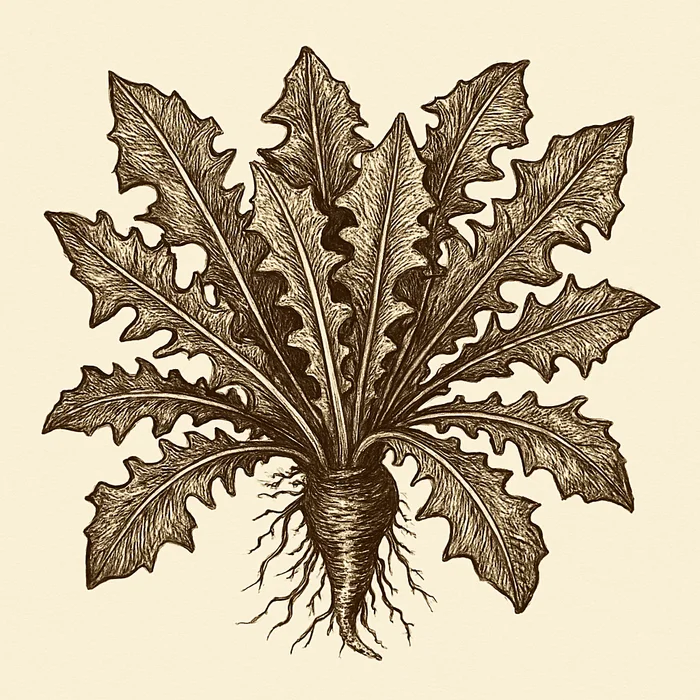
Dandelion Greens
The humble weed that turns out to be a nutritional powerhouse — dandelion greens (Taraxacum officinale) are one of the richest dietary sources of vitamin K, a dense package of carotenoids, and a surprising source of prebiotic fiber. Long eaten across Mediterranean, Middle Eastern, and Asian cuisines as a bitter green, dandelion has re-emerged as a longevity food with a solid mechanistic research base.
Why It Matters for Longevity
Dandelion greens punch well above their weight across several longevity-relevant pathways:
Cardiovascular protection. Leaf and root extracts improve lipid profiles — reducing total cholesterol and triglycerides — while exerting anti-hypertensive effects via antioxidant activity and reduction of lipid peroxidation. Chicoric acid, a polyphenol concentrated in dandelion, inhibits platelet surface receptor expression, reducing platelet aggregation and clot risk. (PMC9002813)
Anti-cancer mechanisms. Dandelion's key phytochemicals — taraxasterol, luteolin, and quercetin — activate autophagy via mTOR/4EBP1 inhibition, induce apoptosis through Bcl-2/caspase pathways, and arrest the cell cycle via p21/p53 upregulation. Anti-proliferative effects have been demonstrated across breast, colorectal, gastric, and lung cancer cell lines. (PMC12694484)
Exceptional micronutrient density. At 778 mcg of vitamin K1 per 100g (649% DV), dandelion greens are among the highest dietary sources of this fat-soluble vitamin, which is critical for bone density and vascular calcification prevention. They also provide 508 mcg RAE of vitamin A and 13,610 mcg of lutein + zeaxanthin per 100g — compounds that support macular health and anti-inflammatory defense. (NCCIH / USDA)
Gut microbiome support. Dandelion leaves contain inulin, a prebiotic fiber fermented by Bifidobacterium and Lactobacillus species in the colon. Gut microbiome diversity supported by inulin is linked to reduced systemic inflammation and healthy aging.
How to Use It
Dandelion greens are a bitter leafy green — their intensity varies significantly with season and age. Young spring leaves (March–May) are the mildest and most versatile; older summer leaves can be intensely bitter and benefit from blanching or sautéing.
- Raw in salads: Young leaves work well mixed with milder greens; dress with olive oil and lemon to balance bitterness and enhance fat-soluble nutrient absorption.
- Sautéed (cicoria ripassata): The classic Italian preparation — blanch briefly, then sauté with extra-virgin olive oil, garlic, and chili flakes. Blanching removes some bitterness while retaining nutrients.
- Middle Eastern style (hindbeh bil zayt): Wilt the greens, then top with caramelized onions and lemon juice. A traditional Lebanese and Palestinian preparation that highlights dandelion's earthy depth.
- In soups and stews: Stir into bean soups or minestrone in the last few minutes of cooking.
Always consume with a fat source (olive oil, nuts, eggs) — vitamin K, beta-carotene, lutein, and zeaxanthin are all fat-soluble and require dietary fat for absorption.
What to Pair It With
| Ingredient | Why | Tradition |
|---|---|---|
| Olive oil | Unlocks fat-soluble vitamins K, A, and carotenoids; oleocanthal amplifies anti-inflammatory effect | Italian / Mediterranean |
| Garlic | Allicin + luteolin/quercetin provide additive NF-κB and mTOR suppression | Italian, Middle Eastern |
| Lemon juice | Vitamin C enhances non-heme iron absorption (3.1 mg/100g); balances bitterness | Mediterranean |
| White beans | Plant protein + resistant starch buffer bitterness; combined prebiotic fiber load supports gut health | Italian cucina povera |
| Caramelized onions | Quercetin from onions pairs with luteolin for additive anti-inflammatory effect; sweetness offsets bitterness | Middle Eastern |
Synergies
- Olive Oil (synergy): Fat-soluble carotenoids (beta-carotene, lutein) and vitamin K require dietary fat for absorption. Extra-virgin olive oil adds oleocanthal and oleic acid, amplifying the overall anti-inflammatory and cardiovascular-protective effect of the pairing.
- Lemon Juice (synergy): Vitamin C enhances non-heme iron absorption from dandelion greens (3.1 mg/100g). The acidity also balances bitterness and may improve polyphenol stability during cooking.
- Garlic (synergy): Allicin and diallyl sulfides in garlic complement dandelion's flavonoids (luteolin, quercetin) with additive NF-κB and mTOR suppression — a pairing that appears across Italian and Middle Eastern longevity cuisines.
- White Beans (complement): Beans buffer dandelion's bitterness with plant protein and resistant starch; dandelion's inulin adds prebiotic fiber to the beans' fiber load, supporting a robust gut microbiome. Classic in Italian cucina povera and Blue Zone-adjacent diets.
Flavor Profile
Taste: bitter, earthy, slightly tangy, mildly herbaceous. Aroma: fresh grassy, faintly vegetal, earthy. Texture: tender when young, fibrous when mature, slightly chewy when cooked, crisp when raw. Category: bitter leafy green.
The Science
- Kania-Dobrowolska and Barańska, 2022, Foods: Comprehensive review of dandelion as a source of biologically active compounds -- luteolin, quercetin, chicoric acid, taraxasterol, and inulin provide anti-inflammatory, antioxidant, anti-cancer, and prebiotic properties; cardiovascular protection via lipid-profile improvement and platelet aggregation inhibition.
- Colle et al., 2012, J Med Food: Taraxacum officinale leaf extract demonstrates significant antioxidant activity and hepatoprotective effects in rodent models; polyphenol content (including luteolin and quercetin) implicated in free-radical scavenging and liver protection.
- Aune et al., 2017, Int J Epidemiol: Meta-analysis of 95 prospective studies -- vegetable and leafy green intake associated with dose-dependent reductions in cardiovascular disease, cancer, and all-cause mortality.
References
- Kania-Dobrowolska M, Baraniak J. Dandelion (Taraxacum officinale L.) as a Source of Biologically Active Compounds Supporting the Therapy of Co-Occurring Diseases in Metabolic Syndrome. Foods. 2022;11(18):2858. PMID: 36140985. doi:10.3390/foods11182858
- Colle D, Arantes LP, Gubert P, et al. Antioxidant properties of Taraxacum officinale leaf extract are involved in the protective effect against hepatotoxicity induced by acetaminophen in mice. J Med Food. 2012;15(6):549-556. PMID: 22424457. doi:10.1089/jmf.2011.0282
- Aune D, Giovannucci E, Boffetta P, et al. Fruit and vegetable intake and the risk of cardiovascular disease, total cancer and all-cause mortality -- a systematic review and dose-response meta-analysis of prospective studies. Int J Epidemiol. 2017;46(3):1029-1056. PMID: 28338764. doi:10.1093/ije/dyw319
Key Nutrients
| Nutrient | Per 100g | Notes |
|---|---|---|
| Vitamin K1 | 778 mcg (649% DV) | Fat-soluble; always consume with olive oil or other dietary fat for absorption. One of the richest food sources of vitamin K among common greens. |
| Beta-carotene | 5,854 mcg | Fat-soluble pro-vitamin A; conversion to retinol enhanced by co-consumption with fat |
| Lutein + Zeaxanthin | 13,610 mcg | Supports macular health; fat-soluble, requires dietary fat |
| Luteolin (flavonoid) | ~8–12 mg (est.) | Potent NF-κB inhibitor and mTOR modulator; pairs with quercetin for additive anti-inflammatory effect |
| Inulin (prebiotic fiber) | ~0.5–1.5 g (leaves) | Fermented by gut bacteria; supports microbiome diversity linked to healthy aging |
| Potassium | 397 mg | Supports blood pressure regulation; well-retained in sautéed preparations |
| Iron (non-heme) | 3.1 mg | Bioavailability enhanced significantly by co-consuming with vitamin C (lemon juice) |