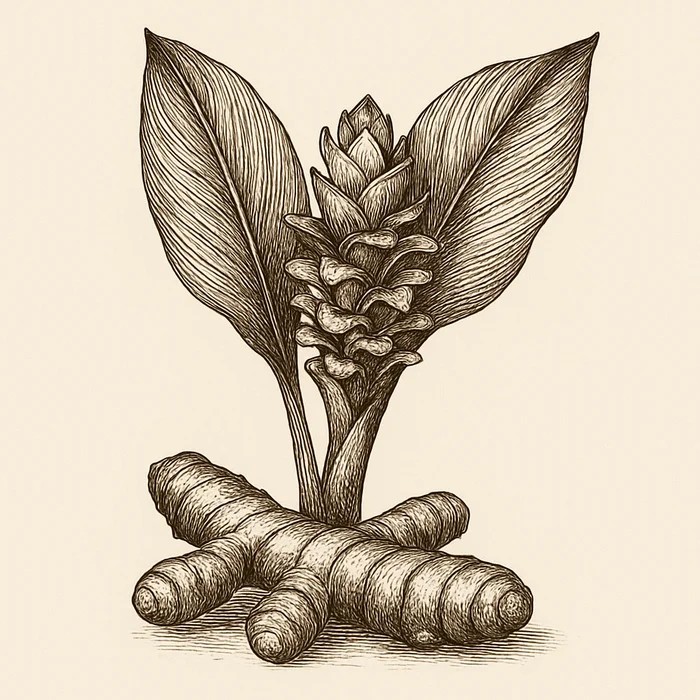
Turmeric
Curcumin, turmeric's headline compound, hits three of the biggest longevity targets at once -- inflammation, cancer, and neurodegeneration -- but your body absorbs less than 1% of it unless you know the trick.
Why It Matters for Longevity
Curcumin works by shutting down NF-κB, the master switch for inflammatory gene expression. It also inhibits COX-2 and LOX pathways. In clinical trials, curcumin at doses of 500–1,000 mg/day significantly reduced C-reactive protein, TNF-alpha, and IL-6 -- the trifecta of chronic inflammatory markers that drive aging-related disease. A meta-analysis of RCTs (Sahebkar et al., 2014, Phytother Res) found curcumin significantly lowered serum C-reactive protein, with the biggest effects in people who already had elevated inflammation.
On the cancer side, curcumin induces apoptosis in cancer cells -- it literally triggers their self-destruct program. Animal studies show inhibitory effects against colon, skin, and oral cancers. A pilot human study combined curcumin with quercetin (found in capers and onions) and saw significant reduction in both the number and size of colon polyps over six months. That quercetin synergy is worth remembering.
The brain data is newer but striking. A double-blind RCT (Small et al., 2018, Am J Geriatr Psychiatry) gave non-demented adults 90 mg of bioavailable curcumin (Theracurmin) twice daily for 18 months. The curcumin group showed significantly improved memory performance and -- here's what got attention -- measurably reduced amyloid and tau accumulation on PET brain scans. That's not just symptom management; it's evidence of structural change in a tissue that is notoriously resistant to intervention.
Joint Pain and Inflammation: The Strongest Clinical Signal
Among curcumin's effects, the evidence for joint pain relief is the most consistent across clinical trials. A systematic review and meta-analysis of 11 RCTs (Hsiao et al., 2021, Complement Ther Med) enrolling 1,258 participants with primary knee osteoarthritis found that curcuminoids were significantly more effective than controls on both VAS (visual analogue scale) and WOMAC (Western Ontario and McMaster Universities) pain scores. Notably, there was no significant difference in pain relief between high-dose and low-dose curcuminoid treatments, and curcuminoids performed comparably to NSAIDs on pain outcomes while producing fewer gastrointestinal adverse events. For someone managing chronic joint inflammation while trying to avoid long-term NSAID use, this is a clinically useful finding.
The mechanism is direct: curcumin suppresses NF-κB in synovial tissue, reducing production of IL-1β, IL-6, TNF-α, and COX-2-derived prostaglandins. It also inhibits matrix metalloproteinases that degrade joint cartilage. The combination of anti-inflammatory and anti-catabolic effects on joint tissue makes it mechanistically plausible and clinically supported.
Lipid and Cardiometabolic Effects
A dose-response meta-analysis of 64 RCTs (Dehzad et al., 2023, Complement Ther Med) found that turmeric/curcumin supplementation produced statistically significant improvements across the full lipid panel: total cholesterol −3.99 mg/dL (95% CI −5.33 to −2.65), LDL-C −4.89 mg/dL (95% CI −5.92 to −3.87), triglycerides −6.69 mg/dL (95% CI −7.93 to −5.45), and HDL-C +1.80 mg/dL (95% CI +1.43 to +2.17). The effect sizes are modest in absolute terms -- roughly comparable to a meaningful dietary change -- but they are consistent across a large body of trials. The authors note, appropriately, that evidence quality was graded as low-to-very-low on GRADE criteria due to heterogeneity in formulations and populations; these numbers should be read as directional rather than prescriptive. Bioavailability-enhanced formulations (piperine, phytosome, nanoparticle) may produce larger effects than standard powder.
The Bioavailability Problem (and Its Solution)
Here's the critical caveat: standard curcumin powder has less than 1% oral absorption. Curcumin is rapidly metabolized in the gut and undergoes extensive first-pass elimination. This is not a minor inconvenience -- it means eating turmeric powder alone, without any absorption enhancer, provides a fraction of the dose used in successful trials.
The solution is simple and well-proven. Black pepper contains piperine, which increases curcumin absorption by roughly 2,000% (Shoba et al., 1998, Planta Medica). That's not a typo -- 20-fold is the measured effect in human pharmacokinetic studies. Piperine inhibits intestinal glucuronidation, the metabolic pathway that breaks curcumin down before it reaches systemic circulation. Always combine turmeric with black pepper.
Fat also helps. Curcumin is fat-soluble, so cooking turmeric into a dish with olive oil, coconut milk, or ghee meaningfully improves absorption. A golden milk with coconut milk, turmeric, black pepper, and a pinch of fat checks every box. For clinical-level effects -- the doses used in the brain and joint trials -- a bioavailability-enhanced supplement (Theracurmin, Meriva, Longvida, or BioPerine-enhanced products) is more reliable than cooking alone.
How to Use It
Use 1–2 teaspoons of turmeric powder daily in cooking, always with black pepper and a fat. Fresh turmeric rhizome (available late autumn through winter) can be grated into stir-fries, soups, and smoothies. Store dried powder away from light -- curcuminoid content degrades with UV exposure. For purposes beyond culinary (joint pain, cognitive support), a standardized supplement with a documented bioavailability enhancer is the pragmatic choice; cooking doses are insufficient to replicate RCT findings.
What to Pair It With
| Ingredient | Why | Tradition |
|---|---|---|
| Black pepper | Piperine boosts curcumin absorption by 2,000% | Indian (Ayurvedic) |
| Capers / onions | Quercetin + curcumin synergy reduced colon polyps in pilot study | Mediterranean / fusion |
| Coconut milk | Fat improves fat-soluble curcuminoid absorption | Thai / Indonesian |
| Ginger | Fellow rhizome with complementary anti-inflammatory pathways | Indian / Southeast Asian |
| Lentils and chickpeas | Traditional vehicle; turmeric is in nearly every Indian dal | Indian |
| Cauliflower | Absorbs turmeric flavor and color; indole-3-carbinol adds cancer-fighting synergy | Indian |
Flavor Profile
Earthy, warm, and slightly bitter with a mild peppery bite and a musky, ginger-adjacent aroma. Fresh turmeric is fibrous and dense; the dried powder is fine and intensely staining. It's a background spice -- it colors and warms a dish rather than dominating it. Foundational across Indian, Southeast Asian, and Persian cooking. Think curries, rice dishes, and golden milk.
The Science
- Hewlings & Kalman, 2017, Foods: Narrative review of curcumin's clinical effects; anti-inflammatory action via NF-κB, COX-2, LOX inhibition.
- Sahebkar et al., 2014, Phytother Res: Meta-analysis — curcumin significantly lowers serum CRP in clinical practice.
- Small et al., 2018, Am J Geriatr Psychiatry: 90 mg bioavailable curcumin twice daily for 18 months improved memory and reduced amyloid/tau on PET scans.
- Hsiao et al., 2021, Complement Ther Med: Meta-analysis of 11 RCTs (n=1,258 knee OA patients) — curcuminoids superior to control on VAS and WOMAC pain scores; non-inferior to NSAIDs with fewer GI events.
- Dehzad et al., 2023, Complement Ther Med: Dose-response meta-analysis of 64 RCTs — turmeric/curcumin reduces TC −3.99 mg/dL, LDL-C −4.89 mg/dL, TG −6.69 mg/dL, raises HDL +1.80 mg/dL.
- Shoba et al., 1998, Planta Medica: Piperine co-ingestion increases curcumin bioavailability ~2,000% in humans.
References
- Hewlings SJ, Kalman DS. Curcumin: A Review of Its Effects on Human Health. Foods. 2017;6(10):92. PMID: 29065496. doi:10.3390/foods6100092
- Sahebkar A. Are curcuminoids effective C-reactive protein-lowering agents in clinical practice? Evidence from a meta-analysis. Phytother Res. 2014;28(5):633-642. PMID: 23922235. doi:10.1002/ptr.5045
- Small GW, Siddarth P, Li Z, et al. Memory and Brain Amyloid and Tau Effects of a Bioavailable Form of Curcumin in Non-Demented Adults: A Double-Blind, Placebo-Controlled 18-Month Trial. Am J Geriatr Psychiatry. 2018;26(3):266-277. PMID: 29246725. doi:10.1016/j.jagp.2017.10.010
- Hsiao AF, Lien YC, Tzeng IS, Liu CT, Chou SH, Horng YS. The efficacy of high- and low-dose curcumin in knee osteoarthritis: A systematic review and meta-analysis. Complement Ther Med. 2021;63:102773. PMID: 34537344. doi:10.1016/j.ctim.2021.102773
- Dehzad MJ, Ghalandari H, Amini MR, Askarpour M. Effects of curcumin/turmeric supplementation on lipid profile: A GRADE-assessed systematic review and dose-response meta-analysis of randomized controlled trials. Complement Ther Med. 2023;75:102955. PMID: 37230418. doi:10.1016/j.ctim.2023.102955
- Shoba G, Joy D, Joseph T, Majeed M, Rajendran R, Srinivas PS. Influence of piperine on the pharmacokinetics of curcumin in animals and human volunteers. Planta Med. 1998;64(4):353-356. PMID: 9619120. doi:10.1055/s-2006-957450
Key Nutrients
| Nutrient | Per 100g | Notes |
|---|---|---|
| Curcumin | 3,000-5,000mg | <1% bioavailability without enhancers; piperine increases absorption ~2,000% |
| Demethoxycurcumin | 1,000-2,000mg | Second curcuminoid; similar bioavailability limitations |
| Turmerone | 2-5% of rhizome (essential oil) | Independent neuroprotective activity; may enhance curcumin absorption |
| Iron | 41.4mg | Non-heme; absorption enhanced by vitamin C |
| Manganese | 19.8mg | High content but small serving sizes limit intake |