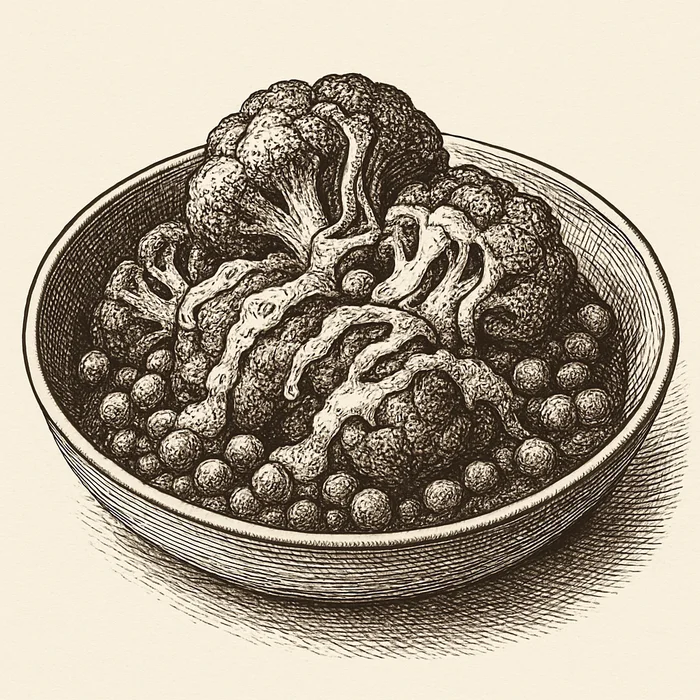
Roasted Cauliflower with Turmeric-Tahini Drizzle
A Middle Eastern-inspired grain bowl that engineers a collision between two of the most studied longevity compounds in food science -- sulforaphane from cauliflower and curcumin from turmeric -- and then solves both of their bioavailability problems in a single tahini drizzle.
Why These Ingredients Together
Cauliflower is a cruciferous vegetable containing glucosinolates, which the enzyme myrosinase converts into sulforaphane -- a compound that activates the Nrf2 pathway, your cells' master antioxidant defense switch. The problem: roasting destroys myrosinase. The fix: a pinch of mustard powder in the tahini drizzle. Mustard seeds contain their own myrosinase, which rescues the glucosinolate-to-sulforaphane conversion even after heat has killed the cauliflower's own enzyme. Curcumin from the turmeric inhibits NF-kB, the inflammatory master switch, through a completely separate pathway from sulforaphane's Nrf2 activation -- hitting both nodes simultaneously is more effective than hitting either one harder. Piperine from black pepper increases curcumin absorption by roughly 2000%, and the tahini provides the fat matrix that fat-soluble curcumin requires to cross the intestinal wall. Sesame lignans (sesamin and sesamolin) in the tahini have their own independent cholesterol-lowering and antioxidant effects. The chickpeas round it out with 8g of fiber per 100g, feeding the Bacteroidetes populations that produce butyrate -- an anti-inflammatory short-chain fatty acid.
Ingredients
- 1 large head cauliflower (about 800g), cut into bite-sized florets
- 1 can (400g) chickpeas, drained and rinsed
- 3 tablespoons extra-virgin olive oil
- 1 tablespoon ground turmeric
- 1 teaspoon freshly ground black pepper
- 1 teaspoon ground cumin
- 1/2 teaspoon smoked paprika
- 1 teaspoon flaky sea salt
Turmeric-Tahini Drizzle:
- 1/4 cup (60g) tahini (unhulled for maximum lignans)
- 1 tablespoon extra-virgin olive oil
- 1 tablespoon lemon juice
- 1 teaspoon ground turmeric
- 1/2 teaspoon mustard powder
- 1/4 teaspoon freshly ground black pepper
- 2-3 tablespoons warm water, to thin
- Pinch of salt
To serve:
- 2 cups cooked grain (bulgur, freekeh, or brown rice)
- Handful of fresh parsley, roughly chopped
- 2 tablespoons pomegranate seeds (optional)
- Lemon wedges
Instructions
-
Preheat the oven to 220C (425F) and line a large baking sheet with parchment paper. You need a hot oven for proper Maillard browning on the cauliflower -- anything under 200C will steam rather than roast.
-
Toss the cauliflower and chickpeas. In a large bowl, combine the cauliflower florets and drained chickpeas with the olive oil, turmeric, black pepper, cumin, smoked paprika, and salt. Toss until every surface is coated in the golden spice mixture. (The turmeric dissolves into the olive oil on contact, creating a lipid-soluble matrix. This is not decorative -- curcumin that is not dissolved in fat has less than 1% oral bioavailability.)
-
Spread in a single layer on the prepared baking sheet. Crucially, do not crowd the pan. Overlapping florets will trap steam and prevent browning. Use two sheets if needed. Roast for 30-35 minutes, flipping once at the 20-minute mark, until the cauliflower is deeply golden with charred edges and the chickpeas are crispy.
-
Make the tahini drizzle while the cauliflower roasts. Whisk together the tahini, olive oil, lemon juice, turmeric, mustard powder, black pepper, and salt. Add warm water one tablespoon at a time until you reach a pourable but not thin consistency -- it should coat the back of a spoon. (The mustard powder is doing essential work here. Mustard seeds contain myrosinase, the same enzyme that cauliflower uses to convert its glucosinolates into sulforaphane. Since roasting destroyed the cauliflower's own myrosinase, the mustard provides a backup source. Research shows adding mustard to cooked cruciferous vegetables recovers significant sulforaphane production.)
-
Assemble the bowls. Divide the cooked grain among four bowls. Top with the roasted cauliflower and chickpeas. Drizzle generously with the turmeric-tahini sauce. Scatter parsley and pomegranate seeds on top, and serve with lemon wedges. (The vitamin C in the lemon juice will increase absorption of the non-heme iron from the chickpeas by 2-6x if squeezed on just before eating.)
What Can Go Wrong
-
Forgetting the mustard powder in the drizzle. Without it, the roasted cauliflower's sulforaphane potential is largely wasted. The myrosinase in mustard is the entire reason the drizzle exists as a longevity intervention rather than just a tasty sauce. Even half a teaspoon makes a measurable difference.
-
Crowding the baking sheet. This is the most common cause of sad, steamed cauliflower. Each floret needs air space around it so moisture can escape. If the florets are touching, the water they release creates a steam environment and you get pale, soft cauliflower instead of caramelized, nutty florets.
-
Using hulled tahini. Unhulled tahini (made from whole sesame seeds with the hull intact) contains significantly more calcium, fiber, and sesame lignans than hulled. The flavor is slightly more bitter, but that bitterness is the lignans themselves -- the exact compounds with cholesterol-lowering and antioxidant activity.
Science Notes
This bowl exploits a specific vulnerability in how cruciferous vegetables work. Glucosinolates are inert storage molecules -- they need to be enzymatically converted into sulforaphane to have any biological activity. In raw cauliflower, chewing ruptures cells and mixes glucosinolates with myrosinase, and the conversion happens in your mouth and stomach. Roasting denatures myrosinase completely. For years, this made cooked cruciferous vegetables a nutritional compromise: better texture, worse bioactivity. The discovery that exogenous myrosinase from mustard seeds, daikon, or wasabi can rescue sulforaphane formation in cooked brassicas changed this equation. You can now have the Maillard flavors of roasting and the sulforaphane of raw -- as long as you add a myrosinase source after cooking.
Nutrition Highlights
- Sulforaphane precursors: Cauliflower provides glucosinolates, with bioactivation rescued by mustard powder myrosinase in the drizzle
- Curcuminoids: Double dose from roasting oil and drizzle, with bioavailability enhanced by piperine (black pepper) and fat (tahini + olive oil)
- Fiber: ~13g per serving from chickpeas and cauliflower, supporting short-chain fatty acid production in the colon
- Sesame lignans: Tahini delivers sesamin and sesamolin, shown to reduce LDL cholesterol and potentiate vitamin E antioxidant activity