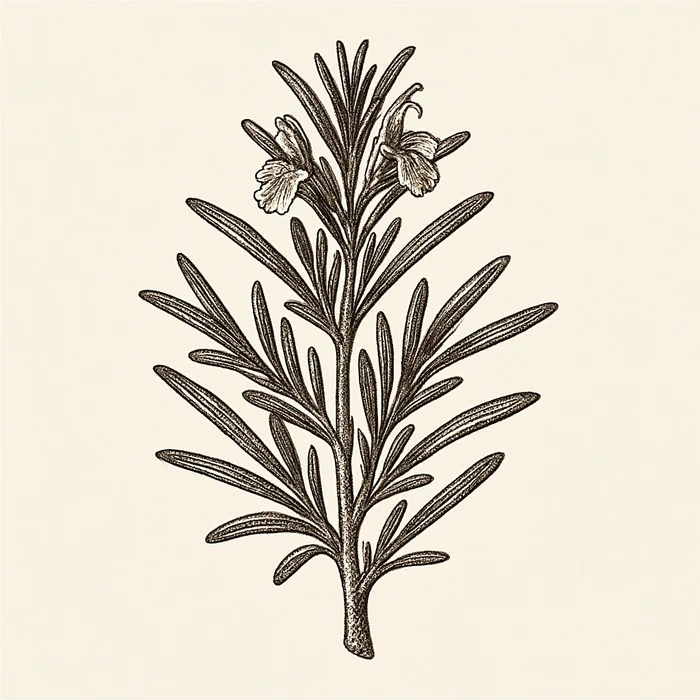
Rosemary
There is a reason rosemary has been associated with memory since ancient Greece. Modern research has caught up with the folklore: the volatile compound 1,8-cineole, absorbed simply by inhaling rosemary's aroma, correlates with improved cognitive performance in controlled trials.
Why It Matters for Longevity
Rosemary's longevity profile centers on two compounds: carnosic acid and rosmarinic acid. Carnosic acid operates on a "pro-electrophilic" mechanism — it becomes more potent under oxidative stress, activating precisely when cells need protection most. The compound protects brain mitochondria from oxidative damage through Nrf2 pathway activation, supporting neurological aging defense. Rosemary's volatile 1,8-cineole is absorbed via inhalation and directly correlates with cognitive performance.
Carnosic acid from rosemary demonstrated neuroprotective activity by protecting mitochondria of brain cells against oxidative stress, and is a promising agent for neuroprotection via Nrf2 pathway activation — relevant to both Alzheimer's and Parkinson's disease models (de Oliveira, 2018, Mol Neurobiol).
Exposure to rosemary essential oil aroma resulted in significantly higher plasma 1,8-cineole concentrations that correlated with improved cognitive performance in healthy older adults, confirming genuine pharmacological activity via inhalation of rosemary volatile compounds (Moss & Oliver, 2012, Ther Adv Psychopharmacol).
There is also a practical food-safety dimension. Ethanolic extracts of rosemary significantly inhibited heterocyclic amine formation in beef patties during high-temperature cooking, reducing carcinogenic compound formation — making rosemary marinade an evidence-based protective strategy (Puangsombat & Smith, 2010, J Food Sci).
Anti-Inflammatory Mechanisms: NF-κB, COX-2, and Nrf2
Carnosic acid and carnosol -- the two principal diterpene phenols in rosemary -- suppress inflammatory signalling through converging and independent pathways. A comprehensive review by Habtemariam (2023, Biomedicines) catalogued the molecular targets: NF-κB activation is suppressed via IKK inhibition; MAPK pathways (ERK1/2, JNK, p38) show reduced phosphorylation; STAT3 activation is dampened; and Nrf2 is induced, driving antioxidant response element gene expression. Downstream, this profile translates to lower TNF-α, IL-1β, IL-6, and prostaglandin E2 output.
In preclinical models, the quantified effects are substantial. Carnosic acid at 10--40 mg/kg reduced NF-κB expression and phosphorylation in LPS-induced acute lung injury models. Carnosol at 20--40 mg/kg (i.p.) downregulated serum IL-1β and TNF-α in septic shock models. Carnosic acid at 15 mg/kg suppressed a broad cytokine panel -- including IL-1β, IL-18, TNF-α, IL-2, IL-4, IL-6, IL-12, and IFN-γ -- in a high-fat diet NAFLD model. COX-2 inhibition by carnosic acid also operates via suppression of microsomal prostaglandin E synthase-1 (mPGES-1), which sits downstream of COX-2 in the prostaglandin synthesis cascade.
The Nrf2 activation by carnosic acid is distinct from a simple antioxidant effect. Carnosic acid's pro-electrophilic behaviour means it reacts with Keap1 (the Nrf2 suppressor) under oxidative conditions, releasing Nrf2 to translocate to the nucleus and upregulate cytoprotective genes including HO-1, NQO1, and glutathione S-transferases. This mechanism means carnosic acid is disproportionately active in inflamed or oxidatively stressed tissue -- the environments most relevant to aging pathology.
Cognitive Effects in Human Trials
Two human trials provide direct clinical evidence for rosemary's cognitive effects, operating through different delivery routes.
A double-blind randomized controlled trial in 68 university students tested 500 mg oral rosemary extract twice daily for one month (Nematolahi et al., 2018, Complement Ther Clin Pract). Prospective and retrospective memory scores improved significantly in the rosemary group relative to placebo, with anxiety and depression also reduced. The oral route delivers rosmarinic acid and carnosic acid systemically via intestinal absorption; 500 mg twice daily is equivalent to approximately 1 g/day of concentrated extract, achievable through regular tea or culinary use at high frequency.
The inhalation route was characterized by Moss & Oliver (2012, Ther Adv Psychopharmacol): plasma 1,8-cineole concentrations following rosemary aroma exposure correlated directly with performance on speed and accuracy tasks in healthy older adults. This is not aromatherapy in the vague wellness sense -- it is a pharmacological effect via pulmonary absorption. 1,8-Cineole inhibits acetylcholinesterase and butyrylcholinesterase, the same enzymatic targets as approved Alzheimer's drugs (donepezil, rivastigmine), though the in vivo magnitude of this effect has not been established in a clinical intervention.
Together these data suggest two complementary mechanisms: systemic carnosic acid and rosmarinic acid absorption from oral intake, and rapid 1,8-cineole delivery via inhalation during cooking. Both pathways are activated by normal kitchen use of fresh rosemary.
How to Use It
Use rosemary several times per week in cooking and as a herbal tea. For maximum neuroprotective benefit, brew fresh rosemary in hot water for 5--10 minutes -- rosmarinic acid is water-soluble and extracts well. The book recommends alternating rosemary infusions with green tea and sage tea. In cooking, add whole sprigs to roasting pans, infuse into olive oil, or strip the leaves and chop finely for marinades. For meat preparation, marinate with rosemary at least 30 minutes before cooking to reduce heterocyclic amine formation.
What to Pair It With
| Ingredient | Why | Tradition |
|---|---|---|
| Garlic | Classic Mediterranean aromatic pairing | Mediterranean |
| Extra-virgin olive oil | Fat enhances carnosic acid absorption | Italian |
| Lemon | Acid brightens resinous quality in marinades | Mediterranean |
| Legumes | Essential in Tuscan white bean dishes | Tuscan |
| Walnuts | Rosemary-walnut breads and pestos | Italian |
| Sage | Both Lamiaceae herbs; complementary antioxidant profiles | Italian |
Flavor Profile
Rosemary is piney, camphoraceous, and warm with a slight bitterness and peppery finish. The aroma is distinctly evergreen -- woody and resinous with mentholated undertones. A little goes a long way; overuse can make dishes taste medicinal. Fresh rosemary has a brighter, more nuanced flavour than dried, though both retain significant bioactive compounds.
The Science
- de Oliveira, 2018, Mol Neurobiol: Carnosic acid protects brain cell mitochondria against oxidative stress via Nrf2 activation; neuroprotective in models of Alzheimer's and Parkinson's disease.
- Moss & Oliver, 2012, Ther Adv Psychopharmacol: Plasma 1,8-cineole concentrations from rosemary aroma exposure correlated with improved cognitive performance in healthy older adults -- confirmed pharmacological activity via inhalation.
- Puangsombat & Smith, 2010, J Food Sci: Rosemary ethanolic extract significantly inhibited heterocyclic amine formation in beef patties during high-temperature cooking, confirming a food-safety protective role for rosemary marinades.
- Habtemariam, 2023, Biomedicines: Carnosic acid and carnosol suppress NF-κB (via IKK inhibition), MAPK, and STAT3 pathways while inducing Nrf2; reduces TNF-α, IL-1β, IL-6, and prostaglandin E2 in preclinical models.
- Nematolahi et al., 2018, Complement Ther Clin Pract: Double-blind RCT in 68 students -- 500 mg oral rosemary extract twice daily for one month significantly improved prospective and retrospective memory versus placebo.
References
- de Oliveira MR, Nabavi SF, Nabavi SM, Jardim FR. Carnosic Acid as a Promising Agent in Protecting Mitochondria of Brain Cells. Mol Neurobiol. 2018;55(8):6687-6699. PMID: 29335845. doi:10.1007/s12035-018-0876-3
- Moss M, Oliver L. Plasma 1,8-cineole correlates with cognitive performance following exposure to rosemary essential oil aroma. Ther Adv Psychopharmacol. 2012;2(3):103-113. PMID: 23983963. doi:10.1177/2045125312436573
- Puangsombat K, Smith JS. Inhibition of heterocyclic amine formation in beef patties by ethanolic extracts of rosemary. J Food Sci. 2010;75(2):T40-T47. PMID: 20492265. doi:10.1111/j.1750-3841.2009.01491.x
- Habtemariam S. Anti-Inflammatory Therapeutic Mechanisms of Natural Products: Insight from Rosemary Diterpenes, Carnosic Acid and Carnosol. Biomedicines. 2023;11(2):545. PMID: 36831081. doi:10.3390/biomedicines11020545
- Nematolahi P, Mehrabani M, Karami-Mohajeri S, Dabaghzadeh F. Effects of Rosmarinus officinalis L. on memory performance, anxiety, depression, and sleep quality in university students: A randomized clinical trial. Complement Ther Clin Pract. 2018;30:54-60. PMID: 29389474. doi:10.1016/j.ctcp.2017.12.008
Key Nutrients
| Nutrient | Per 100g (dried) | Notes |
|---|---|---|
| Carnosic acid | 1.5--2.5 g | Pro-electrophilic antioxidant; activates Nrf2 by reacting with Keap1 under oxidative stress; neuroprotective via brain mitochondria protection |
| Rosmarinic acid | 1.0--2.5 g | Water-soluble; anti-inflammatory via COX-2 and NF-κB inhibition; extracts well into herbal tea; systemic absorption via oral route |
| 1,8-Cineole | Major volatile | Absorbed via inhalation; plasma concentration directly correlates with cognitive performance; inhibits acetylcholinesterase |
| Carnosol | 0.3--0.6 g | Independent anticancer and anti-inflammatory activity; suppresses iNOS, TNF-α via NF-κB pathway |