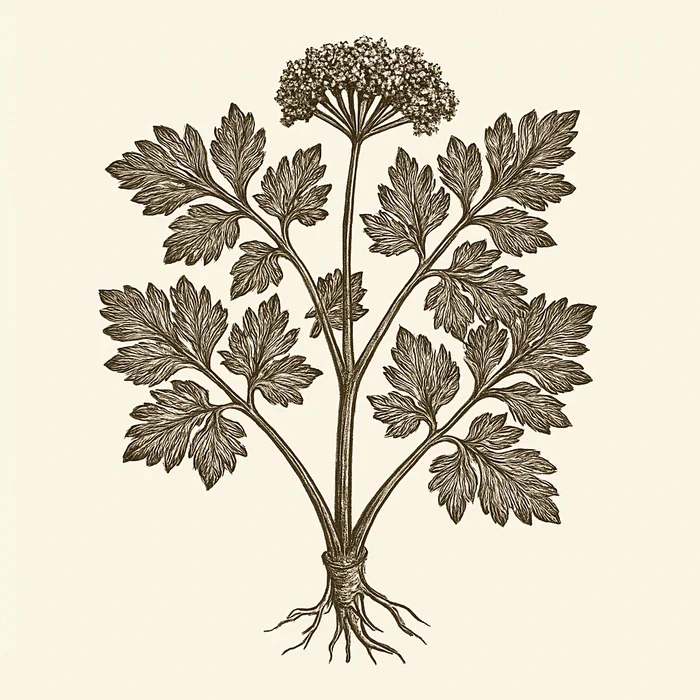
Parsley
Parsley is not a garnish. It is one of the richest dietary sources of apigenin, a flavone that inhibits tumour cell proliferation at concentrations achievable through regular eating. The fact that most restaurant plates come back with the parsley untouched is a small, quiet tragedy for public health.
Why It Matters for Longevity
Apigenin and Cancer Cell Biology
Apigenin is the headline compound. A comprehensive review confirmed that apigenin suppresses cancer cell growth through multiple simultaneous mechanisms: cell cycle arrest at G2/M, apoptosis induction via caspase activation, and inhibition of angiogenesis — the blood vessel formation that tumors need to grow. This was demonstrated across prostate, breast, lung, and colon cancer cell lines, establishing apigenin as one of the most mechanistically well-characterized flavones in cancer prevention research (Shukla & Gupta, 2010, Pharm Res).
The NF-κB pathway is central to apigenin's anti-inflammatory and anti-cancer mechanism. In a TRAMP mouse model of prostate cancer — a widely used in vivo system that recapitulates human disease progression — oral apigenin at 20–50 µg/mouse/day for 20 weeks produced significant decreases in NF-κB/p65 and NF-κB/p50 protein expression, reduced NF-κB DNA binding activity, and suppressed downstream gene products including cyclin D1, COX-2, Bcl-2, and VEGF, while simultaneously inducing apoptosis markers. The result was a significant decrease in tumor volumes and complete abolishment of metastasis in treated animals (Shukla et al., 2015, PLoS One). The mechanistic specificity here matters: apigenin inhibits IKK (IκB kinase), preventing IκBα phosphorylation and degradation, which blocks NF-κB nuclear translocation — the upstream switch controlling chronic inflammatory gene expression.
Bioavailability: What Actually Reaches the Bloodstream
Apigenin in parsley is present primarily as apiin (apigenin-7-O-apiosylglucoside), a glycoside form. A human pharmacokinetic study administering a parsley drink containing apigenin-7-O-(2″-O-apiosyl)glucoside found that 11.2% of the ingested dose appeared in urine as glucuronide and sulfate metabolites, with peak plasma concentration at 4 hours — indicative of absorption in the lower gastrointestinal tract following hydrolysis of the glycoside by colonic microbiota (Borges et al., 2022, Free Radic Biol Med). This is substantially higher recovery than pure apigenin (only 0.5% urinary excretion), confirming that the food matrix and glycoside form meaningfully affect delivery. An earlier crossover trial using whole parsley (2 g/kg body weight, ~65.8 µmol apigenin) found mean peak plasma concentrations of 127 ± 81 nmol/L at 7.2 hours — a level within the range where anti-inflammatory activity has been observed in cell models (Meyer et al., 2006, Ann Nutr Metab). The wide inter-individual variation (peak plasma range: roughly 50–400 nmol/L) likely reflects differences in gut microbiome composition affecting glycoside hydrolysis.
Flat-leaf parsley contains the highest apigenin concentration — 30–45 mg per 100 g fresh weight, rising to 215–300 mg per 100 g dried. At the cooking quantities used in tabbouleh (80–100 g fresh parsley per serving), a single dish delivers a pharmacologically relevant dose.
Vitamin K: Bone Density and Vascular Calcification
Fresh parsley delivers 1640 mcg of vitamin K per 100 g — over thirteen times the daily requirement. Vitamin K is the cofactor required for γ-carboxylation of osteocalcin (bone matrix Gla protein) and matrix Gla protein (MGP). Carboxylated MGP inhibits vascular smooth muscle calcification; undercarboxylated MGP accumulates in calcified arterial walls and is a marker of increased cardiovascular risk. This mechanism links vitamin K status directly to arterial stiffness and cardiovascular mortality — distinct from vitamin K's better-known role in coagulation (which operates through different Gla proteins). Since vitamin K is fat-soluble, eating parsley with olive oil (as in persillade or chimichurri) is not optional for this benefit.
Folate: Homocysteine Lowering and Mortality Data
Parsley contains approximately 152 mcg of folate per 100 g — roughly 38% of the daily requirement from a single serving. Dietary folate is the primary determinant of one-carbon metabolism efficiency: adequate folate drives the remethylation of homocysteine back to methionine via methionine synthase, keeping circulating homocysteine low. Elevated homocysteine independently predicts cardiovascular and all-cause mortality across populations.
A systematic review and dose-response meta-analysis of 25 prospective cohorts (423,304 participants, 36,558 all-cause deaths, 12,662 CVD deaths) found that highest dietary folate intake was associated with hazard ratios of 0.87 for all-cause mortality (95% CI: 0.78–0.96) and 0.77 for CVD mortality (95% CI: 0.57–0.93) compared to lowest intake (Fallah et al., 2025, Nutr Rev). The dose-response relationship was graded, with each 10 nmol/L increment in folate biomarker associated with a 12% marginal reduction in all-cause mortality risk. Parsley as a regular dietary ingredient — not a supplement — is one of the most concentrated whole-food folate sources available.
Vitamin C
Parsley contains more vitamin C than oranges per gram (133 mg vs ~53 mg per 100 g), making a handful of fresh parsley a meaningful contributor to daily ascorbate status. Unlike citrus, parsley provides vitamin C in the context of flavonoids and chlorophyll that may enhance overall antioxidant capacity. Add fresh parsley at the end of cooking or as a raw finishing element to preserve this water-soluble vitamin.
Myristicin and Detoxification Enzymes
Parsley also contains myristicin, a phenylpropene compound that induces glutathione S-transferase in the liver — one of the body's primary phase II detoxification enzymes responsible for conjugating reactive electrophiles and carcinogens for excretion. The magnitude of induction from dietary quantities has been characterized in animal models; direct human evidence is limited, but the mechanism is well-established in the phase II enzyme literature.
How to Use It
Use parsley as a primary ingredient, not a decoration. Tabbouleh is the model: the dish is mostly parsley with some bulgur, not the other way around. Add large handfuls to salads, stir into soups at the end of cooking, blend into salsa verde and chimichurri. Flat-leaf (Italian) parsley has more flavor and higher apigenin content than curly varieties. Add fresh parsley at the end of cooking or as a raw finishing element to preserve vitamin C.
What to Pair It With
| Ingredient | Why | Tradition |
|---|---|---|
| Garlic | Persillade — classic French finishing condiment | French |
| Lemon | Gremolata; acid enhances iron absorption from accompanying proteins | Mediterranean / Middle Eastern |
| Tomatoes | Foundation of tabbouleh and Italian sauces | Italian / Middle Eastern |
| Extra-virgin olive oil | Fat enhances apigenin, vitamin K, and carotenoid absorption | Mediterranean |
| Bulgur wheat | Tabbouleh: parsley as main ingredient | Lebanese |
| Legumes | Essential in falafel and bean salads; vitamin C boosts non-heme iron absorption | Middle Eastern |
Flavor Profile
Fresh parsley tastes clean, grassy, and slightly peppery with a faint bitterness that rounds out rich dishes. Flat-leaf parsley has a more robust, slightly anise-like aroma; curly parsley is milder. The texture is crisp and light, adding both color and freshness.
The Science
- Shukla & Gupta, 2010, Pharm Res: Comprehensive review — apigenin suppresses cancer cell proliferation via G2/M cell cycle arrest, caspase-dependent apoptosis, and inhibition of angiogenesis; demonstrated across prostate, breast, lung, and colon cancer cell lines at dietarily relevant concentrations.
- Shukla et al., 2015, PLoS One: Apigenin (20–50 µg/day oral) in TRAMP mice inhibits NF-κB/p65 nuclear translocation via IKK/IκBα pathway; suppresses cyclin D1, COX-2, VEGF; significant reduction in tumor volumes and abolishment of metastasis at 20 weeks.
- Borges et al., 2022, Free Radic Biol Med: Human ADME study — parsley drink delivers 11.2% urinary recovery of apigenin metabolites; peak plasma at 4 hours; glycoside form from food matrix 22× more bioavailable than pure apigenin.
- Meyer et al., 2006, Ann Nutr Metab: Single-dose human study (n=11); mean peak plasma apigenin 127 ± 81 nmol/L at 7.2 hours after parsley consumption; peak in the range of anti-inflammatory activity demonstrated in vitro.
- Fallah et al., 2025, Nutr Rev: Meta-analysis of 25 cohorts (n=423,304); highest dietary folate associated with HR 0.87 for all-cause mortality and HR 0.77 for CVD mortality vs. lowest intake.
References
- Shukla S, Gupta S. Apigenin: a promising molecule for cancer prevention. Pharm Res. 2010;27(6):962-978. PMID: 20306120. doi:10.1007/s11095-010-0089-7
- Shukla S, Shankar E, Fu P, MacLennan GT, Gupta S. Suppression of NF-κB and NF-κB-Regulated Gene Expression by Apigenin through IκBα and IKK Pathway in TRAMP Mice. PLoS One. 2015;10(9):e0138710. PMID: 26379052. doi:10.1371/journal.pone.0138710
- Borges G, Fong RY, Ensunsa JL, et al. Absorption, distribution, metabolism and excretion of apigenin and its glycosides in healthy male adults. Free Radic Biol Med. 2022;185:113-122. PMID: 35452808. doi:10.1016/j.freeradbiomed.2022.04.007
- Meyer H, Bolarinwa A, Wolfram G, Linseisen J. Bioavailability of apigenin from apiin-rich parsley in humans. Ann Nutr Metab. 2006;50(3):167-72. PMID: 16407641. doi:10.1159/000090736
- Fallah A, Karim Dehnavi R, Lotfi K, Aminianfar A, Azadbakht L, Esmaillzadeh A. Folate Biomarkers, Folate Intake, and Risk of Death From All Causes, Cardiovascular Disease, and Cancer: A Systematic Review and Dose-Response Meta-Analysis of Prospective Cohort Studies. Nutr Rev. 2025;83(3):e589-e603. PMID: 38950416. doi:10.1093/nutrit/nuae080
Key Nutrients
| Nutrient | Per 100g (fresh) | Notes |
|---|---|---|
| Apigenin | 30–45 mg (fresh); 215–300 mg (dried) | Anticancer flavone achievable at dietary doses; flat-leaf parsley highest; bioavailability ~11% from food matrix |
| Vitamin K | 1640 mcg (1367% RDA) | One of the richest food sources; fat-soluble — eat with olive oil; cofactor for MGP (arterial calcification inhibitor) |
| Vitamin C | 133 mg (148% RDA) | More than oranges per gram; add raw to preserve |
| Folate | 152 mcg (38% RDA) | Drives homocysteine remethylation; highest dietary folate associated with 23% lower CVD mortality in meta-analysis |
| Myristicin | Variable | Induces liver phase II detoxification enzymes (glutathione S-transferase) |