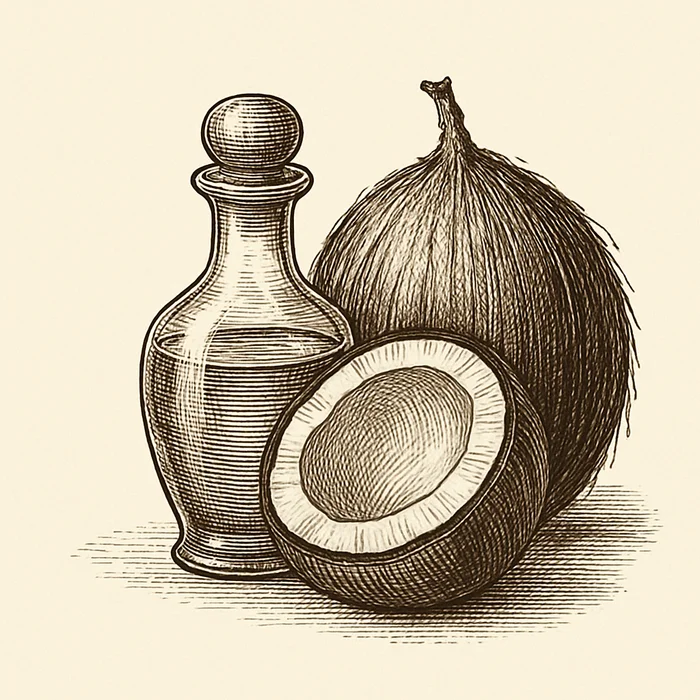
Coconut Oil
Extra virgin coconut oil at 40 mL/day improved cognitive scores in an Alzheimer's disease RCT — but this is a highly specific therapeutic context. Coconut oil also raises LDL cholesterol, which is why the Longevity Diet recommends it cautiously and not as a replacement for extra-virgin olive oil.
Why It Matters for Longevity
The Longevity Diet mentions coconut oil specifically for its medium-chain triglyceride (MCT) content and the hypothesis that MCT-derived ketone bodies can provide alternative brain fuel in Alzheimer's disease, where glucose metabolism is impaired.
The direct human evidence is small but intriguing. Fernando et al. (2015, Br J Nutr) conducted a controlled trial where 40 mL/day of extra virgin coconut oil for 21 days significantly improved MMSE cognitive scores in Alzheimer's patients compared to controls, with women showing greater benefit. The mechanism is the MCT-to-ketone pathway: C8 (caprylic) and C10 (capric) acids in coconut oil are rapidly converted to beta-hydroxybutyrate in the liver, providing ketones as an alternative neuronal fuel. The neuroprotective rationale for ketogenic strategies is supported by broader mechanistic evidence (Maalouf et al., 2009, Brain Res Rev).
The cardiovascular caveat is real. Eyres et al. (2016, Nutr Rev) reviewed 21 human studies and found coconut oil consumption raises both LDL and HDL cholesterol relative to unsaturated plant oils, with net cardiovascular effects intermediate between butter and olive oil. This is why the Longevity Diet explicitly warns against coconut oil for individuals with cardiovascular disease risk, and why extra-virgin olive oil remains the primary cooking fat.
A meta-analysis of 16 clinical trials by Neelakantan et al. quantified this LDL effect precisely: coconut oil consumption increased LDL cholesterol by a mean of 10.47 mg/dL (95% CI: 3.01–17.94) compared to nontropical vegetable oils such as safflower, sunflower, and canola oil, while simultaneously raising HDL by 4.00 mg/dL (95% CI: 2.26–5.73). No significant effects were observed on blood glucose or inflammatory markers. The authors concluded that the LDL elevation should be the primary consideration when evaluating cardiovascular suitability (Neelakantan et al., 2020, Circulation).
The main fatty acid in coconut oil — lauric acid (C12:0, ~47% of total fat) — has the largest LDL-raising effect per gram of any common saturated fatty acid. Isocaloric replacement of carbohydrates with 1% of energy from lauric acid increases LDL-cholesterol by 0.017 mmol/L and HDL-cholesterol by 0.019 mmol/L. Lauric acid is absorbed primarily via the portal vein (unlike the shorter C8 and C10 MCTs, which enter the lymphatic circulation and are more rapidly oxidised to ketones in the liver). This means lauric acid largely behaves metabolically like a long-chain saturated fat rather than a true MCT — an important distinction when evaluating coconut oil versus concentrated MCT oil (Schwingshackl & Schlesinger, 2023, Curr Atheroscler Rep).
MCT Oil versus Coconut Oil
The cognitive and ketogenic claims associated with coconut oil are more accurately attributed to isolated MCT oil (concentrated C8 and C10), not to coconut oil itself. Coconut oil is approximately 14% C8+C10 by weight. MCT oil supplements are 95–100% C8+C10 and produce blood ketone levels roughly four times higher per gram of fat than coconut oil. Clinical studies examining ketone production, satiety, and cognitive outcomes using "MCT" often use isolated C8:C10 products — extrapolating these results to whole coconut oil overstates the ketogenic effect and understates the LDL liability.
What the Evidence Does Not Show
No randomized controlled trials and no prospective cohort studies have directly examined coconut oil consumption as an exposure variable against cardiovascular disease outcomes (myocardial infarction, stroke, cardiovascular mortality). The entire evidence base consists of biomarker trials (lipids, glucose, inflammatory markers) and mechanistic studies. The absence of outcome data makes it impossible to state whether the LDL increase from coconut oil translates into higher cardiovascular event rates in practice — but the absence of evidence for cardiovascular benefit, combined with documented LDL elevation, is why clinical guidelines including the American Heart Association's 2017 advisory continue to recommend replacing saturated fat with unsaturated fat as a primary strategy for reducing cardiovascular risk.
How to Use It
Use sparingly — a teaspoon for flavour in curries, stir-fries, or golden milk. Do not use as a primary cooking fat as a replacement for olive oil. Avoid if you have elevated LDL or cardiovascular disease history. Extra-virgin coconut oil (unrefined) retains more antioxidants and has the most pronounced flavour.
What to Pair It With
| Ingredient | Why | Tradition |
|---|---|---|
| Turmeric | Fat dramatically increases curcumin bioavailability; golden milk pairing | Ayurvedic |
| Sweet potato | Fat enhances beta-carotene absorption | Asian / Pacific |
| Dark chocolate | Complementary fat and antioxidant profiles | Mexican-inspired |
Flavor Profile
Mildly sweet and subtly coconutty, neutral at high heat. Virgin coconut oil has a pronounced tropical aroma and coconut sweetness; refined coconut oil is nearly odourless. Solid below 24°C, liquid above. Melts cleanly with minimal residue.
The Science
- Fernando et al., 2015, Br J Nutr: RCT — 40 mL/day extra virgin coconut oil for 21 days significantly improved cognitive scores (MMSE) in Alzheimer's patients; women showed greater benefit.
- Maalouf et al., 2009, Brain Res Rev: Review of neuroprotective mechanisms of ketogenic strategies — ketone bodies protect neurons against oxidative stress and mitochondrial dysfunction relevant to Alzheimer's disease.
- Eyres et al., 2016, Nutr Rev: Review of 21 human studies — coconut oil raises both LDL and HDL cholesterol versus unsaturated plant oils; cardiovascular effects intermediate between butter and olive oil; caution in cardiovascular-risk populations.
- Neelakantan et al., 2020, Circulation: Meta-analysis of 16 clinical trials — coconut oil raised LDL by 10.47 mg/dL and HDL by 4.00 mg/dL versus nontropical vegetable oils; no significant effect on blood glucose or inflammation; net cardiovascular risk signal from LDL elevation.
- Schwingshackl & Schlesinger, 2023, Curr Atheroscler Rep: Narrative review — lauric acid (47% of coconut oil) has the largest LDL-raising effect per gram among common saturated fatty acids; no RCT or cohort data directly linking coconut oil to cardiovascular disease outcomes.
References
- Fernando WMADB, Martins IJ, Goozee KG, et al. The role of dietary coconut for the prevention and treatment of Alzheimer's disease: potential mechanisms of action. Br J Nutr. 2015;114(1):1-14. PMID: 25997382. doi:10.1017/S0007114515001452
- Maalouf M, Rho JM, Mattson MP. The neuroprotective properties of calorie restriction, the ketogenic diet, and ketone bodies. Brain Res Rev. 2009;59(2):293-315. PMID: 18845187. doi:10.1016/j.brainresrev.2008.09.002
- Eyres L, Eyres MF, Chisholm A, Brown RC. Coconut oil consumption and cardiovascular risk factors in humans. Nutr Rev. 2016;74(4):267-280. PMID: 26946252. doi:10.1093/nutrit/nuw002
- Neelakantan N, Seah JYH, van Dam RM. The Effect of Coconut Oil Consumption on Cardiovascular Risk Factors: A Systematic Review and Meta-Analysis of Clinical Trials. Circulation. 2020;141(10):803-814. PMID: 31928080. doi:10.1161/CIRCULATIONAHA.119.043052
- Schwingshackl L, Schlesinger S. Coconut Oil and Cardiovascular Disease Risk. Curr Atheroscler Rep. 2023;25(4):193-201. PMID: 36971981. doi:10.1007/s11883-023-01085-3
Key Nutrients
| Nutrient | Per 100g | Notes |
|---|---|---|
| Lauric acid (C12:0) | ~47 g | Absorbed via portal vein; raises both LDL and HDL; largest LDL-raising effect per gram of common saturated fatty acids |
| Caprylic + capric acid (C8 + C10) | ~10–14 g | Most ketogenic MCTs; rapidly oxidised to ketone bodies in liver; concentrated in MCT oil supplements (~95–100%) |
| Vitamin E | ~0.1 mg | Modest content; protects the oil from oxidative rancidity |