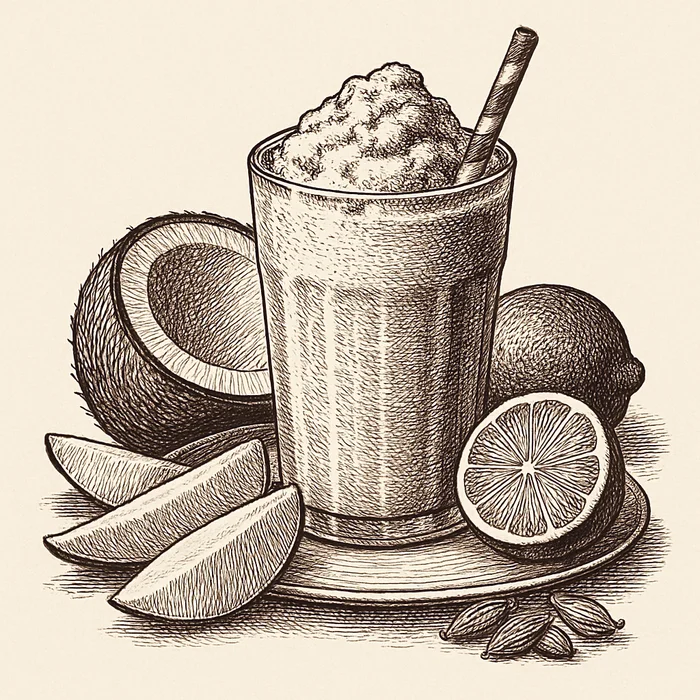
Frozen Mango-Coconut Lassi with Lime and Cardamom
Here is the quiet nutritional trick behind this drink: mango's orange pigment is beta-carotene, a fat-soluble provitamin A, and it barely enters your bloodstream without a fat chaperone to carry it across the intestinal wall. Full-fat coconut milk is exactly that chaperone. Its medium-chain triglycerides and long-chain fats form micelles that shuttle carotenoids and vitamin E straight into circulation. Pair that with mangiferin, the xanthonoid unique to mango pulp that shows anti-inflammatory activity in preclinical work, and a squeeze of lime for vitamin C, and you have a glass that tastes like a Bangkok street stall but reads like a lipid-soluble antioxidant delivery system.
The real technique move is freezing the mango rather than adding ice. Ice cubes are a crutch: they dilute flavor as they melt and they water down coconut milk's emulsion until the drink tastes thin. Frozen mango cubes, by contrast, give you the same cold viscosity a Thai street vendor achieves with shaved ice and sweetened condensed milk, minus the dilution and the sugar spike. This is the same logic behind a proper frozen daiquiri, and it is how South Indian cooks keep a mango lassi thick without yogurt-whey separation. Buy two ripe Alphonso or Ataulfo mangoes when they are fragrant at the stem, cube them, and freeze flat on a parchment-lined tray the night before. Freezing flat and fast minimizes the ice-crystal damage that causes freezer burn and the mealy texture you get from a bag of pre-frozen supermarket chunks.
Ingredients
- 2 ripe Alphonso or Ataulfo mangoes (about 2 cups cubed), frozen flat overnight
- 3/4 cup full-fat canned coconut milk, well shaken
- 1/2 cup cold unsweetened coconut drinking milk (calcium- and D-fortified if possible)
- 1 tablespoon fresh lime juice, plus a strip of zest
- 1/4 teaspoon freshly ground green cardamom (about 2 pods, crushed and sifted)
- 1 teaspoon honey or maple syrup, optional, only if your mangoes are underripe
- Tiny pinch of flaky salt
- Garnish: toasted unsweetened coconut flakes or a few torn mint leaves
Method
-
Freeze the mango flat the night before. Spreading cubes in a single layer on parchment means each piece freezes in under an hour rather than clumping together and forming large, tissue-wrecking ice crystals. Large crystals rupture cell walls and release juice on thawing, which is how you end up with stringy, watery smoothies. Fast, flat freezing is the home cook's version of IQF (individually quick frozen) and it preserves carotenoids and vitamin C better than slow freezing.
-
Bloom the cardamom in the warm coconut fat. Crush the pods, sift out the husks, then stir the ground seed into the full-fat coconut milk and let it sit 2 minutes at room temperature. Cardamom's aromatic compounds (alpha-terpineol, cineole) are fat-soluble, so coconut milk's lipid fraction extracts them far more efficiently than water would. This is the same principle behind tempering whole spices in ghee in South Indian cooking, just cold.
-
Layer the blender for proper emulsification. Pour the infused full-fat coconut milk in first, then the cold drinking coconut milk, then the lime juice and salt, and top with the frozen mango cubes. Liquids on the bottom let the blades engage immediately and pull the frozen fruit down in a smooth vortex. If you dump frozen mango on the blades directly, you get a cavitation pocket (air gap around the blades) and a chunky, unemulsified result.
-
Blend high for 45 to 60 seconds until it climbs the vessel. You are after a proper emulsion where coconut fat, mango puree, and water phase become one glossy body. Under-blending leaves visible droplets of coconut cream; over-blending past 90 seconds warms the mixture enough to begin melting it, which defeats the no-ice strategy. Listen for the pitch to rise and the sound to smooth out; that is the cue the vortex has stabilized.
-
Taste and adjust before pouring. Ripe Alphonso needs nothing; a middling supermarket mango may want the teaspoon of honey and a touch more lime. Salt is non-negotiable, a pinch suppresses bitterness from cardamom husk residue and makes the mango taste more like itself, a trick borrowed from Mexican mango-con-chile vendors.
-
Pour tall, zest over the top, and serve immediately. Grate lime zest directly over the glass so its volatile citrus oils (limonene) land on the foam where you will smell them first. Scatter toasted coconut flakes for textural contrast. Drink within five minutes; the emulsion is most stable cold and will begin to separate as it warms.
What Can Go Wrong
- Your smoothie is gritty, not silky. This is almost always pre-frozen supermarket mango that was slow-frozen in bulk. The ice crystals wrecked the pulp. Fix: freeze fresh mango yourself, flat on parchment, and use within a month.
- The drink tastes thin and icy. You probably reached for ice cubes instead of trusting the frozen fruit, or you used light coconut milk. Full-fat canned coconut milk (minimum 17 percent fat) is structural here, not optional. The fat is both the carotenoid carrier and the body of the drink.
- A grassy, soapy, or bitter note takes over. Over-blending is the usual culprit; friction heat denatures mango's volatile esters and coaxes bitter compounds out of the lime pith if any zest fell in. Blend in shorter bursts and zest only the colored outer layer, never the white pith underneath.