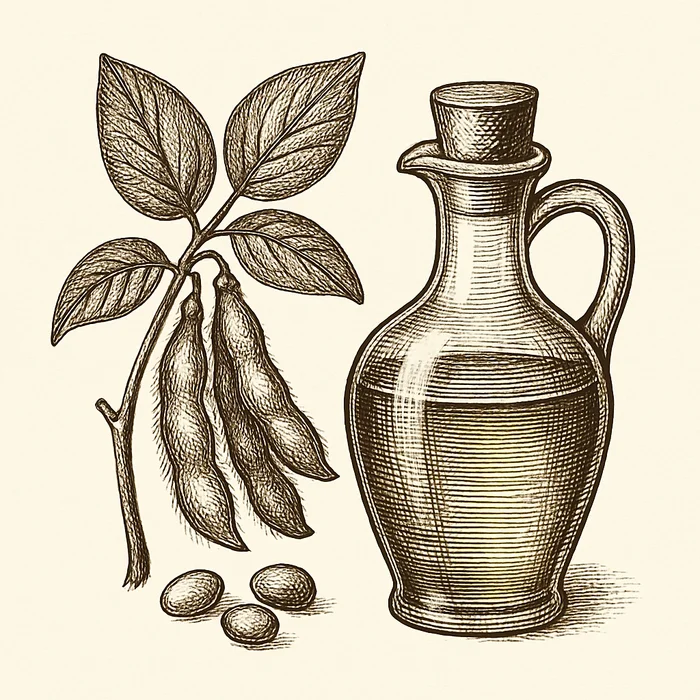
Soybean Oil
Soybean oil is the world's most consumed cooking oil, accounting for roughly 28% of global vegetable oil production. The Longevity Diet lists it as a secondary fat — present as a modest source of plant omega-3 ALA (6.8 g per 100 g) and vitamin E (8.2 mg per 100 g, primarily gamma-tocopherol) — but explicitly defers to extra-virgin olive oil as the primary cooking fat for longevity purposes. Understanding why requires unpacking its fatty acid composition, the contested science on linoleic acid, and the practical realities of cooking chemistry.
Fatty Acid Composition
Soybean oil is a moderately polyunsaturated fat. Its composition per 100 g is approximately:
| Fatty acid | Amount | Type |
|---|---|---|
| Linoleic acid (18:2 n-6) | ~54 g | omega-6 PUFA |
| Oleic acid (18:1 n-9) | ~23 g | MUFA |
| Alpha-linolenic acid (18:3 n-3) | ~7 g | omega-3 PUFA |
| Palmitic acid (16:0) | ~10 g | saturated |
| Stearic acid (18:0) | ~4 g | saturated |
The omega-6 to omega-3 ratio is approximately 7–8:1 — substantially better than corn oil (~50:1) or sunflower oil (~40:1), but far below olive oil's nearly pure monounsaturated profile (~73% oleic acid) or canola oil's more moderate ~2:1 ratio. The ALA content is soybean oil's most notable nutritional asset among common vegetable oils, though ALA's conversion efficiency to EPA and DHA in humans is low (roughly 5–15%), so it cannot substitute for marine omega-3 sources.
Vitamin E in soybean oil is predominantly gamma-tocopherol rather than alpha-tocopherol. While gamma-tocopherol has antioxidant activity and some anti-inflammatory properties distinct from the alpha form, it is less bioactive than alpha-tocopherol and degrades meaningfully during high-heat cooking.
The Linoleic Acid Cardiovascular Debate
Linoleic acid (LA) was demonized for decades on the assumption that omega-6 PUFAs competitively inhibit omega-3 metabolism and generate pro-inflammatory eicosanoids. The evidence does not straightforwardly support that narrative — at least not at moderate intakes.
The clearest counter-evidence comes from large epidemiological data. Farvid et al. (2014) conducted a systematic review and meta-analysis of 13 prospective cohort studies totaling 310,602 participants and 12,479 coronary heart disease (CHD) events. Higher dietary linoleic acid was associated with a 15% lower risk of CHD events and a 21% lower risk of CHD deaths in the highest versus lowest intake categories. Each 5% increase in energy from LA replacing saturated fat correlated with a 9% reduction in CHD event risk. This formed part of the basis for the American Heart Association's continued endorsement of replacing saturated fat with polyunsaturated fat, including LA-rich oils.
At the controlled-trial level, Johnson & Fritsche's 2012 systematic review of 15 randomized controlled trials found no consistent evidence that dietary linoleic acid increases arachidonic acid concentrations or inflammatory biomarkers (interleukins, CRP, TNF-α) at realistic intake levels. The popular framing that "omega-6 is pro-inflammatory" appears to conflate the biochemistry of arachidonic acid signaling cascades — which are indeed pro-inflammatory — with the dietary effect of consuming linoleic acid, which does not reliably raise tissue arachidonic acid in controlled human studies.
This does not mean all concerns about LA are unfounded. The debate is about dose, context, and what LA replaces in the diet.
The Omega-6:Omega-3 Ratio in the Modern Diet
The critical frame for understanding soybean oil's longevity implications is not soybean oil in isolation, but its role in an already heavily omega-6-skewed food supply.
Anthropological and evolutionary evidence suggests humans evolved on an omega-6 to omega-3 ratio of roughly 1:1 to 4:1. Contemporary Western diets now deliver a ratio estimated at 15:1 to 20:1, driven overwhelmingly by industrial seed oils — of which soybean oil is the largest single contributor globally. DiNicolantonio & O'Keefe (2021) document that this ratio now approximates 20:1 in much of the Western world, a state they characterize as creating "a pro-inflammatory, pro-allergic, pro-thrombotic biochemical environment." A ratio of 2–3:1 has been shown to suppress inflammatory markers in rheumatoid arthritis patients; a ratio of 5:1 correlates with benefit in asthma.
The mechanism involves competition for delta-5 and delta-6 desaturase enzymes. When omega-6 linoleic acid overwhelmingly dominates the substrate pool, conversion of ALA to EPA is suppressed, shifting the prostaglandin/leukotriene balance toward pro-inflammatory eicosanoid species derived from arachidonic acid. This does not mean eating soybean oil alone causes this imbalance — the problem is cumulative across processed foods, restaurant cooking, and snack products, almost all of which are cooked in soybean, corn, or cottonseed oil. Adding soybean oil at home on top of this background exposure worsens an already unfavorable ratio, whereas substituting EVOO does not.
The practical implication: soybean oil used occasionally in a diet otherwise rich in omega-3s (fatty fish, walnuts, flaxseed), with plenty of EVOO as the primary fat, does not present a meaningful problem. Used habitually as the kitchen's default oil in a typical Western dietary pattern, it amplifies an existing structural imbalance.
Oxidative Stability: The Heat Cooking Problem
Soybean oil's high polyunsaturated fat content (~61% combined PUFA) makes it significantly more susceptible to oxidative degradation at high cooking temperatures than oils dominated by monounsaturated or saturated fats.
When LA undergoes lipid peroxidation — via free-radical chain reactions accelerated by heat, light, and metal catalysts — it generates a class of oxidized metabolites including 9-HODE and 13-HODE (hydroxyoctadecadienoic acids) and reactive aldehydes such as malondialdehyde, 4-hydroxynonenal (4-HNE), hexanal, and nonanal. These are not benign. DiNicolantonio & O'Keefe (2018) reviewed evidence that 9-HODE concentrations are 20-fold higher in young atherosclerosis patients and 30- to 100-fold higher in older patients with advanced atherosclerosis compared to healthy individuals. Linoleic acid oxidation products dominate the oxidized lipid content of LDL particles, and oxidized LDL is a well-established driver of atherogenesis.
At the whole-body level, Turpeinen et al. (1999) demonstrated in a controlled human trial that a high-linoleic acid diet increases urinary F2-isoprostane excretion — a validated in vivo marker of oxidative stress — compared to a butter-based control diet, and simultaneously disrupts nitric oxide metabolism. More recently, Cao et al. (2024) showed in an animal model that excessive dietary LA generates aldehyde oxidation products (hexanal, 2-hexenal, nonanal) in muscle tissue via 5-lipoxygenase-dependent peroxidation, causing measurable redox imbalance; inhibiting 5-LOX significantly suppressed aldehyde generation.
The practical implication is that soybean oil should not be used for high-heat cooking (deep frying, searing, wok cooking at high temperatures). Its smoke point (~232°C / 450°F) appears tolerant on paper, but PUFA degradation accelerates well below the smoke point — oxidation products accumulate significantly during sustained heating even at moderate temperatures. Olive oil's predominantly monounsaturated oleic acid (one double bond) is an order of magnitude more thermostable than linoleic acid (two double bonds) or ALA (three double bonds), making EVOO the more defensible choice for everyday cooking.
Soybean Oil vs. Olive Oil for Longevity
The comparison is asymmetric: olive oil, particularly extra-virgin, brings additional longevity-relevant properties that soybean oil lacks.
EVOO contains 25–50 mg/kg of oleocanthal, a phenolic compound that inhibits COX-1 and COX-2 with ibuprofen-like potency; over 30 other polyphenols (oleuropein, hydroxytyrosol, tyrosol) with established anti-inflammatory and antioxidant effects in clinical studies; and squalene (~500 mg per 100 mL), a triterpene with potential anticarcinogenic properties. Soybean oil, being a refined industrial oil, retains essentially none of these bioactive compounds after processing — its vitamin E content partially offsets this, but it is not a functional polyphenol source.
On lipid metabolism: both oils lower LDL compared to saturated fat, but olive oil better preserves HDL cholesterol. A 2021 study by López-Salazar et al. examining soybean and olive oil at recommended intakes versus coconut oil found both unsaturated oils improved insulin sensitivity and microbiota diversity, with soybean oil showing the highest Akkermansia muciniphila abundance and olive oil the highest Bifidobacterium populations — both favorable — suggesting both oils are beneficial relative to saturated fat at moderate intakes.
The longevity case for EVOO is also grounded in population data: the Mediterranean basin populations that achieved the highest longevity outcomes in the Blue Zones used EVOO, not soybean oil. Soybean oil dominates in East Asian cuisines where longevity is also high, but those populations pair it with high fish intake (resolving the omega-6:omega-3 imbalance), lower total caloric intake, and very different food processing landscapes.
Practical Use in the Longevity Diet
The Longevity Diet's position is clear: EVOO is the primary fat. Soybean oil is not prohibited, but its role is secondary and context-dependent. Appropriate uses:
- Cold preparations (dressings, dips) where EVOO flavor is undesirable and where oxidative stability is irrelevant
- Low-to-medium heat cooking (light sautéing below 180°C) where its neutral flavor is an asset
- Occasional use in baking applications where EVOO would alter the flavor profile
It should not be used for deep frying, wok cooking, or any sustained high-heat application. It should not be the default kitchen cooking oil if EVOO is available. In a dietary pattern that already includes processed foods cooked in seed oils, additional soybean oil at home adds to an omega-6 burden that is already elevated.
The neutral flavor profile does make soybean oil useful in specific culinary contexts — Japanese tofu preparations, Korean namul, and many tofu-based dishes where olive oil would be incongruous. In those applications, using it moderately alongside a diet otherwise rich in omega-3 sources is a reasonable trade-off.
How to Use It
Use in cold preparations or low-to-medium heat cooking when olive oil flavor is undesirable. Not recommended for high-heat cooking or as a primary cooking oil. Canola oil provides a better omega-6:omega-3 ratio (~2:1) for those seeking a neutral-flavored alternative. Walnut oil offers a more favorable polyunsaturated profile with higher ALA. If soybean oil is used, purchase expeller-pressed or cold-pressed versions where available to minimize refining-related oxidation prior to purchase.
What to Pair It With
| Ingredient | Why | Tradition |
|---|---|---|
| Tofu | Neutral flavor complements soy-based preparations | Japanese, Korean |
| Salad greens | Works in mild vinaigrettes when EVOO flavor is too assertive | East Asian |
| Omega-3 sources (fish, flaxseed) | Compensates for the omega-6 load by restoring ratio | General |
Synergies
- Olive Oil (antagonism): EVOO is the preferred cooking and finishing fat in the Longevity Diet; soybean oil's high omega-6, low polyphenol content, and oxidative instability at heat make it a less favorable alternative for daily use.
- Omega-3 Fatty Acids (complement): ALA in soybean oil contributes modestly to omega-3 status, but the 7:1 omega-6:omega-3 ratio means additional marine omega-3 sources (EPA/DHA) are necessary to correct the dietary ratio.
- Walnut Oil (complement): Both are plant-based oils with ALA content; walnut oil's ~4:1 omega-6:omega-3 ratio is more favorable; both are unsuitable for high-heat cooking.
Flavor Profile
Taste: neutral, very mild. Aroma: neutral, faintly beany when cold-pressed. Texture: liquid, light. Category: cooking oil. Smoke point: ~232°C (450°F) — higher than EVOO, but oxidative degradation of PUFAs occurs well below this temperature.
The Science
- Farvid et al., 2014, Circulation: Meta-analysis of 13 cohort studies (310,602 participants, 12,479 CHD events): higher dietary linoleic acid associated with 15% lower CHD event risk and 21% lower CHD mortality; each 5% energy increase in LA replacing saturated fat reduced CHD risk by 9%.
- Johnson & Fritsche, 2012, J Nutr: Systematic review of 15 RCTs: dietary linoleic acid at realistic intakes did not increase arachidonic acid or inflammatory biomarkers — the pro-inflammatory narrative for omega-6 is not uniformly supported by controlled human trials.
- DiNicolantonio & O'Keefe, 2021, Mo Med: Western diets have shifted the omega-6/omega-3 ratio to approximately 20:1; this creates a pro-inflammatory, pro-thrombotic biochemical state; interventions restoring lower ratios (2–5:1) correlate with reduced inflammatory and autoimmune disease burden.
- Simopoulos, 2016, Nutrients: An elevated omega-6/omega-3 ratio, as seen in Western diets dominated by soybean and seed oils, increases risk for obesity and chronic disease; the ancestral dietary ratio was approximately 1:1.
- DiNicolantonio & O'Keefe, 2018, Open Heart: Oxidized linoleic acid metabolites (9-HODE, 13-HODE) found at 20–100× higher concentrations in atherosclerotic versus healthy tissue; proposes that LA incorporation into LDL and subsequent oxidation is a driver of coronary atherosclerosis.
- Turpeinen et al., 1999, Lipids: Controlled human trial: high-linoleic acid diet increased urinary F2-isoprostanes (in vivo oxidative stress marker) and disrupted nitric oxide metabolism compared to a saturated fat control diet.
- Cao et al., 2024, Redox Biology: Excessive dietary LA induced muscle redox imbalance via 5-lipoxygenase-dependent peroxidation generating reactive aldehydes (hexanal, 2-hexenal, nonanal); 5-LOX inhibition significantly suppressed aldehyde production.
References
- Farvid MS, Ding M, Pan A, Sun Q, Chiuve SE, Steffen LM, Willett WC, Hu FB. Dietary linoleic acid and risk of coronary heart disease: a systematic review and meta-analysis of prospective cohort studies. Circulation. 2014;130(18):1568–1578. PMID: 25161045. doi:10.1161/CIRCULATIONAHA.114.010236
- Johnson GH, Fritsche K. Effect of dietary linoleic acid on markers of inflammation in healthy persons: a systematic review of randomized controlled trials. J Nutr. 2012;142(6):1112S–1117S. PMID: 22889633. doi:10.3945/jn.111.148437
- DiNicolantonio JJ, O'Keefe J. The Importance of Maintaining a Low Omega-6/Omega-3 Ratio for Reducing the Risk of Autoimmune Diseases, Asthma, and Allergies. Mo Med. 2021;118(5):453–459. PMID: 34658440
- Simopoulos AP. An Increase in the Omega-6/Omega-3 Fatty Acid Ratio Increases the Risk for Obesity. Nutrients. 2016;8(3):128. PMID: 26950145. doi:10.3390/nu8030128
- DiNicolantonio JJ, O'Keefe JH. Omega-6 vegetable oils as a driver of coronary heart disease: the oxidized linoleic acid hypothesis. Open Heart. 2018;5(2):e000898. PMID: 30364556. doi:10.1136/openhrt-2018-000898
- Turpeinen AM, Basu S, Mutanen M. A high linoleic acid diet increases oxidative stress in vivo and affects nitric oxide metabolism in humans. Lipids. 1999;34 Suppl:S311–S313. PMID: 10419181
- Cao X, Guo H, Dai Y, Jiang G, Liu W, Li X, Zhang D, Huang Y, Wang X, Hua H, Wang J, Chen K, Chi C, Liu H. Excessive linoleic acid induces muscle oxidative stress through 5-lipoxygenase-dependent peroxidation. Redox Biol. 2024;71:103095. PMID: 38387137. doi:10.1016/j.redox.2024.103095
Key Nutrients
| Nutrient | Per 100g | Notes |
|---|---|---|
| Linoleic acid (omega-6) | ~54 g | Dominant fatty acid; lowers LDL vs. saturated fat but oxidizes under high heat |
| Oleic acid (MUFA) | ~23 g | Lower than olive oil (~73%); less thermostable competition |
| ALA (omega-3) | ~7 g | Best ALA content among common cooking oils; ~5–15% conversion to EPA/DHA |
| Vitamin E (gamma-tocopherol) | 8.2 mg | Antioxidant; degrades significantly with high-heat cooking |
| Saturated fat | ~14 g | Primarily palmitic acid; lower than butter (~51%) or coconut oil (~87%) |