Vitamin E
50–90% of US adults are deficient in vitamin E; important for essential body functions. Deficiency has been implicated in brain aging and dementias; Alzheimer's disease patients have lower serum vitamin E levels.
Why It Matters for Longevity
Vitamin E is a family of eight fat-soluble compounds — four tocopherols (α, β, γ, δ) and four tocotrienols — not a single molecule. Alpha-tocopherol (α-T) is the form the liver preferentially retains and distributes to tissues; it is the primary fat-soluble antioxidant in cell membranes, where it intercepts lipid peroxyl radicals via hydrogen-atom donation to protect polyunsaturated fatty acids from chain-reaction oxidation. Beyond antioxidant chemistry, α-T regulates NF-κB inflammatory signaling and inhibits platelet aggregation by suppressing protein kinase C activity.
Cognitive aging. Morris et al.'s (2002) JAMA study of 815 community-dwelling residents found that dietary vitamin E intake — but not vitamin C or beta-carotene — was associated with a significantly reduced risk of incident Alzheimer's disease over 3.9 years of follow-up. This was a dietary intake finding: food sources showed the protective association, reinforcing the Longevity Diet approach of meeting nutrient needs primarily through whole foods. The likely mechanism is protection of neuronal membrane lipids from peroxidative damage, which accumulates during normal aging and accelerates in Alzheimer's pathology.
Cardiovascular null results — why they matter. The HOPE trial (Yusuf et al., 2000) randomized 9,541 adults aged ≥55 with established cardiovascular disease or diabetes to 400 IU natural-source vitamin E daily or placebo for a mean of 4.5 years. The composite outcome of myocardial infarction, stroke, and cardiovascular death occurred in 16.2% of the vitamin E group versus 15.5% of placebo (RR 1.05, 95% CI 0.95–1.16; P=0.33) — no detectable benefit. The HOPE-TOO extension, extending follow-up to a median of 7 years in 7,030 participants, found an unexpectedly higher risk of heart failure in the vitamin E group (RR 1.13) (Lonn et al., 2005, JAMA). These findings matter because they demonstrate that the antioxidant rationale for supplementation — compelling in vitro — does not translate to cardiovascular protection in high-risk patients receiving pharmacological doses.
The α-tocopherol paradox. One proposed explanation for the failure of α-T supplements involves gamma-tocopherol (γ-T). γ-T is the predominant tocopherol form in the US diet (abundant in corn, soybean, and sunflower oils) and has a distinct anti-inflammatory property: it scavenges reactive nitrogen species (peroxynitrite, NO₂•) more efficiently than α-T. Critically, high-dose α-T supplementation measurably depletes circulating γ-T, because both forms compete for the hepatic alpha-tocopherol transfer protein that determines systemic retention. Devaraj and Jialal (2005) reviewed this mechanism and noted that plasma γ-T levels are inversely associated with cardiovascular disease risk, arguing that displacing γ-T with supplemental α-T may partially explain the null or adverse trial results (Devaraj & Jialal, 2005, Nutr Rev).
Dose-response mortality. The meta-analysis by Miller et al. (2005) across 19 clinical trials found that high-dose vitamin E supplementation (≥400 IU/day alpha-tocopherol) was associated with increased all-cause mortality. A subsequent larger meta-analysis by Abner et al. (2011) pooling 57 randomized controlled trials and 246,371 subjects found an overall risk ratio of 1.00 (95% CI: 0.98–1.02), concluding that supplementation across the tested dose range appears to have no net effect on all-cause mortality — neither harm nor benefit when the full evidence base is pooled. Taken together, the evidence does not support high-dose α-T supplementation for general mortality reduction, while leaving open specific contexts (e.g., patients with low baseline status) where benefit may occur.
Tocotrienols: distinct biology. Tocotrienols differ from tocopherols structurally (an unsaturated isoprenoid side chain versus a saturated phytyl chain), which enables them to distribute more widely in cell membranes and reach compartments less accessible to tocopherols. Animal and early clinical data suggest neuroprotective effects and an ability to inhibit HMG-CoA reductase (the same enzyme targeted by statins), raising interest in cholesterol metabolism. Rice bran and annatto are among the richest dietary sources.
How to Use It
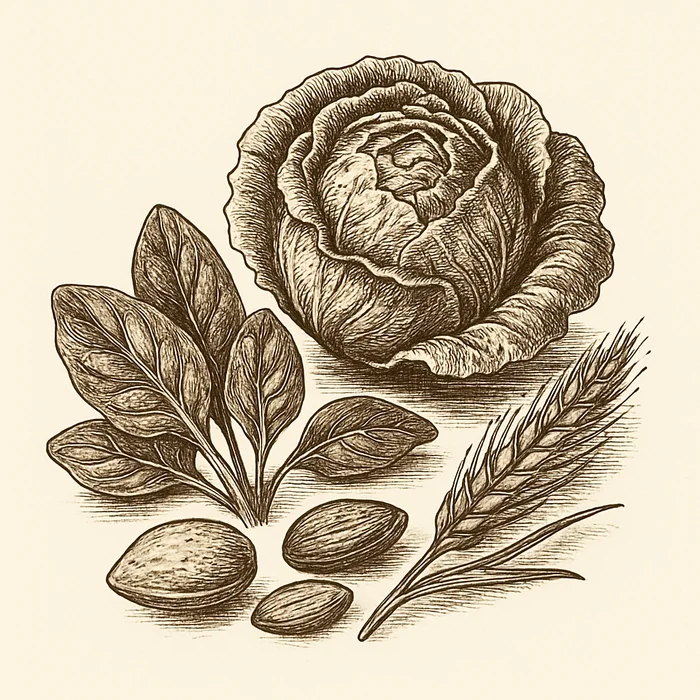
Pairs well with almonds, olive oil, sunflower seeds. Use as a nutrient in your daily meals according to the Longevity Diet guidelines. 1 tablespoon of wheat germ oil delivers the full RDA (15 mg); 1 oz almonds provides ~7.3 mg. The evidence for food-source vitamin E is considerably more consistent than for isolated supplemental α-tocopherol, particularly at high doses.
What to Pair It With
| Ingredient | Why | Tradition |
|---|---|---|
| almonds | See synergies | nutritional science |
| olive oil | See synergies | nutritional science |
| sunflower seeds | See synergies | nutritional science |
| hazelnuts | See synergies | nutritional science |
Synergies
- Vitamin A (synergy): Both fat-soluble vitamins commonly deficient in US adults per the book; co-supplementation in a multivitamin every 2–3 days is recommended.
- Vitamin C (synergy): Vitamin C regenerates oxidized vitamin E, restoring its antioxidant capacity; together they form the primary lipid and aqueous antioxidant defense system.
- Olive Oil (synergy): Olive oil is a primary dietary source of vitamin E; its oleic acid also spares vitamin E from oxidation, enhancing effective status.
Flavor Profile
Category: micronutrient / supplement.
The Science
- Morris et al., 2002, JAMA: Dietary vitamin E — but not vitamin C or beta-carotene — was inversely associated with incident Alzheimer's disease in a prospective community study (n=815, 3.9-year follow-up).
- Yusuf et al., 2000, N Engl J Med: HOPE trial (n=9,541, mean 4.5 years): 400 IU/day natural-source vitamin E produced no reduction in MI, stroke, or cardiovascular death (RR 1.05, P=0.33) versus placebo.
- Lonn et al., 2005, JAMA: HOPE-TOO extension (median 7 years, n=7,030): no cardiovascular benefit; vitamin E group had higher risk of heart failure (RR 1.13) and hospitalization for heart failure (RR 1.21).
- Miller et al., 2005, Ann Intern Med: Meta-analysis of 19 clinical trials: high-dose vitamin E supplementation (≥400 IU/day) was associated with increased all-cause mortality, supporting food-first approach.
- Abner et al., 2011, Curr Aging Sci: Meta-analysis of 57 RCTs (246,371 subjects): overall RR for all-cause mortality 1.00 (95% CI 0.98–1.02); supplementation has no net effect on mortality across tested dose ranges.
- Devaraj & Jialal, 2005, Nutr Rev: High-dose α-tocopherol supplementation depletes plasma γ-tocopherol, which possesses distinct anti-inflammatory (reactive nitrogen species scavenging) activity inversely associated with cardiovascular disease risk.
References
- Morris MC, Evans DA, Bienias JL, et al. Dietary intake of antioxidant nutrients and the risk of incident Alzheimer disease in a biracial community study. JAMA. 2002;287(24):3230-7. PMID: 12076219. doi:10.1001/jama.287.24.3230
- Heart Outcomes Prevention Evaluation Study Investigators; Yusuf S, Dagenais G, Pogue J, Bosch J, Sleight P. Vitamin E supplementation and cardiovascular events in high-risk patients. N Engl J Med. 2000;342(3):154-160. PMID: 10639540. doi:10.1056/NEJM200001203420302
- Lonn E, Bosch J, Yusuf S, et al. Effects of long-term vitamin E supplementation on cardiovascular events and cancer: a randomized controlled trial. JAMA. 2005;293(11):1338-47. PMID: 15769967. doi:10.1001/jama.293.11.1338
- Miller ER 3rd, Pastor-Barriuso R, Dalal D, Riemersma RA, Appel LJ, Guallar E. Meta-analysis: high-dosage vitamin E supplementation may increase all-cause mortality. Ann Intern Med. 2005;142(1):37-46. PMID: 15537682. doi:10.7326/0003-4819-142-1-200501040-00110
- Abner EL, Schmitt FA, Mendiondo MS, Marcum JL, Kryscio RJ. Vitamin E and all-cause mortality: a meta-analysis. Curr Aging Sci. 2011;4(2):158-170. PMID: 21235492. doi:10.2174/1874609811104020158
- Devaraj S, Jialal I. Failure of vitamin E in clinical trials: is gamma-tocopherol the answer? Nutr Rev. 2005;63(8):290-3. PMID: 16190316. doi:10.1111/j.1753-4887.2005.tb00153.x
Key Nutrients
| Nutrient | Per 100g | Notes |
|---|---|---|
| Alpha-tocopherol (primary active form) | RDA: 15 mg/day adults | Fat-soluble; absorbed with dietary fat; liver preferentially retains alpha-tocopherol; UL 1000 mg/day from supplements |
| Gamma-tocopherol (food sources) | abundant in nuts and vegetable oils | Lower retention than alpha-tocopherol but may provide distinct anti-inflammatory (reactive nitrogen species scavenging) benefits; depleted by high-dose alpha-tocopherol supplementation |
| Tocotrienols | present in palm oil, rice bran, annatto | Unsaturated side chain allows broader membrane distribution; emerging evidence for neuroprotection and HMG-CoA reductase inhibition; cholesterol-lowering data from RCTs remain mixed |