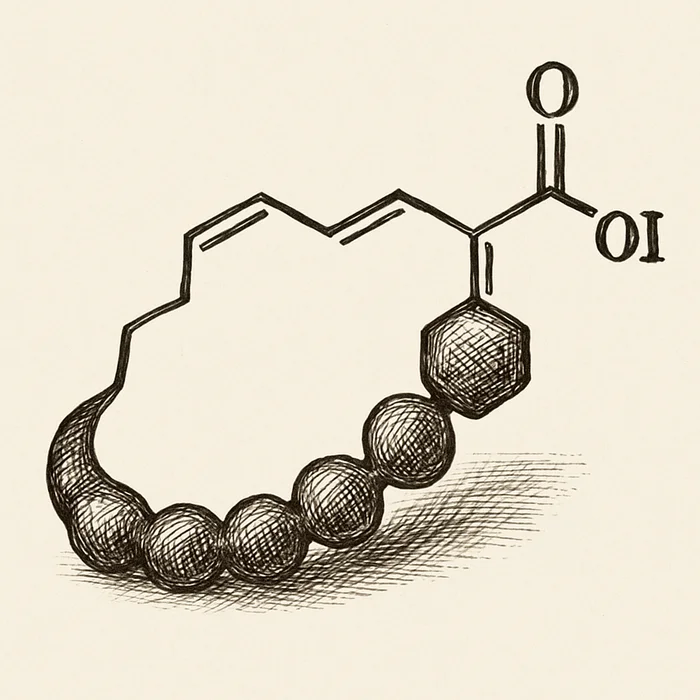
Omega-6 Fatty Acids
Omega-6 is an essential fatty acid the human body cannot synthesize and must obtain from diet; it is required for normal cell membrane function, immune signaling, and reproductive health. The longevity concern is not omega-6 itself but the modern dietary imbalance: Western diets have omega-6:omega-3 ratios of 15–20:1 versus an evolutionary optimal of ~4:1.
Why It Matters for Longevity
Linoleic acid (the principal dietary omega-6) is incorporated into cell membranes and serves as a precursor to arachidonic acid, which gives rise to pro-inflammatory eicosanoids. However, at intakes within normal dietary ranges, linoleic acid is not inherently pro-inflammatory — the critical variable is its ratio to omega-3 intake, which determines the balance of pro- and anti-inflammatory eicosanoid signaling.
The human genome evolved on a diet with an omega-6:omega-3 ratio close to 1:1. The modern Western ratio of 15–20:1 displaces omega-3 from cell membranes and shifts prostaglandin balance toward pro-inflammatory mediators, driving increased rates of cardiovascular disease, cancer, and inflammatory disorders — all modifiable with dietary adjustment (Simopoulos, 2002, Biomed Pharmacother).
A comprehensive analysis of diet-mortality associations in US adults found that replacing saturated fat with polyunsaturated fat (predominantly omega-6 linoleic acid) was among the strongest dietary predictors of reduced cardiovascular mortality — establishing that omega-6 at appropriate intake levels reduces, not increases, cardiovascular risk, and that the quality-of-fat framework supersedes concern about omega-6 in isolation (Micha et al., 2017, JAMA).
The Longevity Diet addresses omega-6:omega-3 balance by emphasizing fatty fish (EPA/DHA), walnuts (ALA), and olive oil while limiting seed oils high in linoleic acid. This shifts the dietary ratio toward the protective ~4:1 range without eliminating omega-6.
Linoleic Acid and Mortality: Prospective Cohort Evidence
A meta-analysis of 38 prospective cohort studies (44 cohorts, 811,069 participants by dietary assessment; 65,411 by biomarker) found that higher linoleic acid intake was associated with significantly lower all-cause mortality (RR 0.87; 95% CI: 0.81–0.94), lower cardiovascular mortality (RR 0.87; 95% CI: 0.82–0.92), and lower cancer mortality (RR 0.89; 95% CI: 0.85–0.93) (Li et al., 2020, Am J Clin Nutr). These associations were consistent whether linoleic acid intake was measured by dietary surveys or by circulating biomarkers, which provides stronger evidence than self-reported diet data alone. The magnitude (~13% lower cardiovascular mortality per increment) places linoleic acid among the dietary fatty acids with the most robust mortality evidence.
Replacing Saturated Fat with PUFA: RCT Evidence
The randomized controlled trial evidence directly addresses whether substituting linoleic acid–rich polyunsaturated fat for saturated fat reduces coronary heart disease events. A meta-analysis of 8 RCTs (13,614 participants, 1,042 CHD events) found that increasing PUFA consumption in place of saturated fat reduced CHD events by 19% overall (RR 0.81; 95% CI: 0.70–0.95; P = 0.008), with each 5% increase in energy from PUFA replacing saturated fat associated with approximately 10% lower CHD risk (Mozaffarian et al., 2010, PLoS Med). Study duration was an independent predictor of benefit, with longer interventions showing greater risk reduction — consistent with the time required for membrane fatty acid remodeling.
The Arachidonic Acid Concern: What the Evidence Shows
The common objection to omega-6 — that linoleic acid raises arachidonic acid (AA), which feeds pro-inflammatory eicosanoid production — is not well supported in humans consuming Western diets. A systematic review of human clinical trials found no significant correlation between reducing dietary linoleic acid by up to 90% and changes in plasma or erythrocyte arachidonic acid levels (P = 0.39), and no significant correlation between increasing dietary linoleic acid up to six-fold and arachidonic acid levels (P = 0.72) (Rett & Whelan, 2011, Nutr Metab). The tightly regulated conversion of linoleic acid to arachidonic acid via delta-6 desaturase (D6D) operates near saturation at typical Western intakes, meaning the enzyme — not dietary linoleic acid supply — is rate-limiting. The implication is that increasing or modestly decreasing linoleic acid intake does not meaningfully shift tissue arachidonic acid concentrations, and the pro-inflammatory concern is largely theoretical when LA is consumed in the context of adequate omega-3 intake.
How to Use It
Obtain omega-6 from whole food sources: nuts, seeds, and modest amounts of plant oils. Reduce intake from refined seed oils (corn, sunflower, soybean oils) used in processed foods. Simultaneously increase omega-3 intake from fatty fish and walnuts to improve the dietary ratio rather than restricting omega-6 in absolute terms.
What to Pair It With
| Ingredient | Why | Tradition |
|---|---|---|
| Omega-3 fatty acids | Metabolic counterparts; maintaining a ratio close to 4:1 (omega-6:omega-3) is associated with reduced cardiovascular and inflammatory disease risk | The Longevity Diet |
| Extra-virgin olive oil | Replacing high-omega-6 seed oils with olive oil naturally improves the dietary omega-6:omega-3 ratio | Mediterranean |
| Walnuts | The only common nut with substantial ALA (omega-3) content that partially offsets its linoleic acid (omega-6) load | Mediterranean |
| Salmon | Marine EPA/DHA directly counterbalances dietary omega-6 in cell membrane composition | The Longevity Diet |
Flavor Profile
Neutral as an isolated nutrient. Category: nutrient / dietary fat.
The Science
- Simopoulos, 2002, Biomed Pharmacother: The human genome evolved on omega-6:omega-3 ratios close to 1:1; the modern Western ratio of 15–20:1 drives pro-inflammatory gene expression and is associated with increased cardiovascular disease, cancer, and inflammatory disorders.
- Micha et al., 2017, JAMA: Association analysis of dietary factors and US mortality — replacing saturated fat with polyunsaturated fat among the strongest dietary predictors of reduced cardiovascular mortality; quality-of-fat framework supersedes restriction of omega-6 in isolation.
- Li et al., 2020, Am J Clin Nutr: Meta-analysis of 38 prospective cohorts (811,069 participants) — higher linoleic acid intake associated with ~13% lower cardiovascular mortality (RR 0.87) and 13% lower all-cause mortality; biomarker and dietary assessment data concordant.
- Mozaffarian et al., 2010, PLoS Med: Meta-analysis of 8 RCTs (13,614 participants) — replacing saturated fat with PUFA reduced CHD events by 19%; each 5% energy substitution reduced CHD risk by ~10%.
- Rett & Whelan, 2011, Nutr Metab: Systematic review of human clinical trials — increasing or decreasing dietary linoleic acid by up to six-fold or 90%, respectively, does not significantly alter tissue arachidonic acid levels in Western diet consumers; D6D enzyme is the rate-limiting step, not substrate supply.
References
- Simopoulos AP. The importance of the ratio of omega-6/omega-3 essential fatty acids. Biomed Pharmacother. 2002;56(8):365-379. PMID: 12442909. doi:10.1016/s0753-3322(02)00253-6
- Micha R, Peñalvo JL, Cudhea F, et al. Association between dietary factors and mortality from heart disease, stroke, and type 2 diabetes in the United States. JAMA. 2017;317(9):912-924. PMID: 28267855. doi:10.1001/jama.2017.0947
- Li J, Guasch-Ferré M, Li Y, Hu FB. Dietary intake and biomarkers of linoleic acid and mortality: systematic review and meta-analysis of prospective cohort studies. Am J Clin Nutr. 2020;112(1):150-167. PMID: 32020162. doi:10.1093/ajcn/nqz349
- Mozaffarian D, Micha R, Wallace S. Effects on coronary heart disease of increasing polyunsaturated fat in place of saturated fat: a systematic review and meta-analysis of randomized controlled trials. PLoS Med. 2010;7(3):e1000252. PMID: 20351774. doi:10.1371/journal.pmed.1000252
- Rett BS, Whelan J. Increasing dietary linoleic acid does not increase tissue arachidonic acid content in adults consuming Western-type diets: a systematic review. Nutr Metab (Lond). 2011;8(1):36. PMID: 21663641. doi:10.1186/1743-7075-8-36
Key Nutrients
| Nutrient | Per 100g | Notes |
|---|---|---|
| Linoleic acid (LA, 18:2n-6) | N/A — varies by food source | Parent omega-6; efficiently absorbed from plant oils (sunflower, safflower, soybean); elongated and desaturated to arachidonic acid in liver via delta-6 desaturase, which is rate-limited rather than substrate-limited at Western intake levels |
| Arachidonic acid (AA, 20:4n-6) | ~0.1–0.2 g per 100 g in meat | Pre-formed in animal foods; directly incorporated into cell membranes; precursor to pro-inflammatory prostaglandins, thromboxanes, and leukotrienes; tissue levels not significantly altered by dietary linoleic acid variation in clinical trials |
| Gamma-linolenic acid (GLA, 18:3n-6) | Trace in evening primrose, borage, hemp | Downstream omega-6 with anti-inflammatory properties; uncommon in standard diets |