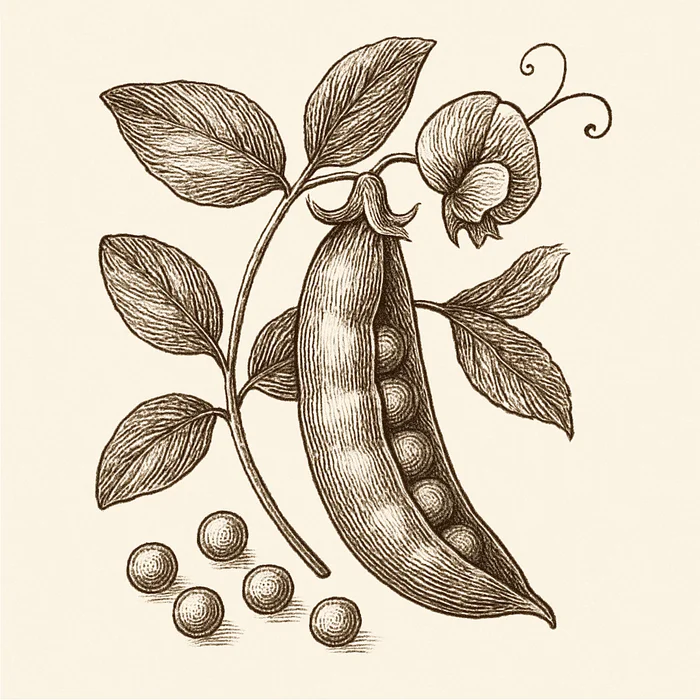
Peas
Regular legume consumption (3+ servings/week) associated with longest lifespan among Loma Linda Adventists. Peas are a core Longevity Diet legume, featured in riso con zucchine e piselli and other traditional dishes.
Why It Matters for Longevity
Legumes are a core food in all centenarian blue-zone diets — Okinawa, Sardinia, Calabria, Loma Linda, Costa Rica, and Greece. Peas provide plant protein without the IGF-1-elevating effect of animal protein, alongside high fiber content for gut health and a glycemic index of approximately 22, among the lowest of all starchy foods.
Cholesterol Reduction and Cardiovascular Risk
A meta-analysis of 11 randomized trials found that non-soy legume consumption significantly lowered total and LDL cholesterol — a key mechanism linking legume consumption to reduced cardiovascular mortality in prospective studies (Bazzano et al., 2011, Nutr Metab Cardiovasc Dis). Peas share these cholesterol-lowering properties through their soluble fiber (principally pectin-type polymers) and plant sterol content. Soluble fiber binds bile acids in the small intestine, increasing their fecal excretion and forcing the liver to draw on circulating cholesterol to synthesize replacement bile acids — net effect: reduced LDL.
Regular pulse consumption (pulses include peas, lentils, beans, and chickpeas) for 8 weeks significantly reduced markers of metabolic syndrome including waist circumference and blood lipids in a controlled trial, confirming that peas contribute to the metabolic improvements associated with legume-rich dietary patterns (Mollard et al., 2012, Br J Nutr).
Slow-Digestible Starch and Glycemic Control
Pea starch has an unusually high amylose fraction (approximately 30--35% of total starch), which forms tightly packed granules that resist enzymatic digestion in the small intestine. A crossover trial in 13 healthy adults measured blood glucose responses to 25 g available carbohydrate from native pea starch (containing 30% slow digestible starch, SDS) versus maltodextrin. The glucose response after pea starch was significantly lower compared to maltodextrin, with no adverse gastrointestinal effects reported — supporting pea starch as a tool for glycemic management without tolerability trade-offs (Perreau et al., 2023, J Med Food).
The broader evidence for resistant and slowly digestible starch is robust: a systematic review and meta-analysis of 19 RCTs found that resistant starch supplementation produced significant reductions in fasting plasma glucose versus digestible starch, with effects more pronounced when daily dose exceeded 28 g/day or intervention exceeded 8 weeks (Xiong et al., 2021, Br J Nutr). Peas deliver this benefit as a whole food matrix — their starch arrives packaged with fiber, protein, and polyphenols that further blunt post-meal glucose excursions.
Pea Protein, Satiety, and IGF-1
Cooked peas contain approximately 5.4 g protein per 100 g. Pea protein has a PDCAAS (Protein Digestibility-Corrected Amino Acid Score) of approximately 0.67, lower than soy (1.0) or animal proteins, but still a complete protein source across a mixed diet. Crucially, pea protein provides lower concentrations of methionine and leucine than animal proteins — the amino acids most implicated in activating mTORC1 and stimulating IGF-1 secretion. Caloric restriction studies and longevity research consistently point to lower mTOR and IGF-1 activity as a mechanistic pathway to extended healthspan.
A randomized crossover trial in 43 healthy young men found that high-protein legume-based meals (beans and peas) produced significantly lower composite appetite scores, lower hunger, lower prospective food consumption, and higher fullness ratings compared to high-protein veal and pork meals. Participants ate 12--13% fewer calories at the subsequent meal after the legume condition (Kristensen et al., 2016, Food Nutr Res). Notably, the low-protein legume meal was as satiating as the high-protein meat meal — suggesting fiber and water content contribute substantially to satiety independently of protein quantity.
Fiber, Gut Microbiome, and Butyrate Production
Cooked peas contain approximately 4.5 g dietary fiber per 100 g, a mix of soluble and insoluble fractions. The insoluble fiber (cellulose, hemicellulose) adds fermentable substrate and stool bulk; the soluble fiber (pectin and oligosaccharides) is selectively fermented by colonic bacteria to produce propionate and butyrate. Butyrate is the primary energy source for colonocytes, maintains gut barrier integrity via tight junction protein regulation, and suppresses NF-κB-mediated intestinal inflammation. Consistent butyrate production from fermentable fibers is one of the most replicated microbiome-health associations in the literature, and is particularly characteristic of the microbiome profiles seen in long-lived populations from Sardinia and Okinawa.
Saponins and Anti-Inflammatory Activity
Peas contain saponins — glycoside compounds with amphiphilic detergent properties — at concentrations of approximately 0.1--0.5% of dry weight. Pea saponins form complexes with cholesterol in the gut lumen, reducing its absorption, and have demonstrated anti-inflammatory and immunomodulatory effects in cell culture studies. The saponin content survives cooking, though it is reduced by soaking and discarding the soaking water.
Lutein Content
Peas are a meaningful, often-overlooked source of lutein (~2.5 mg per 100 g cooked), the same macular carotenoid found in high concentrations in kale. While the concentration is far below that of dark leafy greens, regular pea consumption as part of a diverse plant-based diet contributes to cumulative lutein intake and its associated protection against late AMD.
How to Use It
Use fresh, frozen, or dried peas in soups, pasta dishes, rice dishes (riso e piselli), and salads. The Longevity Diet features peas in multiple traditional Calabrian and Italian recipes. Frozen peas retain their nutritional profile nearly as well as fresh; dried split peas offer convenient storage with identical fiber and protein content. To maximise resistant starch, cook peas and allow them to cool before eating — retrograded starch is more resistant to digestion than freshly cooked starch.
What to Pair It With
| Ingredient | Why | Tradition |
|---|---|---|
| Rice | Complete amino acid profile when combined; basis of Longevity Diet riso con zucchine e piselli | The Longevity Diet |
| Extra-virgin olive oil | Fat enhances vitamin K bioavailability and lutein absorption; slows carbohydrate absorption | Mediterranean |
| Anchovies | Small amounts of umami-rich anchovies amplify flavor while adding EPA/DHA omega-3s | Italian |
| Mint | Classic English and Middle Eastern pea herb pairing; cooling contrast | British / Middle Eastern |
Flavor Profile
Sweet, grassy, and mildly starchy. Aroma is fresh and vegetal when young, sweeter when frozen. Texture is tender and slightly firm (al dente fresh), soft and creamy when fully cooked. Category: legume.
The Science
- Bazzano et al., 2011, Nutr Metab Cardiovasc Dis: Meta-analysis of 11 RCTs -- non-soy legume consumption significantly lowered total and LDL cholesterol via soluble fiber and plant sterol mechanisms; foundational evidence for legumes' link to reduced cardiovascular mortality.
- Mollard et al., 2012, Br J Nutr: Controlled trial -- regular pulse consumption for 8 weeks significantly reduced waist circumference and blood lipids in adults with metabolic syndrome criteria.
- Perreau et al., 2023, J Med Food: Crossover RCT (n=13) -- native pea starch (30% slow digestible starch) produced significantly lower postprandial glucose compared to maltodextrin, with no adverse gastrointestinal effects.
- Xiong et al., 2021, Br J Nutr: Meta-analysis of 19 RCTs -- resistant starch supplementation produced significant reductions in fasting plasma glucose; effects stronger at doses >28 g/day and durations >8 weeks.
- Kristensen et al., 2016, Food Nutr Res: Randomized crossover (n=43) -- legume-based meals (beans and peas) produced lower composite appetite scores and 12--13% lower subsequent calorie intake compared to veal/pork meals.
References
- Bazzano LA, Thompson AM, Tees MT, Nguyen CH, Winham DM. Non-soy legume consumption lowers cholesterol levels: a meta-analysis of randomized controlled trials. Nutr Metab Cardiovasc Dis. 2011;21(2):94-103. PMID: 19939654. doi:10.1016/j.numecd.2009.08.012
- Mollard RC, Luhovyy BL, Panahi S, Nunez M, Hanley A, Anderson GH. Regular consumption of pulses for 8 weeks reduces metabolic syndrome risk factors in overweight and obese adults. Br J Nutr. 2012;108 Suppl 1:S111-122. PMID: 22916807. doi:10.1017/S0007114512000712
- Perreau C, Desailly E, Grard B, et al. Slow Digestible Starch in Native Pea Starch (Pisum sativum L.) Lowers Glycemic Response with No Adverse Effects on Gastrointestinal Symptoms in Healthy Adults. J Med Food. 2023;26(12):898-906. PMID: 38039382. doi:10.1089/jmf.2023.0113
- Xiong K, Wang J, Kang T, Xu F, Ma A. Effects of resistant starch on glycaemic control: a systematic review and meta-analysis of randomised controlled trials. Br J Nutr. 2021;125(11):1260-1269. PMID: 32959735. doi:10.1017/S0007114520003700
- Kristensen MD, Bendsen NT, Christensen SM, Astrup A, Raben A. Meals based on vegetable protein sources (beans and peas) are more satiating than meals based on animal protein sources (veal and pork) -- a randomized cross-over meal test study. Food Nutr Res. 2016;60:32634. PMID: 27765144. doi:10.3402/fnr.v60.32634
Key Nutrients
| Nutrient | Per 100g | Notes |
|---|---|---|
| Protein | 5.4 g (cooked) | Plant protein; lower leucine and methionine than animal sources reduces IGF-1 and mTOR activation |
| Dietary fiber | 4.5 g (cooked) | Mix of soluble and insoluble fiber; soluble portion fermented into propionate and butyrate by gut bacteria |
| Slow digestible starch | ~30% of total starch | High amylose fraction resists digestion; significantly lower postprandial glucose vs refined carbohydrate |
| Lutein | ~2.5 mg (cooked) | Macular carotenoid; fat-soluble; contributes to cumulative dietary intake protective against late AMD |
| Folate | 47 mcg (cooked) | Water-soluble; critical for one-carbon metabolism and DNA methylation |
| Vitamin K1 | 24 mcg (cooked) | Fat-soluble; absorption enhanced with dietary fat; supports vascular calcification prevention |
| Saponins | ~0.1--0.5% dry weight | Bind cholesterol in gut lumen; anti-inflammatory in cell studies |