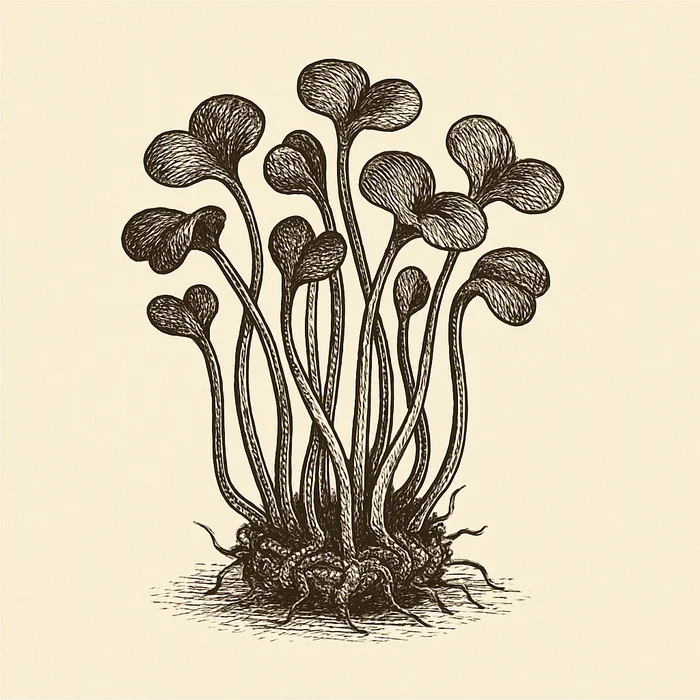
Broccoli Sprouts
Three-day-old broccoli sprouts pack 10 to 100 times more glucoraphanin than a mature broccoli head — making them gram-for-gram the most concentrated food source of the sulforaphane precursor you can eat. The catch is that you need to chew them raw, or add mustard powder after cooking, to activate the enzyme that converts glucoraphanin into active sulforaphane.
Why It Matters for Longevity
Sulforaphane is one of the most potent naturally occurring activators of the Nrf2 pathway — a master regulator that switches on a battery of phase 2 detoxification enzymes which neutralize carcinogens, reduce oxidative stress, and dampen chronic inflammation.[4] The original research by Fahey et al. (1997) at Johns Hopkins established that broccoli sprouts contain 20–50 times the chemoprotective glucosinolates of mature broccoli,[1] and subsequent human trials confirmed the practical implications: a broccoli sprout beverage increased urinary excretion of the air pollutant benzene by 61% and acrolein by 23% in a randomized trial in China.[3]
Shapiro et al. (2006) ran the first clinical phase I study establishing safety, tolerance, and pharmacokinetics of broccoli sprout extracts in healthy volunteers, confirming dose-dependent excretion of dithiocarbamates and setting the stage for efficacy trials.[2]
Beyond detoxification, sulforaphane targets two major drivers of aging. First, it improves insulin sensitivity: a 2019 study in Nutrients found sulforaphane prevents hepatic insulin resistance by blocking ceramide synthesis — a lipid that accumulates in metabolically dysfunctional tissue and drives type 2 diabetes.[5] Second, it slows neurodegeneration: in animal models of retinitis pigmentosa, sulforaphane modulated inflammatory pathways and delayed neuronal loss.[6] These effects share a common mechanism — Nrf2 upregulates hundreds of protective genes simultaneously, rather than targeting a single pathway.
Critically, Nrf2 activity declines with age. Sulforaphane acts as what researchers call a "hormetic" stress signal: a low-level stressor that primes the body's defenses and counteracts the age-related decline in cellular protection.[4] Calabrese et al. (2021) reviewed the evidence base and concluded sulforaphane prevents inflammatory degenerative diseases and age-related pathologies through this Nrf2-mediated hormesis — making it one of the best-evidenced food compounds for longevity-oriented nutrition.
The practical barrier is bioavailability. Glucoraphanin itself is inert — it requires the enzyme myrosinase to convert it into active sulforaphane. Raw sprouts contain abundant myrosinase, so chewing them does the job. But cooking destroys myrosinase within minutes. A key human study by Vermeulen et al. (2008) measured sulforaphane bioavailability in people eating raw versus cooked broccoli and found that raw consumption resulted in substantially higher urinary isothiocyanate excretion — the standard marker for sulforaphane reaching the bloodstream — compared to well-done cooked broccoli.[7] The workaround: add a pinch of mustard powder to cooked sprouts, and you restore most of the conversion by providing exogenous myrosinase.
How to Use It
Raw (best): Eat 30–60g of fresh sprouts as a garnish on salads, sandwiches, grain bowls, or rice. Chew thoroughly — this is what activates myrosinase. Do not cook them after adding.
If you cook them: Steam very briefly (under 3 minutes), then immediately add a pinch of dry mustard powder or crushed mustard seeds and let rest 10 minutes before eating. This restores sulforaphane conversion.
Growing at home: Soak broccoli sprouting seeds for 8–24 hours, drain, and spread in a jar or tray covered with a damp cloth. Rinse twice daily. Harvest day 3–4 when white sprouts emerge. Refrigerate immediately and consume within 4 days — glucoraphanin content peaks at day 3 and declines after.
Frequency: Aim for several times per week rather than a daily large dose. Human trials used doses equivalent to roughly 40–100 μmol of sulforaphane per day, achievable with 30–60g of raw sprouts.
Dosage
Clinical trials have used broccoli sprout preparations providing 40–100 μmol of sulforaphane equivalents per day. In practical food terms, this corresponds to approximately:
- 30g fresh raw sprouts — provides roughly 40–60 μmol glucoraphanin (converts to ~30–50 μmol sulforaphane when chewed)
- 60g fresh raw sprouts — the upper end of the range used in human detoxification trials
Consistency matters more than quantity. Studies showing carcinogen detoxification and anti-inflammatory effects typically ran 2–12 weeks of daily or near-daily consumption. There is no established toxicity ceiling from food-form sprouts at these doses; the Shapiro et al. (2006) safety study found the extract well-tolerated at pharmacological doses well above typical food intake.[2]
If you cannot eat raw sprouts consistently, a standardized broccoli seed extract (look for "myrosinase-active" on the label) is a reasonable alternative — but absorption varies significantly between products, and fresh sprouts remain the most reliable delivery vehicle.
What to Pair It With
| Ingredient | Why | Tradition |
|---|---|---|
| Mustard seeds/powder | Provides exogenous myrosinase to restore sulforaphane conversion after cooking | European |
| Avocado | Fat enhances sulforaphane absorption; mild flavor balances bitterness | Californian |
| Extra-virgin olive oil | Healthy fat carrier for fat-soluble isothiocyanates | Mediterranean |
| Lemon juice | Acid brightens flavor and may help stabilize sulforaphane | Global |
| Smoked salmon | Omega-3 complements sprout antioxidants; open sandwich topping | Scandinavian |
| Rice bowls | Sprouts as garnish, similar to traditional kaiware daikon | Japanese |
See also: broccoli for the mature form comparison.
Flavor Profile
Mildly bitter and peppery with a fresh, grassy quality. The sulfurous bite is gentler than mature broccoli. Stems are crunchy and delicate. They work best as a raw finishing element rather than a cooked ingredient.
The Science
- Fahey et al., 1997, Proc Natl Acad Sci: Broccoli sprouts contain 10–100x the glucoraphanin of mature broccoli, with young sprouts the richest source of chemoprotective enzyme inducers.
- Shapiro et al., 2006, Cancer Epidemiol Biomarkers Prev: Phase I clinical study establishing safety and pharmacokinetics of broccoli sprout glucosinolate and isothiocyanate extracts in healthy volunteers.
- Egner et al., 2014, Cancer Prev Res: Randomized clinical trial in China: broccoli sprout beverage increased urinary excretion of the carcinogen benzene by 61% and acrolein by 23%.
- Calabrese et al., 2021, Pharmacol Res: Comprehensive review: sulforaphane prevents inflammatory degenerative diseases and age-related pathologies via Nrf2-mediated hormesis.
- Teng et al., 2019, Nutrients: Sulforaphane prevents hepatic insulin resistance by blocking ceramide synthesis — a key mechanism linking sprouts to metabolic longevity.
- Cantó et al., 2022, Front Pharmacol: Sulforaphane modulates inflammation and delays neurodegeneration in animal models.
- Vermeulen et al., 2008, J Agric Food Chem: Human bioavailability study: raw broccoli delivers significantly more sulforaphane to the bloodstream than cooked broccoli.
References
- Fahey JW, Zhang Y, Talalay P. Broccoli sprouts: an exceptionally rich source of inducers of enzymes that protect against chemical carcinogens. Proc Natl Acad Sci USA. 1997;94(19):10367-72. PMID: 9294217. doi:10.1073/pnas.94.19.10367
- Shapiro TA, Fahey JW, Dinkova-Kostova AT, et al. Safety, tolerance, and metabolism of broccoli sprout glucosinolates and isothiocyanates: a clinical phase I study. Nutr Cancer. 2006;55(1):53-62. PMID: 16965241. doi:10.1207/s15327914nc5501_7
- Egner PA, Chen JG, Zarth AT, et al. Rapid and sustainable detoxication of airborne pollutants by broccoli sprout beverage: results of a randomized clinical trial in China. Cancer Prev Res. 2014;7(8):813-23. PMID: 24913818. doi:10.1158/1940-6207.CAPR-14-0103
- Calabrese EJ, Calabrese V, Giordano J. The phytoprotective agent sulforaphane prevents inflammatory degenerative diseases and age-related pathologies via Nrf2-mediated hormesis. Pharmacol Res. 2021;163:105283. PMID: 33160067. doi:10.1016/j.phrs.2020.105283
- Teng W, Wu Y, Fan X, et al. Sulforaphane Prevents Hepatic Insulin Resistance by Blocking Serine Palmitoyltransferase 3-Mediated Ceramide de Novo Synthesis. Nutrients. 2019;11(5):1185. PMID: 31137828. doi:10.3390/nu11051185
- Cantó A, Olivar T, Lidón L, et al. Sulforaphane Modulates the Inflammation and Delays Neurodegeneration on a Retinitis Pigmentosa Mice Model. Front Pharmacol. 2022;13:851054. PMID: 35300301. doi:10.3389/fphar.2022.851054
- Vermeulen M, Klöpping-Ketelaars IWAA, van den Berg R, Vaes WHJ. Bioavailability and kinetics of sulforaphane in humans after consumption of cooked versus raw broccoli. J Agric Food Chem. 2008;56(22):10505-9. PMID: 18950181. doi:10.1021/jf801989e
Key Nutrients
| Nutrient | Per 100g | Notes |
|---|---|---|
| Glucoraphanin | 70–100 mg | 10–100x more than mature broccoli[1] |
| Sulforaphane (from chewing raw) | Up to 40 mg | Bioavailability significantly higher raw vs. cooked[7] |
| Vitamin C | 60–100 mg | Complements sulforaphane's antioxidant action |
| Vitamin K | ~100 mcg | Fat-soluble; pair with olive oil or avocado |