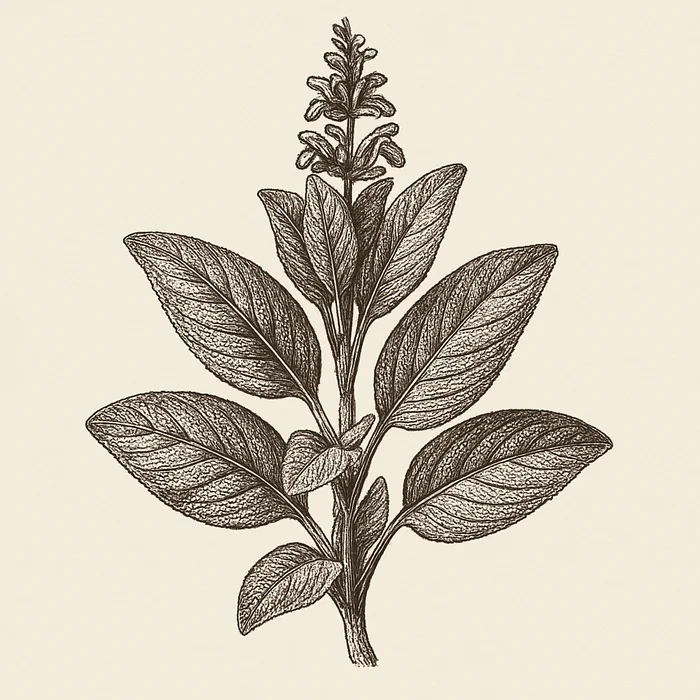
Sage
The medieval School of Medicine at Salerno asked: "Why should a man die when sage grows in his garden?" A thousand years later, the question sounds less absurd than it once did. Sage contains compounds that inhibit acetylcholinesterase — the same enzyme targeted by pharmaceutical Alzheimer's drugs like donepezil.
Why It Matters for Longevity
Sage's longevity story is dominated by cognitive protection. Akhondzadeh et al. (2003) ran a double-blind RCT giving Salvia officinalis extract to patients with mild-to-moderate Alzheimer's disease. After four months, the sage group showed significantly improved cognitive function compared to placebo. This is a small study, but the fact that a culinary herb produced measurable improvement in actual Alzheimer's patients — not just healthy volunteers — is remarkable.
The mechanism is well-characterized. Sage compounds inhibit acetylcholinesterase, the enzyme that breaks down acetylcholine, a neurotransmitter critical for memory and learning. This is precisely how donepezil and rivastigmine work, and sage does it without their common side effects of nausea and diarrhoea. Kennedy et al. (2006) extended this to healthy young adults, finding dose-dependent improvements in mood, memory, and performance on cognitive stressor batteries.
Lopresti's systematic review (2017) pulled together eight human trials and confirmed consistent cognitive and mood benefits. Beyond acetylcholinesterase inhibition, sage's effects include direct antioxidant activity and anti-inflammatory action. Its dried polyphenol content — 12,073 mg per 100g — is staggering, placing it among the most antioxidant-dense foods measurable. For context, blueberries, often celebrated as antioxidant powerhouses, contain roughly 560 mg per 100g.
The book also recommends sage as a herbal tea, alternated with green tea and rosemary infusions, for daily polyphenol diversity.
Cognitive Effects Across the Lifespan
The cholinesterase-inhibition data extends across age groups in a consistent pattern. Scholey et al. (2008) recruited 20 healthy volunteers aged 65 and older (mean age 72.95 years) and administered four doses of Salvia officinalis extract (167, 333, 666, and 1,332 mg) against placebo in a crossover design. The 333 mg dose produced the strongest results: significant enhancement of secondary memory performance at all post-dose testing times and improved attention accuracy. Crucially, higher doses did not linearly improve outcomes -- the 333 mg dose outperformed the 1,332 mg dose -- suggesting a U-shaped dose-response relationship, possibly because very high thujone concentrations at supraphysiological doses may counteract some effects (Scholey et al., 2008, Psychopharmacology).
More recently, Wightman et al. (2021) conducted a 29-day randomised, placebo-controlled trial in 94 adults aged 30-60. Participants receiving 600 mg daily of a standardised sage extract (equivalent to the commercially available SagePro formulation) showed significant improvements in Corsi Blocks spatial span (p = 0.04 at day 1; p = 0.002 at day 29), numeric working memory accuracy (p = 0.03 at day 29), and name-to-face recall. The placebo group showed accuracy decline on memory tasks over the 29 days, while the sage group maintained or improved. The effect was present both acutely (within hours of the first dose) and chronically (building over the 29 days), which is consistent with both immediate cholinesterase inhibition and longer-term neuroprotective adaptation (Wightman et al., 2021, Nutrients).
Rosmarinic Acid and Ursolic Acid: Distinct Mechanisms
Sage's polyphenol profile contains compounds that operate through entirely separate pathways, giving the herb a mechanistic breadth unusual even among the most studied culinary herbs.
Rosmarinic acid -- present at 1.0-3.5 g per 100 g dried sage and highly water-soluble, making it well-extracted in tea -- is an ester of caffeic acid and 3,4-dihydroxyphenyllactic acid. It inhibits complement activation, suppresses pro-inflammatory prostaglandin production via cyclooxygenase inhibition, and demonstrates direct free-radical scavenging activity superior to vitamin E in some assays. It is shared with rosemary and basil (both Lamiaceae family members), which is part of why these herbs pair so well both culinarily and pharmacologically.
Ursolic acid is a pentacyclic triterpenoid concentrated in sage's waxy leaf surface. Baricevic et al. (2001) isolated ursolic acid as the primary active compound responsible for sage's topical anti-inflammatory effect, reporting an ID50 of 0.14 µmol/cm² -- roughly twice the potency of indomethacin (ID50 = 0.26 µmol/cm²) in a mouse ear oedema model (Baricevic et al., 2001, J Ethnopharmacol). Beyond inflammation, ursolic acid has attracted longevity research interest because it inhibits mTORC1 -- the nutrient-sensing kinase complex whose chronic activation is associated with accelerated ageing -- and activates autophagy in muscle tissue. These effects have been confirmed primarily in cell culture and animal models; human tissue pharmacokinetics for ursolic acid remain a limiting factor since oral bioavailability is low and highly variable. The practical implication is that ursolic acid is likely more active topically or in slow-digested whole food matrix than in extracted supplement form.
Carnosic acid, a diterpene phenol co-occurring with rosmarinic acid, adds a third mechanism: it is converted in vivo to carnosol and then to rosmanol in a cascade that activates the Nrf2 pathway, upregulating the cell's own antioxidant enzyme systems (superoxide dismutase, glutathione peroxidase, catalase) rather than simply supplying exogenous antioxidants. This self-amplifying mechanism means a small amount of carnosic acid can trigger a disproportionately large cellular antioxidant response.
How to Use It
Brew sage tea by steeping 4–5 fresh leaves (or 1 teaspoon dried) in hot water for 5–8 minutes. Drink several times per week, alternating with green tea and rosemary. In cooking, sage pairs beautifully with brown butter for pasta sauces, with beans in Tuscan soups, and with squash in autumn risottos. Use fresh sage when possible — it has a more nuanced flavour than dried, though dried sage is more concentrated in active compounds. Sage grows easily in pots on a windowsill and is practically maintenance-free.
What to Pair It With
| Ingredient | Why | Tradition |
|---|---|---|
| Brown butter | Burro e salvia — the classic ravioli and gnocchi sauce | Italian |
| Legumes | Essential in Tuscan bean soups and stews | Tuscan |
| Squash | Classic autumn pairing in risotto and ravioli fillings | Italian / European |
| Rosemary | Complementary Lamiaceae herbs for broader antioxidant coverage | Italian |
| Garlic | Foundational aromatic combination | Mediterranean |
| Walnuts | Sage-walnut pesto; traditional variation | Ligurian |
Flavor Profile
Sage is earthy, warm, and slightly camphoraceous with a musty sweetness. The aroma is aromatic and pine-like with eucalyptus undertones. The leaves have a distinctive velvety texture — almost fuzzy — that becomes leathery when dried. Use it with restraint in cooking; sage can overwhelm a dish quickly, but in the right amount it adds a sophisticated depth that no other herb quite replicates.
The Science
- Akhondzadeh et al., 2003, J Clin Pharm Ther: Salvia officinalis extract improved cognition vs placebo in a 4-month double-blind RCT in mild-to-moderate Alzheimer's patients.
- Kennedy et al., 2006, Neuropsychopharmacology: Cholinesterase-inhibiting sage improved mood, anxiety, and cognitive performance on a psychological stressor battery in healthy young adults.
- Lopresti, 2017, Drugs R D: Systematic review of 8 human trials confirming consistent cognitive and mood benefits across multiple Salvia species.
- Scholey et al., 2008, Psychopharmacology: 333 mg Salvia officinalis extract enhanced secondary memory and attention in 20 healthy adults aged 65+; dose-response was non-linear with 333 mg outperforming 1,332 mg.
- Wightman et al., 2021, Nutrients: 29-day RCT in 94 adults (ages 30-60) — 600 mg daily sage extract improved Corsi Blocks span (p = 0.002), numeric working memory accuracy (p = 0.03), and name-to-face recall vs placebo.
- Baricevic et al., 2001, J Ethnopharmacol: Isolated ursolic acid from Salvia officinalis leaves showed anti-inflammatory potency (ID50 = 0.14 µmol/cm²) approximately twice that of indomethacin (ID50 = 0.26 µmol/cm²) in a mouse ear oedema model.
References
- Akhondzadeh S, Noroozian M, Mohammadi M, Ohadinia S, Jamshidi AH, Khani M. Salvia officinalis extract in the treatment of patients with mild to moderate Alzheimer's disease: a double blind, randomized and placebo-controlled trial. J Clin Pharm Ther. 2003;28(1):53-9. PMID: 12605619. doi:10.1046/j.1365-2710.2003.00463.x
- Kennedy DO, Pace S, Haskell C, Okello EJ, Milne A, Scholey AB. Effects of cholinesterase inhibiting sage (Salvia officinalis) on mood, anxiety and performance on a psychological stressor battery. Neuropsychopharmacology. 2006;31(4):845-52. PMID: 16205785. doi:10.1038/sj.npp.1300907
- Lopresti AL. Salvia (Sage): A Review of its Potential Cognitive-Enhancing and Protective Effects. Drugs R D. 2017;17(1):53-64. PMID: 27888449. doi:10.1007/s40268-016-0157-5
- Scholey AB, Tildesley NTJ, Ballard CG, Wesnes KA, Tasker A, Perry EK, Kennedy DO. An extract of Salvia (sage) with anticholinesterase properties improves memory and attention in healthy older volunteers. Psychopharmacology (Berl). 2008;198(1):127-39. PMID: 18350281.
- Wightman EL, Jackson PA, Spittlehouse B, Heffernan T, Guillemet D, Kennedy DO. The Acute and Chronic Cognitive Effects of a Sage Extract: A Randomized, Placebo Controlled Study in Healthy Humans. Nutrients. 2021;13(1):218. PMID: 33466627.
- Baricevic D, Sosa S, Della Loggia R, Tubaro A, Simonovska B, Krasna A, Zupancic A. Topical anti-inflammatory activity of Salvia officinalis L. leaves: the relevance of ursolic acid. J Ethnopharmacol. 2001;75(2-3):125-32. PMID: 11297842.
Key Nutrients
| Nutrient | Per 100g (dried) | Notes |
|---|---|---|
| Total polyphenols | 12,073 mg | Among the highest of any herb; dwarfs blueberries by 20x |
| Rosmarinic acid | 1.0–3.5 g | Water-soluble; well-extracted in tea |
| Thujone | 4–35 mg/ml (essential oil) | Acetylcholinesterase inhibitor; safe in culinary amounts |
| Ursolic acid | Variable | Anti-inflammatory triterpenoid; low bioavailability |