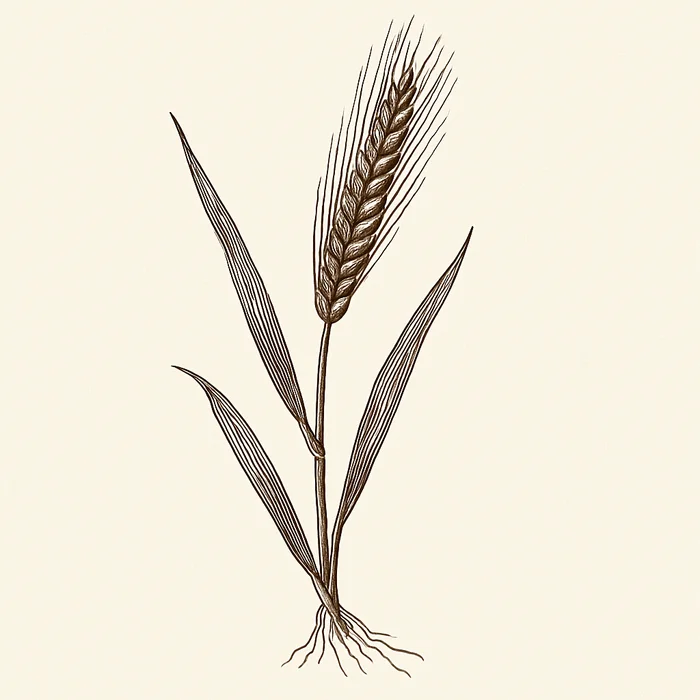
Rye
Rye is the richest cereal source of alkylresorcinols — phenolic lipids with anti-cancer properties that are so specific to whole grain intake they are used as biomarkers in epidemiological studies. It also delivers more fiber per calorie than almost any other grain, with a uniquely satiating effect that persists into the next meal.
Why It Matters for Longevity
Whole grains including rye are associated with significantly reduced all-cause and cardiovascular mortality in large cohort studies. But rye brings something extra beyond generic whole grain benefits.
The alkylresorcinol story is distinctive. Rye and whole wheat are the primary dietary sources of alkylresorcinols — phenolic lipids found in the outer bran layer that are detectable in blood and used as biomarkers of whole grain intake in epidemiological research (Linko-Parvinen et al., 2007, J Nutr).
A large dose-response meta-analysis confirmed that whole grain consumption — of which rye is among the most nutrient-dense examples — was associated with significant reductions in cardiovascular disease, cancer, and all-cause mortality, with a 7 g/day increment in whole grain intake linked to a 19% lower CVD risk (Aune et al., 2016, BMJ).
Rye bread fed at regular meal frequency significantly reduced postprandial glucose and insulin responses and improved lipid metabolism compared to control diets in controlled clinical trials, with effects related to rye's unique arabinoxylan fiber composition (Lundin et al., 2004, Eur J Clin Nutr).
The Rye Factor: Lower Insulin Without Lower Glucose
Rye does something unusual among grains: it can reduce postprandial insulin levels without a corresponding reduction in blood glucose. This decoupling -- dubbed the "rye factor" -- has been replicated across multiple studies but remained incompletely mechanized until recently. A 2022 review of 24 postprandial studies with 72 pairwise product comparisons (Iversen, Jonsson & Landberg, 2022, Front Nutr) found that 64% of comparisons showed positive effects on glucose and/or insulin after rye-based foods compared to wheat controls. The rye factor -- reduced insulin without reduced glucose -- appeared in 32% of all comparisons, and tracer technique studies confirmed that the mechanism involves slowed intestinal glucose absorption rather than simply reduced starch availability. A lower insulin response to the same glucose load means improved insulin sensitivity, which is a distinct metabolic benefit from glycemic lowering per se: the pancreas secretes less insulin to handle the same glucose challenge, reducing the long-term burden on beta cells.
Arabinoxylan, the dominant fiber in rye's cell walls, differs from wheat arabinoxylan in two important ways: rye contains roughly 50% more arabinoxylan by weight, and a larger fraction of rye's arabinoxylan is soluble, allowing it to form viscous solutions in the gut lumen. The viscous fraction slows gastric emptying and nutrient transit, extending the absorptive surface area contact time in a way that reduces both glucose influx velocity and the insulinemic demand on the pancreas.
Alkylresorcinols, Whole-Grain Rye, and Type 2 Diabetes Risk
The C17:0/C21:0 alkylresorcinol ratio is a plasma biomarker that reflects the relative proportion of whole-grain rye versus whole-grain wheat in the diet: rye-derived alkylresorcinols (C17:0) have a different chain length from wheat-derived forms (C21:0), making the ratio interpretable as a proxy for rye dominance in the grain intake. A prospective case-control study of 931 Scandinavian pairs (Biskup et al., 2016, Am J Clin Nutr) found that the C17:0/C21:0 ratio was inversely associated with type 2 diabetes risk (OR: 0.54; 95% CI: 0.37--0.78), while total alkylresorcinol concentration -- representing aggregate whole-grain intake regardless of grain type -- showed no protective association. This grain-type-specific finding implies that the metabolic advantages of whole grain extend beyond fiber quantity to composition: what grain you eat within the whole-grain category appears to matter, with rye-dominant intake showing stronger diabetes protection than wheat-dominant intake at equivalent fiber volumes.
A randomized crossover study of 166 participants in the Nordic countries (Magnusdottir et al., 2014, Eur J Clin Nutr) reinforced this picture: higher C17:0/C21:0 ratios -- reflecting greater rye consumption within a Nordic diet -- correlated inversely with fasting insulin (p = 0.002) and positively with Matsuda insulin sensitivity index (p = 0.026). The effect was absent when total alkylresorcinol concentration was used, again confirming that relative rye intake, not mere whole-grain quantity, predicts insulin sensitivity in this context. The proposed mechanism involves rye-specific bioactives, including lignans and alkylresorcinols themselves, modulating gut microbiota composition in ways that indirectly improve peripheral insulin signaling.
A 2025 meta-analysis of 31 RCTs involving 922 participants (Ghazvini et al., 2025, Nutr Metab) found that rye consumption did not significantly reduce fasting glucose or postprandial glucose overall, but did produce a significant reduction in insulin area-under-the-curve (AUC) (WMD = −0.48 mU/L; p < 0.001). Benefits on insulin AUC were observed at rye fiber doses of ≥12 g/day. The insulin AUC reduction without a corresponding glucose AUC reduction is the population-level statistical signature of the rye factor: the grain is improving insulin efficiency, not just blunting hyperglycemia.
How to Use It
Whole rye flour makes dense, flavorful bread — especially when combined with sourdough fermentation, which breaks down phytic acid and improves mineral absorption. Rye flakes work in porridge or granola. Whole rye berries can be cooked like wheat berries for grain salads (about 60 minutes simmering). Store rye flour in the fridge, as its higher fat content makes it prone to rancidity.
What to Pair It With
| Ingredient | Why | Tradition |
|---|---|---|
| Caraway seeds | Shared earthy aromatics; classic flavor match | Northern / Eastern European |
| Sauerkraut | Fermented pairing; complementary gut bacteria and fiber | German / Eastern European |
| Smoked fish | Rich protein on dense rye base | Scandinavian (smørrebrød) |
| Dill | Fresh herb lifts rye's earthy depth | Scandinavian / Eastern European |
| Beetroot | Complementary earthy flavors on rye bread | Nordic |
Flavor Profile
Earthy, robust, and slightly sour with a malty depth that sets it apart from wheat. Rye bread has a dense, moist crumb and a flavor complexity that rewards long fermentation. Lighter rye flour is milder; dark rye flour is deeply flavored and almost bitter. Toasted rye berries develop a pronounced nutty-malty character.
The Science
- Linko-Parvinen et al., 2007, J Nutr: Rye and whole wheat are the primary dietary sources of alkylresorcinols; these phenolic lipids are transported in plasma and measurable as biomarkers of whole grain rye intake.
- Aune et al., 2016, BMJ: Dose-response meta-analysis of whole grain consumption — each 7 g/day increment linked to 19% lower CVD risk, 15% lower cancer risk, and 17% lower all-cause mortality.
- Lundin et al., 2004, Eur J Clin Nutr: Rye bread diet significantly reduced postprandial glucose and insulin responses and improved lipid metabolism in controlled clinical trials.
- Iversen, Jonsson & Landberg, 2022, Front Nutr: Review of 24 postprandial studies — 64% of comparisons showed positive glucose/insulin effects for rye vs wheat; the rye factor (reduced insulin without reduced glucose) confirmed in 32% of comparisons via tracer studies.
- Biskup et al., 2016, Am J Clin Nutr: Prospective case-control study (n = 931 pairs) — plasma C17:0/C21:0 alkylresorcinol ratio (rye vs. wheat biomarker) inversely associated with type 2 diabetes risk (OR: 0.54; 95% CI: 0.37–0.78).
- Magnusdottir et al., 2014, Eur J Clin Nutr: RCT (n = 166) — higher C17:0/C21:0 ratio correlated with lower fasting insulin (p = 0.002) and improved Matsuda insulin sensitivity index (p = 0.026).
- Ghazvini et al., 2025, Nutr Metab: Meta-analysis of 31 RCTs (n = 922) — rye reduced insulin AUC significantly (WMD = −0.48 mU/L; p < 0.001) without significantly affecting glucose AUC; benefits at ≥12 g/day rye fiber.
References
- Linko-Parvinen AM, Landberg R, Tikkanen MJ, Adlercreutz H, Peñalvo JL. Alkylresorcinols from whole-grain wheat and rye are transported in human plasma lipoproteins. J Nutr. 2007;137(5):1137-1142. PMID: 17449571. doi:10.1093/jn/137.5.1137
- Aune D, Keum N, Giovannucci E, et al. Whole grain consumption and risk of cardiovascular disease, cancer, and all cause and cause specific mortality: systematic review and dose-response meta-analysis of prospective studies. BMJ. 2016;353:i2716. PMID: 27301975. doi:10.1136/bmj.i2716
- Lundin EA, Zhang JX, Lairon D, Tidehag P, Aman P, Hallmans G, Adlercreutz H. Effects of meal frequency and high-fibre rye-bread diet on glucose and lipid metabolism and ileal excretion of energy and sterols in ileostomy subjects. Eur J Clin Nutr. 2004;58(12):1625-1632. PMID: 15100716. doi:10.1038/sj.ejcn.1602001
- Iversen KN, Jonsson K, Landberg R. The Effect of Rye-Based Foods on Postprandial Plasma Insulin Concentration: The Rye Factor. Front Nutr. 2022;9:933070. PMID: 35757252. doi:10.3389/fnut.2022.933070
- Biskup I, Kyrø C, Marklund M, et al. Plasma alkylresorcinols, biomarkers of whole-grain wheat and rye intake, and risk of type 2 diabetes in Scandinavian men and women. Am J Clin Nutr. 2016;104(1):88-96. PMID: 27281306. doi:10.3945/ajcn.115.122697
- Magnusdottir OK, Landberg R, Gunnarsdottir I, et al. Plasma alkylresorcinols C17:0/C21:0 ratio, a biomarker of relative whole-grain rye intake, is associated to insulin sensitivity: a randomized study. Eur J Clin Nutr. 2014;68(4):428-433. PMID: 24549027. doi:10.1038/ejcn.2013.283
- Ghazvini M, Ghanbari-Gohari F, Foshati S, Akhlaghi M. Effect of rye consumption on markers of glycemic control: evidence on the "rye factor." Nutr Metab (Lond). 2025;22(1):30. PMID: 40165312. doi:10.1186/s12986-025-00924-3
Key Nutrients
| Nutrient | Per 100g | Notes |
|---|---|---|
| Alkylresorcinols | 36–320 mg | Richest cereal source; phenolic lipids measurable in plasma as whole grain biomarkers |
| Dietary fiber | 15.1 g (whole grain flour) | Arabinoxylan more water-soluble than wheat fiber; creates viscosity slowing gastric emptying |
| Lignans | 0.3–1.0 mg | Phytoestrogens linked to reduced breast and prostate cancer risk |
| Ferulic acid | 100–150 mg | Anti-inflammatory bound phenolic acid |
| Manganese | 2.6 mg (113% RDA) | Cofactor for antioxidant enzymes |