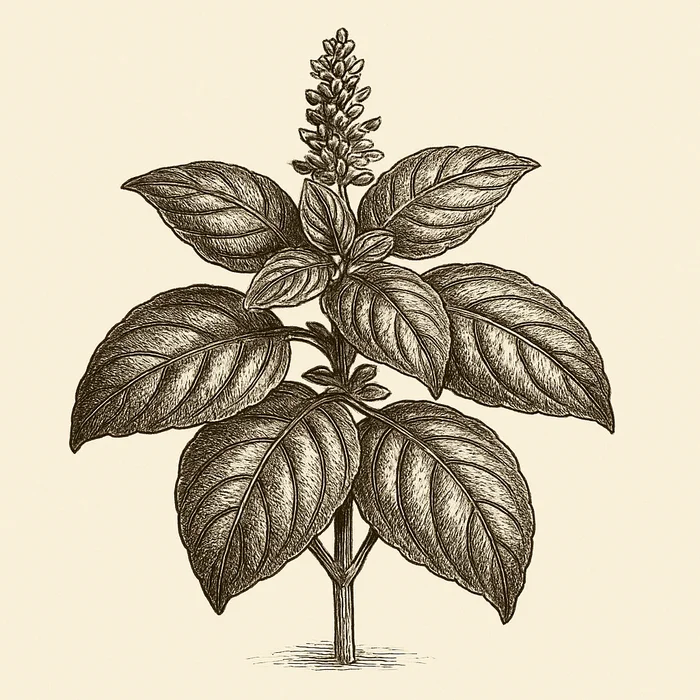
Basil
Basil (Ocimum basilicum) is one of the most frequently used herbs in the Longevity Diet, appearing in roughly five leaves per dish across dozens of recipes. That frequency is not accidental: behind its familiar sweet-clove aroma sits a concentrated package of phenolic acids, a volatile phenylpropanoid, and an unusual density of fat-soluble vitamins — all of which operate on biological pathways directly implicated in aging and chronic disease.
Why It Matters for Longevity
The longevity case for basil rests on three pillars: its rosmarinic acid content, its eugenol, and its remarkably high vitamin K concentration. Each acts through a distinct mechanism, and all three become more bioavailable when basil is eaten with a fat source — the way it almost always appears in Mediterranean cooking.
Rosmarinic Acid: Mechanism and Evidence
Rosmarinic acid is a phenolic ester present at roughly 60 mg per 100 g of fresh sweet basil — a higher concentration than in most culinary herbs outside of rosemary and oregano. Once absorbed in the small intestine, it enters systemic circulation and suppresses a central node in the inflammatory cascade: nuclear factor kappa B (NF-κB).
NF-κB is a transcription factor that, when activated by cytokines, pathogen-associated molecular patterns, or oxidative stress, drives expression of downstream inflammatory enzymes. The most consequential of these is cyclooxygenase-2 (COX-2), the inducible enzyme that converts arachidonic acid into prostaglandin E2 (PGE2). PGE2 is a key mediator of both acute inflammation and — at chronically elevated concentrations — the low-grade systemic inflammation associated with accelerated aging. By blocking NF-κB translocation to the nucleus, rosmarinic acid reduces COX-2 expression and thereby limits PGE2 output without the gastrointestinal side-effects associated with pharmacological COX inhibitors.
A 2015 study by Rocha et al., Basic and Clinical Pharmacology & Toxicology tested rosmarinic acid in two rat models of systemic and local inflammation. At a dose of 25 mg/kg, it reduced carrageenan-induced paw edema by over 60% at 6 hours and significantly lowered serum transaminases (AST, ALT) and LDH in a liver ischemia-reperfusion model — outcomes consistent with NF-κB suppression reducing COX-2-mediated tissue damage. A 2020 review by Luo et al., Frontiers in Pharmacology catalogued these preclinical findings and identified early human signals: a topical 0.3% rosmarinic acid emulsion reduced symptom severity scores in patients with mild atopic dermatitis, and oral supplementation meaningfully decreased rhinitis symptom remission rates relative to placebo. Human clinical trial data remain thin, but the mechanistic chain from NF-κB inhibition to COX-2 suppression to reduced PGE2 is well-characterised across cell, animal, and early human evidence.
At culinary doses — five basil leaves deliver roughly 3 mg of rosmarinic acid — the pharmacological effects are modest compared to isolated supplement studies, but they are cumulative and synergistic with other phenolic compounds present in a typical Mediterranean meal.
Eugenol: Selective COX-2 Inhibition
Eugenol, the compound responsible for basil's faint clove note, is present at about 1.5 mg per 100 g of fresh herb. It is a phenylpropanoid volatile that is rapidly absorbed and metabolised in the liver. What makes it pharmacologically interesting is selectivity: unlike aspirin and ibuprofen, which inhibit both COX-1 and COX-2 non-selectively, eugenol preferentially suppresses COX-2 expression while leaving COX-1 activity largely intact.
A foundational study by Kim et al., 2003, Life Sciences demonstrated that eugenol inhibited prostaglandin E2 production in LPS-activated macrophage cells with an IC50 of 0.37 µM, and that this effect was mediated by suppression of COX-2 gene expression rather than direct enzymatic blockade — a mechanism that overlaps with selective COX-2 inhibitors (coxibs) used pharmacologically, but operating at concentrations achievable in food. The significance of COX-1 sparing is practical: COX-1 is expressed constitutively in gastric mucosa and platelets, where it is protective; COX-2 is the inducible isoform that drives inflammatory PGE2 in activated immune cells. A compound that suppresses COX-2 without touching COX-1 produces anti-inflammatory benefit without the ulcerogenic risk of non-selective NSAIDs.
Eugenol's effect at typical dietary intake is small in absolute terms but directionally consistent with reducing chronic low-grade inflammation — a key driver of cardiovascular disease, neurodegeneration, and cellular senescence.
Vitamin K: Beyond Coagulation
Fresh basil contains approximately 414 µg of vitamin K per 100 g — one of the highest concentrations of any culinary herb, surpassing even kale on a per-gram basis. Most people associate vitamin K with blood clotting (factors II, VII, IX, X are vitamin K-dependent), but this is a historical accident of early discovery. The more recently characterised and longevity-relevant role of vitamin K concerns matrix Gla protein (MGP), a potent inhibitor of soft-tissue calcification.
MGP is synthesised by vascular smooth muscle cells and chondrocytes. To become biologically active, it must be carboxylated — a reaction that is entirely vitamin K-dependent. Uncarboxylated MGP (uc-MGP) cannot bind calcium ions and therefore cannot prevent their deposition in arterial walls. Vascular calcification, the pathological mineralisation of arterial intima and media, stiffens vessels, raises systolic blood pressure, and is independently associated with cardiovascular mortality — particularly in older adults. Elevated circulating uc-MGP is now used clinically as a biomarker of vascular vitamin K insufficiency.
A 2019 randomised trial by Oikonomaki et al., International Urology and Nephrology tested 200 µg daily MK-7 (menaquinone-7, a vitamin K2 form) supplementation in haemodialysis patients over 12 months. The treatment group showed a 47% reduction in circulating uc-MGP versus a 12% increase in controls — confirming that supplemental vitamin K2 carboxylates MGP in vivo. The Agatston aortic calcification score increased in both groups without a significant between-group difference over 12 months, suggesting that biochemical activation of MGP does not immediately reverse existing calcification but may slow its progression. This pattern is consistent with vitamin K's role as a brake on calcification initiation rather than a reversal agent for established lesions.
Critically, the K in fresh basil is predominantly K1 (phylloquinone). K1 and K2 differ in hepatic retention and extrahepatic bioavailability: K1 is preferentially retained in the liver for clotting-factor synthesis, while K2 forms (particularly MK-7 from fermented foods) circulate longer and reach vascular tissue more effectively. However, K1 from dietary sources does contribute to MGP carboxylation, and the very high density of K in basil makes it a meaningful contributor to total daily vitamin K intake — particularly when combined with a fat source that aids absorption, since phylloquinone is fat-soluble and poorly absorbed from fat-free meals.
How to Use It
Fresh versus dried. Fresh basil and dried basil differ significantly in nutrient profile. Dried basil concentrates the fat-soluble compounds (vitamin K reaches ~1714 µg per 100 g) but loses most of the volatile eugenol during drying. For eugenol's anti-inflammatory effect, fresh leaves are the relevant form. For vitamin K density, either form contributes meaningfully; a tablespoon of dried basil (~2 g) delivers approximately 34 µg of vitamin K.
Add fat. Vitamin K is fat-soluble, and rosmarinic acid's bioavailability is enhanced by dietary fat. Basil eaten with extra-virgin olive oil — as in pesto, caprese, or a simple herb finish on roasted vegetables — delivers substantially more absorbable phenolics and vitamin K than basil eaten in a dry salad. This is not coincidental to Mediterranean cuisine; it reflects an empirically derived food pairing that optimises bioavailability.
Add late. Heat degrades eugenol and destroys delicate phenolics rapidly. When using fresh basil, add it after cooking or at the table. When a recipe calls for dried basil in a sauce, add it early for flavour development, but consider a fresh garnish to preserve eugenol.
Quantity. The Longevity Diet uses approximately five leaves per dish. That is a starting minimum. The dose-response for rosmarinic acid and eugenol is not steep at culinary levels — ten leaves is meaningfully better than five, and a full cup of fresh basil (roughly 40 g) in a pesto delivers ~24 mg of rosmarinic acid, approaching the lower range of doses studied experimentally.
What to Pair It With
| Ingredient | Why | Tradition |
|---|---|---|
| Extra-virgin olive oil | Fat increases absorption of vitamin K (fat-soluble) and rosmarinic acid; olive oil polyphenols and basil polyphenols exert additive NF-κB suppression | Mediterranean / The Longevity Diet |
| Tomato | Lycopene in tomato is fat-soluble and synergistically absorbed with olive oil; basil's eugenol complements tomato's glutamates; together form a foundational anti-inflammatory culinary unit | Southern Italian / The Longevity Diet |
| Garlic | Allicin from garlic activates Nrf2 (antioxidant response element) via a complementary pathway to rosmarinic acid's NF-κB suppression | General Mediterranean |
| Lemon juice | Vitamin C preserves polyphenol stability in prepared dishes and enhances non-heme iron absorption from plant-based meals basil accompanies | General culinary |
Flavor Profile
Taste: sweet, slightly peppery, mildly anise-like. Aroma: herbaceous, floral, clove-like (from eugenol), sweet. Texture: tender, delicate leaves that bruise easily and oxidise on cutting. Category: fresh herb.
The Science
- Tao et al., 2014, Phytomedicine: Phenolcarboxylic acids from medicinal herbs including rosmarinic acid exert anticancer effects through disruption of microtubule dynamics and modulation of apoptotic pathways.
- Kim et al., 2003, Life Sciences: Eugenol inhibited PGE2 production with IC50 = 0.37 µM in LPS-activated macrophages via selective COX-2 gene expression suppression, leaving COX-1 largely unaffected.
- Rocha et al., 2015, Basic and Clinical Pharmacology & Toxicology: Rosmarinic acid at 25 mg/kg reduced carrageenan-induced paw edema by >60% at 6 hours and attenuated systemic inflammation markers via NF-κB modulation.
- Luo et al., 2020, Frontiers in Pharmacology: Review identifying clinical signals for rosmarinic acid in atopic dermatitis and allergic rhinitis, with the NF-κB → COX-2 → PGE2 pathway as the primary documented mechanism.
- Oikonomaki et al., 2019, International Urology and Nephrology: RCT showing 200 µg/day MK-7 reduced circulating uncarboxylated MGP by 47% over 12 months, confirming in vivo activation of the vascular calcification-inhibiting protein.
- Vitamin K: 414 µg per 100 g fresh basil (fat-soluble; requires dietary fat for absorption); drives carboxylation of Matrix Gla Protein, the key inhibitor of vascular calcification.
- Rosmarinic acid: ~60 mg per 100 g fresh basil; absorbed in small intestine; anti-inflammatory via NF-κB inhibition reducing downstream COX-2 expression.
References
- Tao L, Forester SC, Lambert JD. Phenolcarboxylic acids from medicinal herbs exert anticancer effects through disruption of extended repair capacity and modulation of intracellular signaling. Phytomedicine. 2014;21(12):1573-1581. PMID: 24916702. doi:10.1016/j.phymed.2014.05.001
- Kim SS, Oh OJ, Min HY, Park EJ, Kim Y, Park HJ, Han YN, Lee SK. Eugenol suppresses cyclooxygenase-2 expression in lipopolysaccharide-stimulated mouse macrophage RAW264.7 cells. Life Sciences. 2003;73(3):337-348. PMID: 12757841.
- Rocha J, Eduardo-Figueira M, Barateiro A, Fernandes A, Brites D, Bronze R, et al. Anti-inflammatory effect of rosmarinic acid and an extract of Rosmarinus officinalis in rat models of local and systemic inflammation. Basic and Clinical Pharmacology & Toxicology. 2015;116(5):398-413. PMID: 25287116.
- Luo C, Zou L, Sun H, Peng J, Gao C, Bao L, Ji R, Jin Y, Sun S. A Review of the Anti-Inflammatory Effects of Rosmarinic Acid on Inflammatory Diseases. Frontiers in Pharmacology. 2020;11:153. PMID: 32184728. doi:10.3389/fphar.2020.00153
- Oikonomaki T, Papasotiriou M, Ntrinias T, Kalogeropoulou C, Zabakis P, Kalavrizioti D, Papadakis I, Goumenos DS, Papachristou E. The effect of vitamin K2 supplementation on vascular calcification in haemodialysis patients: a 1-year follow-up randomized trial. International Urology and Nephrology. 2019;51(12):2221-2229. PMID: 31529295.
Key Nutrients
| Nutrient | Per 100g | Notes |
|---|---|---|
| Rosmarinic acid | ~60 mg (fresh) | Absorbed in small intestine; bioavailability enhanced by dietary fat; inhibits NF-κB → COX-2 → PGE2 inflammatory axis. |
| Eugenol | ~1.5 mg (fresh) | Rapidly absorbed; selectively suppresses COX-2 gene expression (IC50 0.37 µM in macrophages); COX-1 largely spared. |
| Vitamin K | 414 µg (fresh) / ~1714 µg (dried) | Fat-soluble, requires dietary fat for absorption; activates Matrix Gla Protein to inhibit vascular calcification. |