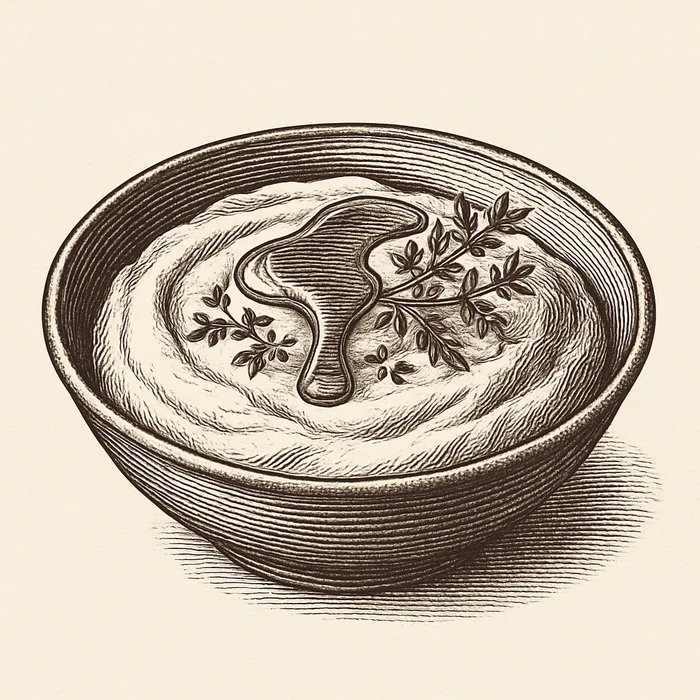
Cretan Strained Goat Yogurt with Warm Thyme Honey
There's a reason shepherds on the Lasithi Plateau have been eating yogurt and honey for breakfast for roughly four thousand years: the two foods are metabolically built for each other. Goat's milk yogurt carries a live population of Lactobacillus cultures on the order of 10^7 to 10^9 CFU per 100 grams, and those bacteria are hungry. Honey carries prebiotic oligosaccharides and trace polyphenols (quercetin, kaempferol) that feed exactly those kinds of strains — studies on moderate honey intake show measurable bumps in Lactobacillus and Bifidobacterium populations. So this bowl isn't "dessert for breakfast." It's a probiotic (the live cultures) eating a prebiotic (the honey sugars and polyphenols) in real time, inside your gut. The Cretans intuited this centuries before microbiome science caught up.
The technique beat here is straining. Supermarket "Greek-style" yogurt is usually thickened with milk solids or gums; the real Cretan texture comes from draping cultured yogurt in cheesecloth and letting gravity pull the whey out for twenty minutes. You lose volume, you concentrate protein and probiotics per spoonful, and the sour tang intensifies — which is exactly what you want against the floral sweetness of a raw thyme honey. Goat's milk yogurt is worth seeking out over cow: the fat globules are smaller, the casein curds softer, and calcium bioavailability is measurably higher. If you can find it, a raw varietal honey (thyme, orange blossom, buckwheat) keeps the hydrogen peroxide and heat-sensitive flavonoids intact — processed honey has been pasteurized, and pasteurization is where most of the interesting bioactive chemistry goes to die.
Ingredients
- 400 g (about 1 3/4 cups) plain whole-milk goat's milk yogurt
- 2 tablespoons raw thyme honey (or any raw varietal: orange blossom, wildflower, buckwheat)
- Optional grace notes: a small handful of toasted walnuts, a pinch of Ceylon cinnamon, a scatter of toasted sesame seeds, a few torn mint leaves
You'll also need: a fine-mesh sieve, a square of cheesecloth (or a clean thin kitchen towel), and a bowl to catch whey.
Method
-
Set up the strain. Line your sieve with two layers of cheesecloth and rest it over a bowl deep enough that the sieve doesn't touch the bottom — you want the whey to drip freely. Scrape all 400 g of yogurt into the cloth. Fold the corners loosely over the top to keep the surface from drying. Why: straining is the single move that separates a weeknight yogurt from the dense, almost cheese-like texture you get at a taverna in Heraklion. Twenty minutes pulls off roughly a third of the whey and roughly doubles the protein density per spoonful.
-
Refrigerate, don't counter-rest. Slide the whole setup into the fridge for 20 to 30 minutes. Why: Lactobacillus cultures stay happiest between 2 and 8 C. Straining at room temperature is fine for texture but it lets the acidity keep climbing, and after ten minutes on the counter in a warm kitchen you're closer to labneh-on-its-way-to-sour than breakfast yogurt.
-
Warm the honey — gently. While the yogurt strains, measure your honey into a small heatproof bowl and set it over (not touching) a pot of barely steaming water for about 60 seconds, just until it loosens and runs. Why: raw honey's antimicrobial hydrogen peroxide and its heat-sensitive flavonoids start degrading around 40 C / 104 F. You want the honey pourable, not hot. If you can comfortably hold a finger in it, you're fine. A microwave will blow past this threshold in seconds — stick with the water bath.
-
Unmold and plate. Lift the cheesecloth bundle out, peel it back, and spoon the strained yogurt into two shallow bowls. Use the back of the spoon to make a shallow well in the center of each — a Cretan swirl, not a crater. Why: the well gives the honey somewhere to pool rather than sliding off the dome. Shallow bowls beat deep ones because the first spoonful should always catch both textures at once.
-
Drizzle and fold, don't stir. Pour one tablespoon of warm honey into each well. Then, with a spoon, do a single lazy fold from the edge toward the center — lift, turn, stop. Why: over-mixing dissolves the honey into the yogurt and you lose the ribbon effect. One fold gives you marbled streaks so every bite hits sweet-then-tangy instead of a homogenous sweet-tang average. This is the same logic as folding jam into a parfait.
-
Finish and serve immediately. Scatter any grace notes on top — walnuts for omega-3 crunch, a whisper of cinnamon, a few sesame seeds, torn mint. Eat within five minutes. Why: the honey keeps seeping into the strained yogurt, and after ten or fifteen minutes the textural contrast collapses into something uniformly sweet. The whole point is the first bite.
What Can Go Wrong
- Yogurt goes watery instead of thick. You used a yogurt that was already thin (low-fat, or a brand stabilized with gums that don't release whey). Either swap to a full-fat, short-ingredient-list goat yogurt, or double the strain time. If it's still loose at 40 minutes, the culture is the problem, not the technique.
- Honey tastes flat and one-note. You're using pasteurized supermarket honey. The floral top notes and the subtle bitterness that make raw thyme or buckwheat honey interesting are both heat-killed in processing. This recipe is 50% honey by flavor — it's worth finding a jar from a beekeeper or a specialty shop. Look for "raw" or "unfiltered" on the label.
- Bowl tastes aggressively sour. Goat yogurt is naturally tangier than cow, and straining concentrates that tang. If the first bite makes you wince, either cut the strain to 10 minutes (less concentration), add a second teaspoon of honey, or lean on a sweeter varietal like orange blossom rather than the more medicinal thyme. This is also where the cinnamon grace note pulls its weight — it rounds the edge without adding more sugar.