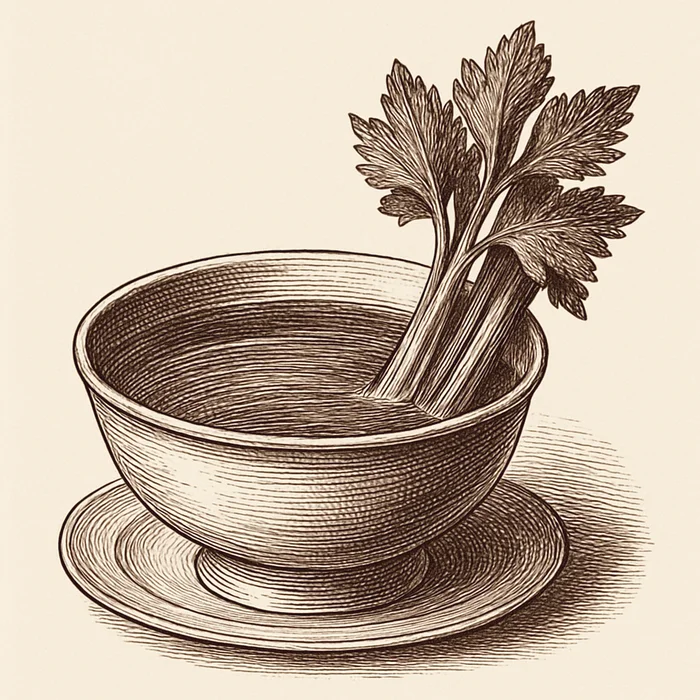
Clarified Celery Sipping Broth
This is a broth you drink from a mug, not a bowl — think of it as the vegetal cousin of a Japanese dashi or an Italian brodo bevuto, the kind of small cup a nonna hands you before dinner on a cold day. The technique here is simple but exacting: we gently extract celery's water-soluble aromatics into a savory base, then clarify the result so what lands in the cup is transparent, glinting, and tastes more intensely of celery than celery itself does. The whole thing is essentially calorie-free, which is why this style of broth has a long history as a restorative drink — and why it's the vehicle Valter Longo's Fasting Mimicking Diet leans on. Celery carries 3-n-butylphthalide (3nB), apigenin, and luteolin, all water-soluble or mildly water-soluble bioactives that leach readily into hot liquid. Simmer, not boil, is the rule: above a true rolling boil you'd drive off the volatile phthalides (that anise-ish top note) and muddy the liquid with emulsified starch and chlorophyll.
The second technique worth naming is the raft — a French consommé move where whipped egg white traps suspended particles as it coagulates, leaving the broth optically clear. It sounds fancy; it takes three minutes. Chefs like Thomas Keller and the old-school Escoffier lineage swear by it because clarity changes how you perceive flavor: with nothing cloudy in the way, the tongue reads the umami and mineral notes earlier and more sharply. When you're drinking broth rather than eating it, that matters. You'll also finish the cup with a drop of fat — a few drops of extra-virgin olive oil on top — because 3nB and vitamin K1 are fat-soluble, and without that little lipid shuttle you're leaving the cardiovascular-active compounds on the table.
Ingredients
- 1 liter (4 cups) low-sodium vegetable broth
- 4 large celery stalks, leaves on, roughly chopped (reserve a handful of pale inner leaves for garnish)
- 1 strip of lemon peel, yellow only, no pith (about 3 cm)
- 2 whole black peppercorns
- 1 small bay leaf
- 1 large egg white (for clarifying)
- Flaky sea salt, to taste (start with a generous pinch — drinking broth needs more seasoning than you'd think)
- A few drops of extra-virgin olive oil, to finish each cup
- Optional: 1 thin slice of fresh ginger, for a pre-meal or post-workout cup
Method
-
Bruise the celery before it hits the pot. Lay the chopped celery on a board and give it a firm smack with the flat of a knife — the way you'd bruise lemongrass. Crushing the cell walls ruptures the oil ducts that hold 3nB and the phthalide aromatics, so they diffuse into the liquid instead of staying locked inside fiber. This is the same reason bartenders muddle rather than stir.
-
Build a cold infusion start, then bring up slowly. Combine the broth, bruised celery, lemon peel, peppercorns, and bay leaf in a saucepan over low heat. Don't shortcut by starting in hot liquid — a slow ramp from cold pulls water-soluble flavonoids (apigenin, luteolin) out gradually without shocking the celery into releasing bitter chlorophyll compounds. You're aiming for the surface to barely shiver, never bubble.
-
Hold at a bare simmer for 30 minutes. Keep it between 85 and 90 C if you have a thermometer — just below a simmer. Above 95 C the volatile phthalides that give celery its anise-like top note flash off with the steam; below 80 C you under-extract. This temperature window is the same one Japanese cooks use for dashi, and for the same reason: gentle infusion preserves aromatic compounds that hard boiling destroys.
-
Strain, cool slightly, then build the raft. Pour the broth through a fine sieve into a clean pot and discard the solids. Let it cool to about 60 C — warm, not hot. In a small bowl, whisk one egg white with a splash of cold water until foamy but not stiff. Whisk the foamy white into the warm broth, then set the pot over medium-low heat. As it warms, the egg white proteins denature, unfold, and grab every suspended particle in the liquid, floating them up as a gray raft. This is the classic French consommé technique, and it works because coagulating protein has a huge surface area — it acts like a net at the molecular level.
-
Let the raft set, then ladle through it carefully. Once the raft forms (about 8–10 minutes), poke a small hole in one side with a spoon — your ladling window. Don't stir, don't break the raft. Ladle the clear broth out through the hole and pour it through a coffee filter or a sieve lined with a damp paper towel. What comes through should look like pale amber tea.
-
Season for drinking, not for cooking. Taste the clarified broth. It will feel under-seasoned at first — that's because your tongue reads a sipped liquid differently than a spooned one. Add flaky salt until the celery tastes more like celery; you're amplifying, not salting. A chef's trick: if it tastes flat, it almost always wants salt, not more celery.
-
Warm the mugs and finish with oil. Pour into pre-warmed mugs — a cold mug will strip 10 C off the broth in seconds and mute the aroma. Float a few drops of extra-virgin olive oil on the surface of each cup and drop in a couple of pale celery leaves. The olive oil does double duty: it captures volatile aromatics on its surface so you smell them as you sip (smell drives 80% of flavor perception), and its fat helps your gut absorb celery's fat-soluble 3nB and vitamin K1.
What Can Go Wrong
- Your broth is cloudy after clarifying. Almost always because the liquid was too hot when you added the egg white, so the proteins coagulated instantly in little beads instead of forming a cohesive raft. Let the broth drop below 65 C before whisking the egg white in, and warm slowly from there. If it's already cloudy, you can re-clarify with a second egg white — it's forgiving.
- It tastes grassy or bitter instead of clean. This is an over-extraction problem. Either you boiled it (celery's chlorophyll and pectins break down and turn vegetal-bitter above 95 C) or you simmered past 40 minutes (the woody outer stalks start giving up tannins). Next time, keep the heat gentle and pull it at 30 minutes even if you're tempted to go longer.
- It tastes like nothing. Under-salted, almost certainly. Drinking broth needs roughly 30% more salt than a broth you'd cook pasta in, because there's no starch or fat to carry flavor across your palate — it's all on the salt and the aromatics. Add flaky salt in pinches, stir, and taste between each one.