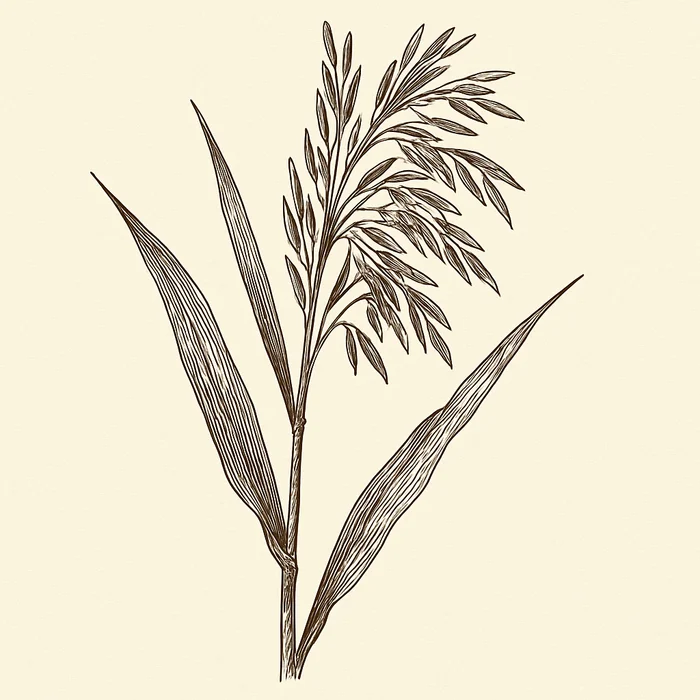
Wild Rice
Wild rice is used in the Longevity Diet as a base for vegetable dishes and is listed as an acceptable substitute for pasta at 40 g dry weight per serving.
Why It Matters for Longevity
Wild rice (Zizania palustris and related species) is a true aquatic grass native to North America — botanically distinct from Asian paddy rice (Oryza sativa) — and its nutritional profile reflects that difference. It provides roughly double the protein of white rice (~14 g per 100 g dry vs. ~7 g), significantly more magnesium and zinc, and a substantially lower glycemic index. A direct measurement in healthy adults found a GI of 53.7, placing wild rice in the low-GI category, and substituting 50% of refined rice and flour with wild rice in animal models significantly lowered fasting glucose, insulin, glucagon, and the HOMA-IR insulin-resistance index (Zhang et al., 2015, Wei Sheng Yan Jiu). For people managing blood-glucose or insulin sensitivity — central to longevity biology — that is a meaningful difference from conventional white rice.
Wild rice is a whole grain with its bran layer intact, providing dietary fiber, resistant starch, and micronutrients. The intact bran also concentrates a complex of phytochemicals — ferulic acid, vanillic acid, ellagic acid, flavonoids, phytosterols, and anthocyanins — that are absent in milled white rice. Free phenolic fractions of wild rice (Zizania aquatica) reach 1,061–2,988 mg GAE/kg, with ferulic, vanillic, ellagic, sinapic, and syringic acids as the principal antioxidant contributors (correlation coefficients r > 0.76 against both DPPH and FRAP assays; Sumczynski et al., 2017, Food Chemistry). The dark-pigmented varieties additionally contain cyanidin-3-glucoside (C3G) — the most abundant anthocyanin found by HPLC in both black and wild rice — a compound known to inhibit LDL oxidation and suppress inflammatory NF-κB signaling (Kim et al., 2008, Nutrition Research and Practice).
These antioxidant and lipid-modulating properties translate to measurable cardiovascular outcomes. In LDL receptor knockout mice — a stringent model of atherosclerosis — wild rice consumption reduced plaque size by 71% in males and 61% in females; the primary mechanism identified was cholesterol lowering (Moghadasian et al., 2013, Atherosclerosis). Epidemiologically, higher whole-grain and cereal-fibre intake is associated with significantly lower all-cause and CVD mortality across dose-response meta-analyses of large prospective cohort studies (Benisi-Kohansal et al., 2016, Advances in Nutrition). Wild rice, as an intact whole grain dense in both fiber and bioactive phytochemicals, sits comfortably within the food pattern that drives those associations.
One practical advantage over paddy rice is heavy-metal safety. Paddy rice (Oryza sativa) accumulates inorganic arsenic from flooded paddy fields through silicon-transporter pathways; wild rice (Zizania spp.) grows in clean, flowing water with different mineral uptake biology, and its arsenic burden is substantially lower in commercially available samples, making it a favorable substitution from a food-safety standpoint.
How to Use It
Pairs well with zucchini, mushrooms, cranberries. Use as a grain in your daily meals according to the Longevity Diet guidelines.
What to Pair It With
| Ingredient | Why | Tradition |
|---|---|---|
| zucchini | See synergies | Rice with zucchini dish featured in the Longevity Diet |
| mushrooms | See synergies | Classic wild rice pilaf combination |
| cranberries | See synergies | Traditional preparation with wild berries |
| olive oil | See synergies | Longevity Diet cooking fat |
| vegetable broth | See synergies | Cooking liquid that adds flavor and micronutrients |
| walnuts | See synergies | Omega-3 and protein enrichment for grain bowls |
Synergies
- Zucchini (complement): Featured together in the Longevity Diet recipe; wild rice provides sustained energy and protein while zucchini contributes water content, potassium, and vitamin C — a balanced longevity grain bowl. - Legumes (synergy): Wild rice is low in lysine; legumes are rich in lysine but low in methionine (abundant in rice). Combining them creates a complete amino acid profile — the classic protein complementarity of traditional diets. - Olive Oil (complement): Adding olive oil to cooked wild rice increases caloric density (important for those over 65) and enhances absorption of fat-soluble vitamins present in accompanying vegetables.
Flavor Profile
Taste: nutty, earthy, slightly grassy, rich. Aroma: toasted grain, woodsy, earthy. Texture: chewy, firm, slightly al dente when cooked. Category: whole grain / base.
The Science
- Yu et al., 2020, Food Chemistry: Comprehensive review of wild rice (Zizania spp.) nutritional constituents and phytochemicals; phenolic acids, flavonoids, and phytosterols from wild rice have pronounced antioxidant properties associated with prevention of chronic diseases, and health-promoting effects include atherosclerosis prevention and anti-inflammatory activity.
- Moghadasian et al., 2013, Atherosclerosis: Wild rice (Zizania palustris L.) consumption significantly reduced atherosclerotic lesion size by 71% (male) and 61% (female) in LDL receptor knockout mice; cholesterol-lowering effects were identified as the primary mechanism.
- Benisi-Kohansal et al., 2016, Advances in Nutrition: Dose-response meta-analysis of prospective cohort studies; higher whole grain and cereal fibre intake significantly associated with lower all-cause and CVD mortality.
- Zhang et al., 2015, Wei Sheng Yan Jiu: Measured the GI of wild rice in 8 healthy adults and found a GI of 53.7, classifying it as a low-GI food; replacing 50% of refined rice with wild rice in high-fat-diet-fed rats significantly reduced fasting glucose, insulin, glucagon, and HOMA-IR (all p < 0.05).
- Sumczynski et al., 2017, Food Chemistry: In Zizania aquatica, free phenolic fractions reached 1,061–2,988 mg GAE/kg; ferulic, vanillic, ellagic, sinapic, and syringic acids were the principal contributors to antioxidant capacity (r > 0.76 for DPPH and FRAP assays).
- Kim et al., 2008, Nutrition Research and Practice: HPLC and mass spectrometry identified cyanidin-3-glucoside (C3G) as the most abundant anthocyanin in both black and wild rice; C3G is one of the most potent anthocyanins for inhibiting LDL oxidation and modulating inflammatory NF-κB signaling.
- Surendiran et al., 2014, Nutrition Reviews: Narrative review confirming that wild rice (Zizania spp.) is rich in protein (~14 g/100 g dry), dietary fiber, and antioxidant phytochemicals, with documented lipid-lowering and cardiovascular benefits in experimental models; authors noted additional human clinical studies are needed.
- Book claim (high confidence): Wild rice is used in the Longevity Diet as a base for vegetable dishes and is listed as an acceptable substitute for pasta at 40 g dry weight per serving.
References
- Yu X, Chu M, Chu C, et al. Wild rice (Zizania spp.): A review of its nutritional constituents, phytochemicals, antioxidant activities, and health-promoting effects. Food Chemistry. 2020;331:127213. PMID: 32554311. doi:10.1016/j.foodchem.2020.127213
- Moghadasian MH, Alsaif M, Le K, et al. Wild rice (Zizania palustris L.) prevents atherogenesis in LDL receptor knockout mice. Atherosclerosis. 2013;231(2):393–395. PMID: 24075758. doi:10.1016/j.atherosclerosis.2013.09.027
- Benisi-Kohansal S, Saneei P, Salehi-Marzijarani M, et al. Whole-Grain Intake and Mortality from All Causes, Cardiovascular Disease, and Cancer: A Systematic Review and Dose-Response Meta-Analysis of Prospective Cohort Studies. Advances in Nutrition. 2016;7(6):1052–1065. PMID: 28140323. doi:10.3945/an.116.012567
- Zhang H, Liu Y, Zhao J, Zhai U. Determination of the glycemic index of wild rice and the effects of wild rice on insulin resistance in rats. Wei Sheng Yan Jiu. 2015;44(3):394–397. PMID: 25997214
- Sumczynski D, Kotásková E, Orsavová J, Valášek P. Contribution of individual phenolics to antioxidant activity and in vitro digestibility of wild rices (Zizania aquatica L.). Food Chemistry. 2017;218:107–115. PMID: 27719885. doi:10.1016/j.foodchem.2016.09.063
- Kim MK, Kim HA, Koh K, Kim HS, Lee YS, Kim YH. Identification and quantification of anthocyanin pigments in colored rice. Nutrition Research and Practice. 2008;2(1):46–49. PMID: 20126365. doi:10.4162/nrp.2008.2.1.46
- Surendiran G, Alsaif M, Ramezani Kapourchali F, Moghadasian MH. Nutritional constituents and health benefits of wild rice (Zizania spp.). Nutrition Reviews. 2014;72(4):227–236. PMID: 24684371. doi:10.1111/nure.12101
Key Nutrients
| Nutrient | Per 100g | Notes |
|---|---|---|
| Protein | ~14.7 g per 100 g dry; ~4 g per 100 g cooked | Higher protein content than any other rice; contains all essential amino acids though low in lysine; complements legumes well. |
| Magnesium | ~177 mg per 100 g dry (~32 mg per 100 g cooked) | Magnesium is essential for over 300 enzymatic reactions including ATP synthesis, DNA repair, and insulin signaling; wild rice provides a meaningful whole-food source. |
| Zinc | ~6 mg per 100 g dry (~1.3 mg per 100 g cooked) | Phytates in whole grain reduce bioavailability; soaking before cooking or consuming with vitamin C-rich foods improves absorption. |
| Anthocyanins and phenolic acids | ~40–60 mg GAE per 100 g (varies by source) | Dark pigmentation indicates high anthocyanin content; these antioxidants reduce oxidative stress and inflammation associated with aging. |